Altadena Rebuild Permit Process: What's Faster, What's Not
Key Facts
- Like-for-like Eaton Fire rebuilds get first permit review within 10 business days, with subsequent reviews in 5, per LA County's recovery portal.
- Altadena's like-for-like allowance permits floor area increases up to 200 square feet or 10% — more generous than the Palisades' flat 10% cap, per county guidance.
- As of April 2025, zero building permits had been finalized among 1,500 Altadena properties ready for rebuilding, NBC Los Angeles reported.
- By December 2025, only 23 of nearly 6,000 significantly damaged Altadena properties had completed rebuilding, per Catalyst California tracking.
- Altadena new-construction permits peaked at 1,024 per month seven months after the fire, with $2.78 billion in permitted job value recorded, according to Shovels.ai permit data.
- Post-fire LA County permitting runs roughly three times faster than pre-fire averages due to regulatory changes, per Bridgford Law rebuild guidance.
- Homeowners can submit rebuild plans during debris removal, but permits won't issue until Phase 1 and Phase 2 removal finish, per Cal OES guidance.
Two Speeds of Rebuilding: Like-for-Like vs. Everything Else
Every Eaton Fire homeowner in Altadena faces one decision before drawing a single plan: rebuild exactly what burned, or build something different. That choice determines whether your permit moves at the county's expedited pace or gets pulled into a far slower review process.
A like-for-like rebuild — same size, location, and purpose as the destroyed structure — is exempt from current zoning requirements and qualifies for expedited review, with a first review within 10 business days and subsequent reviews within 5, according to LA County's recovery portal. You still must meet current Building, Fire, and Health/Safety Codes, but the zoning grandfathering is the real prize.
The Eaton Fire area also gets a generous allowance: like-for-like rebuilds may increase floor area by up to 200 square feet or 10%, whichever is greater — more generous than the Palisades area's flat 10% cap, per the county's like-for-like guidance. Your rebuild can even have a different floor plan or be smaller than the original and still qualify.
Step outside those limits and the process changes. Non-like-for-like rebuilds must comply with current zoning, pass through the Altadena Community Standards District, and can trigger:
- Discretionary review, including a public hearing
- CEQA review if a Conditional Use Permit is required
- Administrative Housing Permits, Oak Tree Permits, or Variances
- A minimum 20-foot front yard setback (the Altadena CSD setback rules don't apply, but this floor does)
County staff tell applicants plainly that they "can choose to redesign the project to be like-for-like before you spend more time and money" — an official acknowledgment of which path is faster and cheaper.
The expedited timelines sound impressive on paper. The outcomes have been harder. As of April 8, 2025, zero building permits had been finalized among roughly 1,500 Altadena properties ready for rebuilding — of 173 applications received, the county had initiated the process for only 23. One resident was told to expect at least three months, not the month originally promised.
By December 2025, tracking by Catalyst California found only 23 of nearly 6,000 significantly damaged properties had completed rebuilding, and just 43% of owners had applied for or received permits. The 10/5-day clock only starts once a complete application is accepted — a caveat that explains much of the gap between promise and practice.
This is why the like-for-like decision matters so much, and why working with builders who know LA County's expedited process is worth seeking out. Altadena Builder Directory lists fire-rebuild specialists and design-build firms, each verified against the California Contractors State License Board — a free way to confirm you're hiring someone who knows which track your project is really on.
The Fast Track Rules: What Qualifies and What You Gain
Speed is the single biggest difference between the two rebuild tracks in Altadena, and the county has put its fastest lane in writing. If your rebuild qualifies as "like-for-like," LA County commits to a first review within 10 business days, with subsequent reviews completed in just 5 business days — a commitment published on the county's official permit application guidance.
Qualifying is more flexible than many homeowners assume. A like-for-like rebuild means the same size, location, and purpose as the destroyed structure, but the county confirms your new home can be smaller or have a different floor plan and still qualify for expedited review. You're exempt from current Zoning Code requirements, though current Building, Fire, and Health/Safety Codes still apply.
The Eaton Fire area also gets a uniquely generous size allowance. Like-for-like rebuilds here may increase floor area by up to 200 square feet or 10%, whichever is greater — a bigger cushion than the Palisades area, where the cap is 10% only. That extra margin matters when you're reworking a floor plan around modern layouts or accessibility needs.
A few specific rules shape whether your project stays on the fast track:
- Septic-system properties qualify only if the bedroom count stays the same as the original home.
- The Eaton Fire floor-area allowance (+200 SF or 10%, whichever is greater) applies only to like-for-like rebuilds.
- Non-like-for-like rebuilds must comply with current zoning and pass through the Altadena Community Standards District — but a relaxed 20-foot minimum front setback applies to all of them.
Perhaps the strongest signal comes from county staff themselves. Applicants are explicitly advised they "can choose to redesign the project to be like-for-like before you spend more time and money" — an official acknowledgment that the fast track is the faster, cheaper path, since stepping outside it can trigger discretionary review, public hearings, and possible CEQA review.
The practical takeaway: design within like-for-like limits first, then decide whether any change is worth months of additional review. Working with a builder who understands these thresholds from day one prevents costly redesigns later. The Altadena Builder Directory lists fire-rebuild specialists familiar with LA County's expedited process, and its free CSLB license-lookup tool lets you verify any California contractor before you commit — every listing in the registry is license-verified against CSLB records.
What's Slowing Rebuilds Down — and How the County Is Fixing It
By April 2025, not a single building permit had been finalized among the 1,500 Altadena properties ready for rebuilding — despite the county's promise of permits in about a month. That gap between commitment and reality is what forced the structural reforms now reshaping the process.
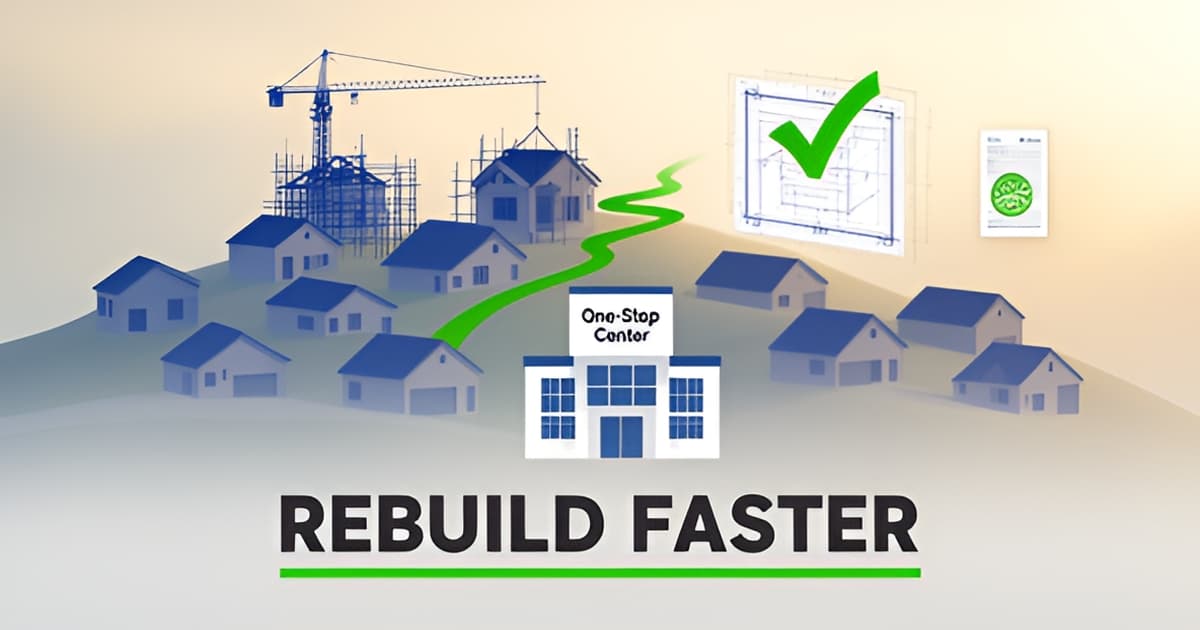
The root cause was bureaucratic fragmentation. Three separate departments — planning, fire, and building and safety — each reviewed every application, layering sequential reviews onto a single project. Supervisor Kathryn Barger called the result unacceptable, and on April 8, 2025, the Board of Supervisors created a unified permitting authority within the Altadena One-Stop Recovery Permitting Center, empowered to make final decisions without waiting on individual departments.
Since then, the county has rolled out two more fixes:
- The Unified Permit (August 2025) reduces the number of separate applications required per rebuild project.
- A Bundled Projects Pilot Program lets owners group multiple projects into one coordinated submittal.
- LA County eCheck, an AI pilot with Archistar, pre-screens architectural drawings for zoning compliance in R-1 zones to cut down review comments and back-and-forth.
One point of confusion worth untangling: Cal OES guidance says owners don't need to wait for debris removal to apply for permits, while LA County's own guidance notes permits won't issue until Phase 1 (EPA hazardous material) and Phase 2 (fire debris) removal is complete. These aren't contradictory — the practical takeaway is to submit plans anytime, but expect issuance to wait until the lot is cleared.
The results are mixed but moving. Permit data shows Altadena went from demolition to new construction on a "streamlined timeline," with new-construction permits peaking at 1,024 per month seven months after the fire. Yet by December 2025, only 23 of nearly 6,000 significantly damaged properties had completed rebuilding, and just 43% of owners had applied for or received permits, according to Catalyst California, which also calls for enhanced staffing and navigation help for vulnerable residents.
For homeowners, the lesson is that process reform only helps those who use it deliberately. Stay within like-for-like limits, submit early, and work with contractors who know LA County's expedited rebuild path. The Altadena Builder Directory lists license-verified fire-rebuild specialists — every listing is checked against the California Contractors State License Board, so you can confirm credentials before signing anything.
Your Action Plan: Timing, Fees, and the One-Stop Center
Knowing the rules is one thing; executing them in the right order is what actually shaves months off your rebuild. Here is the sequence that works with the system, not against it.
Start by submitting your plans before debris removal finishes. Cal OES confirms you can submit plans and apply for permits while crews are still clearing your lot. Permits won't be issued until Phase 1 and Phase 2 debris removal are complete, per LA County guidance — but the review clock can be running while the lot is still being cleared.
Next, confirm your fee-waiver eligibility before you pay anything. Owners who both owned and occupied their unincorporated LA County property before January 7, 2025 qualify for waived permit fees, according to the County's recovery portal. If you rented out the property or owned it as a second home, budget for standard fees instead.
Then work through both intake channels:
- In person: the Altadena One-Stop Permit Center at 464 W. Woodbury Rd, Suite 210 — open Monday–Friday 9:30am–6pm and Saturday 8am–1pm, with walk-ins welcome.
- Online: the EPIC-LA portal, where the Unified Permit introduced in August 2025 cuts the number of applications you file per rebuild.
Track the review clock carefully, because it starts later than most homeowners assume. The 10-business-day first review and 5-business-day subsequent reviews apply only to complete applications. If your submittal is missing documents, the clock hasn't started — which explains part of the gap between the official commitment and early on-the-ground reports of zero permits finalized as of April 2025.
Is the system actually moving? The permit data says yes. Shovels.ai's analysis shows Altadena new-construction permits peaked at 1,024 per month around seven months post-fire, with $2.78 billion in permitted job value recorded over 13 months — roughly 18 times the pre-fire baseline. That volume means queue times at the One-Stop Center fluctuate, so go early and bring complete documentation.
One last step before you sign with a builder: verify their CSLB license. The Altadena Builder Directory offers a free license-lookup tool and lists only contractors whose licenses are verified against California Contractors State License Board records. A license-verified builder who already knows the expedited like-for-like process keeps your application complete — and keeps that 10-day clock running.
Pairing Your Permit Strategy with a License-Verified Builder
A fast permit strategy only works when the person submitting your plans knows how to use it. LA County's expedited review — first review within 10 business days, subsequent reviews within 5 — applies only when a complete application lands on the right desk, and county staff themselves suggest redesigning to like-for-like "before you spend more time and money." A contractor fluent in that process can keep your project on the fast track; one who isn't can quietly push you onto the slow one.
The stakes are real. As of December 2025, tracking by Catalyst California found that only 43% of owners of significantly damaged properties had applied for or received permits, and just 23 of nearly 6,000 such properties had finished rebuilding. Much of that gap is red tape and staffing — but an inexperienced builder who designs outside the Eaton Fire's like-for-like allowance of +200 SF or 10% (whichever is greater) can trigger the Altadena Community Standards District review, public hearings, and months of delay you didn't budget for.
Before you sign anything, verify the contractor's license with the California Contractors State License Board. It takes minutes and costs nothing:
- Look up the CSLB license number on the contractor's bid, contract, or website — for example, JMB Builders LLC, CSLB #1103479.
- Confirm the license is active, the classification matches your project (fire rebuild, custom home, ADU), and the bonding and workers' comp information is current.
- Check that the business name and address on the CSLB record match the company you're actually dealing with.
- Ask specifically about experience with like-for-like rebuilds, the Unified Permit, and the EPIC-LA portal.
The Altadena Builder Directory makes this easier: every listing is license-verified against CSLB records before it appears, and a free license-lookup tool lets you independently confirm any California contractor — including ones you found elsewhere. Featured placements, such as JMB Builders LLC, are always labeled as paid, so you always know what you're looking at.
A license-verified builder paired with a like-for-like permit strategy is the shortest path through a system that, despite being roughly three times faster than pre-fire averages per rebuild guidance from Bridgford Law, still punishes unprepared applications. Verify first, sign second.
Frequently Asked Questions
What does 'like-for-like' mean for my Altadena rebuild, and does it really speed up permits?
Can I make my new house bigger than the one that burned and still get the fast permit track?
What happens if I build something different from what burned down?
Do I have to wait for debris removal to finish before applying for my permit?
Are Altadena rebuild permits actually being issued, or is the fast track just a promise?
How do I make sure my contractor won't slow down my expedited permit?
The Fast Lane Is Real — If You Stay In It
Altadena's rebuild system rewards preparation more than patience. The like-for-like track — same size, location, and purpose, with a generous +200 SF or 10% allowance — unlocks zoning grandfathering and the county's 10-day first review, while stepping outside those limits invites Community Standards District review, public hearings, and months you didn't budget for. County staff themselves recommend redesigning to like-for-like "before you spend more time and money." Yet the numbers show the system only helps those who use it deliberately: by December 2025, only 43% of significantly damaged property owners had applied for or received permits. Your next steps are straightforward: submit plans before debris removal finishes, confirm your fee-waiver eligibility, and design within like-for-like limits from day one. Then verify your builder's CSLB license before signing — the Altadena Builder Directory lists fire-rebuild specialists already vetted against CSLB records, with a free license-lookup tool to check any California contractor. The fast track exists. Make sure your project stays on it.