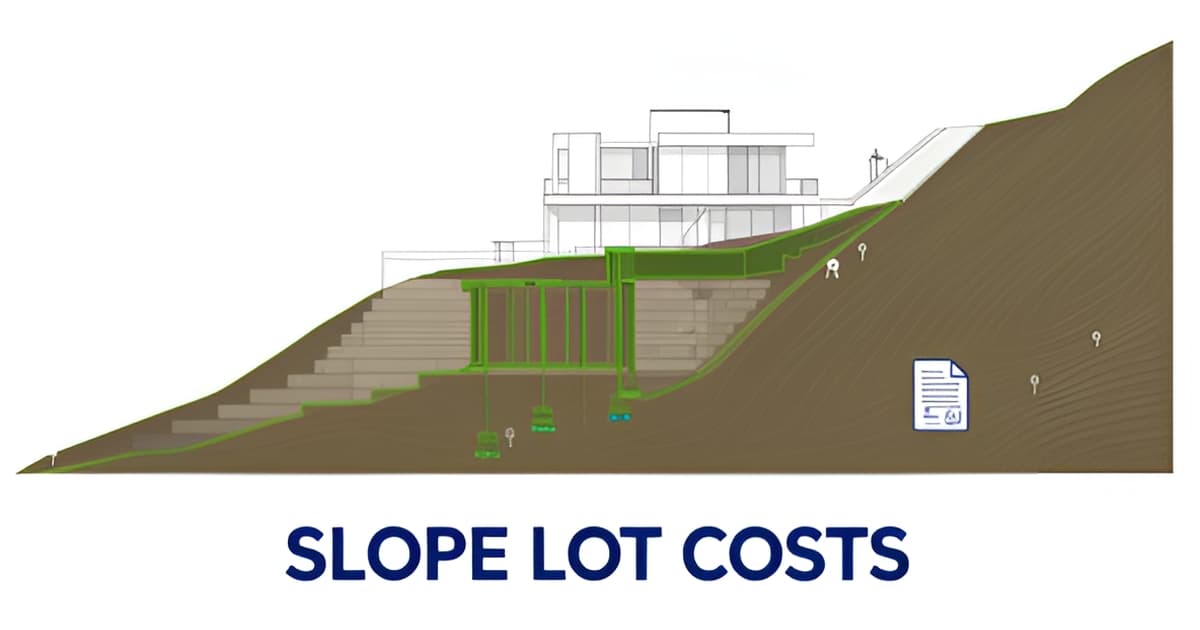
Building on a Slope Lot in Altadena: Costs, Grading, and Permits
Key Facts
- Building on an Altadena slope lot adds 15–40% to total project cost versus flat ground, per sloped-lot construction research.
- Hillside geotechnical reports cost $10,000–$20,000+, more than triple the $3,000–$6,000 flat-lot price, according to Southern California geotechnical data.
- Drilled caissons run $3,000–$8,000 each, and a hillside home may need 20 or more — a six-figure line item, per sloped-lot construction analysis.
- Site development alone consumes 25–35% or more of total project cost on steep hillside lots, per LA custom-home cost analysis.
- One Altadena rebuild avoided a $60,000 retaining wall by deepening its foundation, finishing at $545/sq ft all-in, per builder cost data from the completed project.
- Grading review adds 6–8 weeks before the building permit, and the county won't issue it until grading is approved, per hillside permitting analysis.
- Fire-rebuild site work — soil testing, debris clearance, utilities — adds $25,000–$60,000 on a typical Altadena lot, per builder cost data.
The Hillside Premium: Why Slope Lots Cost 15–40% More in Altadena
The view from an Altadena hillside lot is spectacular — until the first grading estimate arrives. Building on a slope here doesn't just change the design; it rewrites the entire budget, typically adding 15–40% to what the same home would cost on flat ground.
The premium comes from four compounding factors: grading and excavation, engineered retaining walls, deep foundations, and drainage that the county treats as mandatory rather than optional. According to builder cost data from a completed Altadena project, a steep hillside lot adds roughly 15% project-wide, with foundation costs alone rising 10–30% for deeper footings and caissons. Regional estimates run higher — sloped-lot construction research puts the premium at 20–40%, with moderate slopes (15–25% grade) adding $50,000–$150,000 in foundation and grading costs, and severe slopes exceeding $200,000 before framing even begins.
The per-square-foot math makes the gap concrete. LA County hard construction costs run $475–$815 per square foot as a baseline, but LA custom-home cost analysis shows hillside projects running $1,000–$1,400+ per square foot — and $1,400–$1,800+ on steep sites with high-end finishes.
What breaks most budgets isn't the house — it's the site. On steep hillside lots, site development alone consumes 25–35% or more of total project cost, covering retaining walls, over-excavation, soil export trucking, and specialized equipment. Crews also move slower on a grade, which shows up directly in labor hours.
For Altadena specifically, the post-Eaton fire context adds another layer. Fire-rebuild site work — soil testing, certified debris clearance, utility reconnection, and temporary power — runs $25,000–$60,000 on a typical lot, on top of code-required rebuild scope that can reach $30,000–$200,000+ depending on the age of the lost home.
The main hillside cost drivers to budget for separately:
- Grading, excavation, and soil import/export — the #1 site-driven cost escalator
- Engineered retaining walls, which may require their own permit
- Deep foundations: drilled caissons run $3,000–$8,000 each, and a hillside home may need 20 or more
- Mandatory drainage and erosion control engineering — a permit requirement, not an upgrade
- Post-fire site work of $25,000–$60,000 on many Altadena lots
Because these numbers vary so widely by slope severity, the estimate you get from a builder who hasn't reviewed a soils report is little more than a guess. When comparing bids, the Altadena Builder Directory lists hillside-experienced builders with licenses verified against CSLB records — a baseline worth confirming before any hillside number crosses your desk.
The Geotechnical Report Gatekeeper: Why the Soils Report Shapes Everything
Before a single shovel hits the ground on an Altadena slope lot, one document decides nearly everything: the geotechnical report. In Hillside Ordinance areas, permitting officers won't approve your project without one, and its findings cascade through your entire budget — foundation type, caisson requirements, retaining wall calculations, and grading ratios all trace back to what the soils say.
The cost difference between flat and hillside reports is significant. A geotechnical report on a flat lot typically runs $3,000–$6,000, while hillside sites require $10,000–$20,000 or more due to the complexity of slope stability analysis, per geotechnical engineering data for Southern California. It's tempting to see that as an expense to minimize — practitioners in the field describe it as the opposite: a quality report may cost a few thousand dollars but can save you millions over the life of the project.
Why such leverage? Because the report determines your foundation. On steep slopes, engineers frequently specify drilled caissons — typically 20–40 feet deep, costing $3,000–$8,000 each installed — and a typical hillside home may need 20 or more of them, according to sloped-lot construction analysis. That's a six-figure line item that simply doesn't exist on a flat lot with standard footings.
This creates what contractors call the sequencing problem. As one builder put it: homeowners receive early estimates before anyone has reviewed a soils report, then the report comes back, the foundation type changes, and the project looks different. That's not a flaw in the report — it's a flaw in the order of operations. Any bid made before the soils report is unreliable, no matter how confident it sounds.
The cheapest insurance available is a preliminary soils investigation. For roughly $5,000 before you close on a lot, you can avoid discovering a $200,000 caisson requirement after the purchase is final. For Altadena homeowners rebuilding after the fire, where site work already adds $25,000–$60,000 on a typical lot, that early knowledge compounds in value.
- Commission the geotechnical report before accepting any construction bid — early estimates without it are guesses.
- Budget $10,000–$20,000+ for a hillside report versus $3,000–$6,000 on flat ground.
- Ask specifically about caisson counts and depths, since each installed caisson runs $3,000–$8,000.
- Consider a ~$5,000 preliminary investigation before purchasing a slope lot.
Foundation selection on a slope isn't a preference — it's an engineering determination made from this report. When you're evaluating builders for a hillside project, look for firms who ask for the soils report before quoting a number; the Altadena Builder Directory lets you verify any California contractor's license free through its CSLB lookup tool, and every listing is license-verified against the California Contractors State License Board before it appears.
Navigating LA County Permits: EPIC-LA, Grading Review, and Fire-Zone Layers
The single most common mistake Altadena homeowners make is filing permits with the wrong agency. Because Altadena is unincorporated Los Angeles County, your build goes through the County's EPIC-LA portal — not the City of Pasadena and not LADBS. Submitting to the wrong jurisdiction can cost weeks before anyone reviews your plans.
Once you're in the right system, expect layered reviews that flat lots never encounter. Grading review adds 6–8 weeks before the building permit, and the building permit won't issue until grading is approved. The trigger matters: hillside lots typically need a grading permit at 50+ cubic yards of soil disturbance, so run that math before your design is finalized, not after.
Altadena's fire context adds another layer. Most of the community sits in a Very High Fire Hazard Severity Zone, and fire review adds 2–6 weeks outside the standard plan-check clock. In practice, sloped-lot permitting runs 3–6 months or longer depending on jurisdiction, with single-family permits in LA generally taking 4–8 months.
The best real-world benchmark comes from a Fair Oaks Altadena rebuild that navigated this exact path. That project took roughly 4 months from design to permit and about 10 months of construction — approximately 14 months total, finishing at $545 per square foot all-in. Notably, one design revision — deepening the south-side foundation instead of building a $60,000 retaining wall — was approved by LA County in just two weeks.
Your pre-application checklist should include:
- A completed geotechnical report, which hillside-area projects require before approval and which typically costs $10,000–$20,000+ on hillside sites
- Grading calculations confirming whether your earthwork crosses the 50-cubic-yard permit threshold
- Drainage and erosion control plans, which are permit requirements rather than optional extras
- VHFHSZ compliance documentation for materials and defensible space
- Separate permit tracking for retaining walls, which may require their own approval
Budget for the review stack itself: LA County permit and plan-check fees run $15,000–$40,000+ before construction begins. Because the soils report shapes every downstream approval — foundation type, cut-and-fill ratios, retaining wall design — getting it right before submission is the difference between a 4-month permit cycle and a 6-month one. As hillside permitting analysis notes, early estimates made before anyone has reviewed a soils report are unreliable, and that sequencing problem shows up most painfully at the permit counter.
Before you file, it's also worth confirming who's filing for you. Every contractor listing in the Altadena Builder Directory is license-verified against the California Contractors State License Board, and a free CSLB lookup tool lets you verify any California contractor yourself — including hillside and fire-rebuild specialists who already know the EPIC-LA process.
Design With the Grade: The Strategy That Saves Six Figures
The single biggest cost decision on an Altadena slope lot isn't the countertop package — it's whether your design fights the grade or works with it. As one builder puts it, "a design that steps with the land is almost always cheaper than one that flattens it." That principle can save six figures.
The Fair Oaks case study proves it. On one Altadena rebuild, the team avoided a $60,000 retaining wall by deepening the south-side foundation instead — a revision LA County approved in just two weeks. The project finished at $545 per square foot all-in, with roughly ten months of construction and about four months of design-to-permit work through the county's EPIC-LA portal.
Why does stepping with the slope work so well? Because site development — not the house — is what breaks hillside budgets. On steep sites, site work alone can consume 25–35% or more of total project cost, and moderate slopes already add $50,000–$150,000 in foundation and grading expenses before framing begins.
The design-with-grade toolkit includes:
- Split-level layouts that place floor plates at different elevations, following the natural contours of the lot
- Daylight basements that turn the downhill side of the slope into usable, code-compliant living space
- Garages positioned at the lower level, eliminating the need to grade a flat pad for vehicle access
- Cantilevered decks that capture views without pushing more soil around
Used together, these approaches can recapture much of the slope premium, which sources estimate at anywhere from 15% project-wide to 20–40% depending on severity.
One caution: don't judge hillside budgets by blended per-square-foot figures. As Jeff Benson of Benson Construction Group argues, a single blended number conflates the building with site and hillside scope, which behave very differently — the same budget can produce wildly different $/SF results depending on what's measured. Demand two numbers: one for the building, one for the site.
If you're assembling a team for a slope-lot build or rebuild, every listing in the Altadena Builder Directory is license-verified against the California Contractors State License Board, and the directory's free CSLB lookup tool lets you verify any California contractor yourself — a critical first step, since hillside-experienced builders are widely cited as the single most important factor in keeping costs and timelines under control.
Your Action Plan: Budget Separately, Sequence Smartly, Verify Your Builder
The difference between a hillside project that finishes on budget and one that bleeds cash rarely comes down to luck — it comes down to sequencing. Contractors who work slopes consistently see the same failure pattern: bids get accepted before anyone reads the soils report, and the budget resets when the foundation type changes.
Get the geotech report first. A hillside geotechnical report runs $10,000–$20,000+ versus $3,000–$6,000 on flat lots, but it drives everything downstream — foundation type, caisson depth, retaining wall pressure calculations, and cut-and-fill ratios, according to geotechnical engineers. As one contractor puts it, estimates made before the soils report exists aren't estimates — they're guesses. A roughly $5,000 preliminary soils investigation can prevent discovering a $200,000 caisson requirement after you've committed.
Run the grading math before finalizing the design. Hillside lots typically cross the grading permit threshold at 50+ cubic yards of soil disturbance, and grading review adds 6–8 weeks before the building permit is even issued — the county won't release the building permit until grading is approved (hillside construction guidance). If your design flattens the lot, you pay for that decision twice: once in trucking and once in delay.
Budget in two columns, not one. Blended per-square-foot figures are misleading on hillside projects because the building and the site scope behave completely differently — site development alone can hit 25–35%+ of total project cost on steep hillside sites (LA construction cost analysis). Your budget should separate them:
- Building scope, priced from current LA County hard costs of $475–$815/sq ft
- Site scope: grading, retaining, drainage engineering (mandatory, not optional), and caissons at $3,000–$8,000 each if the soils report requires them
- A hillside contingency of at least 15% — steeper projects warrant 20%+
If you're rebuilding after the Eaton Fire, check your policy now: Building Ordinance/Law coverage is typically capped at 10–25% of the dwelling limit, while code-required rebuild scope can run $30,000–$200,000+ depending on the age of the lost home. That gap comes out of your pocket unless you negotiate coverage before demolition.
Finally, hire for hillside experience specifically. Builder experience is widely identified as the single most important factor in keeping slope-lot costs and timelines under control. Verify every candidate's license — the Altadena Builder Directory offers a free CSLB license-lookup tool, and every listing in the registry carries a license-verification seal confirmed against California Contractors State License Board data. Five minutes of verification beats discovering a lapsed license mid-grading.
Frequently Asked Questions
How much more does it cost to build a house on a slope lot in Altadena compared to flat ground?
Why do I need a geotechnical report before getting construction bids on a hillside lot?
Which agency handles building permits in Altadena — Pasadena or LA County?
How long does permitting take on a slope lot in Altadena?
Can good design actually save money when building on a slope?
What extra costs should Eaton Fire rebuilders on hillside lots plan for?
The Slope Doesn't Decide Your Budget — Your Sequence Does
Building on an Altadena slope lot comes down to three disciplines: get the geotechnical report before any bid, design with the grade instead of against it, and budget building and site scope in separate columns with a 15–20%+ hillside contingency. The Fair Oaks rebuild proved the payoff — stepping with the land avoided a $60,000 retaining wall and finished at $545 per square foot in roughly 14 months. But the sequencing problem contractors describe most often starts with the team you hire: estimates made before anyone reads the soils report are guesses, and hillside experience is the single most important factor in keeping costs and timelines under control. Before you sign anything, spend five minutes confirming who you're dealing with. Every listing in the Altadena Builder Directory is license-verified against the California Contractors State License Board, and a free CSLB lookup tool lets you verify any contractor yourself. Browse hillside-experienced, license-verified builders in the directory — and start your slope-lot project on facts, not guesses.