Craftsman Style Home Builders: What to Look For in the Portfolio
Key Facts
- The median build year of Craftsman homes nationally is 2000, meaning most are modern reproductions per Realtor.com research
- Craftsman home values appreciated 43.7% over six years, outpaced only by ranch-style homes according to Realtor.com
- The Craftsman movement began as an explicit rejection of mass-produced industrial construction in late 19th-century Britain style historians note
- Well-built homes should still look solid after five years of normal upkeep, which is why aged builds are the true quality test experienced builders advise
- Ask for a builder's 'last three clients, not the favorite three' — cherry-picked references tell you nothing per builder-vetting guidance
- A suspiciously low bid with thin specifications is 'a down payment on a larger number later,' warns builder-author Jared Gossett in his vetting guide
- Craftsman homes frequently draw multiple-offer situations where buyers waive contingencies to win them Realtor.com reports
Why Craftsman Detail Work Exposes Weak Builders
Craftsman homes command fierce loyalty in Altadena and across Southern California, where buyers actively seek "character over cookie-cutter housing." But here's the uncomfortable truth: the median build year of Craftsman homes nationally is 2000, according to Realtor.com research. Most Craftsman homes you'll tour are modern reproductions — which means builder skill, not age, determines whether a home carries genuine character or a convincing costume.
That distinction matters because the Craftsman style was never about surface aesthetics. It emerged from the late 19th-century arts-and-crafts movement, which explicitly rejected mass-produced industrial construction in favor of handcrafted building, as style historians explain. The style demands artisan-level finish carpentry, built-in furniture, exposed beams, coffered ceilings, and leaded glass — details that a production-minded builder simply cannot fake.
This is precisely where weak builders expose themselves. As one Los Angeles practitioner put it, authentic Craftsman interiors feature "exposed wood galore" with "expensive finished carpentry throughout" — interiors that were "works of art in themselves." A builder who installs stock trim and calls it Craftsman produces something closer to contemporary construction with Craftsman touches, a confusion the style taxonomy makes easy to spot.
The financial stakes are real. Craftsman home values appreciated 43.7% over six years, outpaced only by ranch homes, and frequently draw multiple-offer situations where buyers waive contingencies to win them. Hire the wrong builder and you risk both your budget and the very character that commands that premium.
So what separates genuine execution from imitation? Look for these portfolio signals:
- Handcrafted detail work — built-in window seats, wainscoting, and trim precision that holds up under close inspection
- Multiple completed Craftsman projects, since a portfolio heavy in other styles often signals a mismatch
- Aged builds you can visit in person, because photographs cannot capture material quality or fit-and-finish firsthand
- Written specifications for every detail element — a builder with real systems shows documents, not stories
Before you trust any portfolio, verify the builder behind it. The Altadena Builder Directory's free CSLB license-lookup tool lets you confirm any California contractor's license independently, so claims of craftsmanship rest on a verified foundation.
Judge Portfolios Against a Craftsman Feature Checklist
A Craftsman home's value lives in its details, and a builder's portfolio tells you whether they can actually deliver them. Since the median build year of Craftsman homes nationally is 2000, many are modern reproductions where builder skill — not age — determines authenticity, according to Realtor.com research. That makes a scored checklist far more reliable than a general impression of "nice photos."
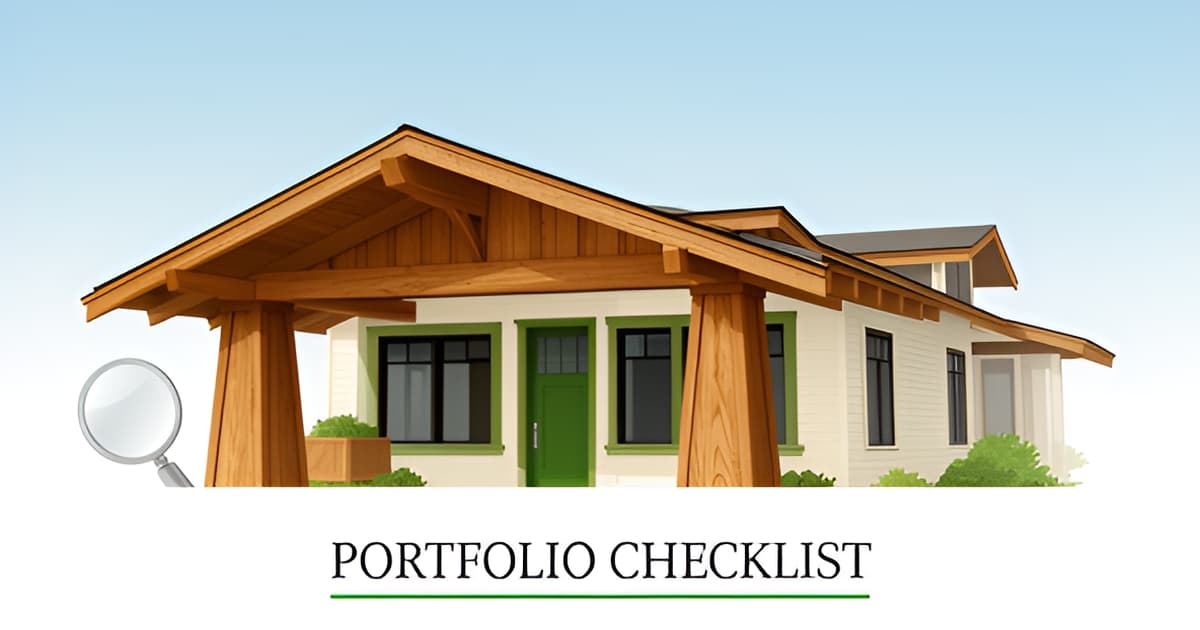
Treat the portfolio as a visual resume and score each project against the style's signature exterior features. The movement began as a rejection of mass production, so look for evidence of handcrafted execution: wide covered porches with square or tapered columns, overhanging eaves, low-pitched gabled roofs, exposed roof rafters, and a mix of stone, wood, and brick elements, as style guides describe.
Inside, the checklist gets stricter:
- Built-in furniture and window seats integrated into the walls
- Coffered ceilings, exposed beams, and wainscoting
- Leaded or stained glass accents
- Artisan finish carpentry throughout — "interiors were often works of art in themselves," as one Los Angeles practitioner put it
Here is the trap to watch for: contemporary homes (popular 1950–1970) often borrow simple Craftsman elements while relying on clean lines, flat roofs, and glass-and-metal materials. A portfolio showing a porch column here and exposed beam there may be contemporary work with Craftsman touches, not genuine period-faithful building. If the built-ins, coffered detailing, and woodwork are absent, keep looking.
The single most direct question cuts through the ambiguity: "How many Craftsman homes like mine have you finished?" Size, price range, and lot type all count, and a portfolio heavy in another style often signals a mismatch, per builder-vetting guidance. Ask to see homes completed five or more years ago, too — well-built Craftsman detail work should still look solid after five years of normal upkeep, experienced builders note.
When you review candidates in the Altadena Builder Directory, apply this same checklist to their project photos before you ever pick up the phone. And once a portfolio passes, confirm the builder's CSLB license with the directory's free lookup tool — verified credentials plus a checklist-ready portfolio is the strongest combination you can get.
Verify Beyond the Photos: Aged Builds, Job Sites, and Last-Three References
Beautiful portfolio photos can hide a mediocre build — trim gaps, sticking doors, and sloppy transitions rarely show up in a well-lit photo shoot. That's why serious buyers verify in person, and it's why this step separates confident builders from nervous ones.
Start by asking to walk through homes the builder completed five or more years ago. As one builder vetting guide puts it, visiting older builds reveals the true quality of materials and craftsmanship — look for signs of settling, exterior wear, or maintenance issues, because well-built homes should still look solid after five years with normal upkeep. For Craftsman work specifically, this matters enormously: the style's whole identity rests on exposed rafters, built-ins, and finished carpentry that must survive the years, not just the photo session.
When you're inside an aged build, inspect the details less-skilled builders overlook:
- Consistent grout lines and properly aligned fixtures
- Tight-fitting doors and windows that operate smoothly
- Clean flooring transitions and smooth drywall finishes
- Trim work precision and quality cabinet installation
Next, ask to walk an active job site. A clean, organized site tells you a lot about how a builder runs projects day to day — and a builder with real systems answers quickly and shows you documents, while one without them tells you stories. This is also a practical safeguard given that Craftsman homes appreciated 43.7% over a six-year period, making a botched reproduction an expensive mistake in a market where these homes often draw multiple offers.
Finally, demand references the right way: "Can I talk to your last three clients?" — the last three, not the favorite three. Cherry-picked references tell you nothing; recent ones tell you everything. When you call, ask whether the final cost matched expectations, how the builder handled changes and problems, how communication held up, whether they'd rehire, and what the post-move-in warranty service actually looked like.
One caution before you schedule any walkthroughs: confirm the builder's license independently rather than trusting portfolio claims. Altadena Builder Directory offers a free CSLB license-lookup tool so California homeowners can verify any contractor against California Contractors State License Board records, with listings showing a verification seal once a license match is confirmed. Every listing in the registry is license-verified against CSLB, so you can shortlist builders — such as featured paid listing JMB Builders LLC (CSLB #1103479) — and head into those aged-build walkthroughs knowing the credentials already check out.
Red Flags and the Paperwork Test
Some builders will tell you exactly what they're going to build. The better ones will show you — in writing, with numbers, line by line. When you ask a builder to describe what's included in the Craftsman detail work — the tapered columns, the built-ins, the coffered ceilings — pay close attention to the answer. According to builder-vetting guidance, a good builder "hands you a detailed specification document and walks you through it," while a weak answer sounds like "everything, don't worry about it."
That distinction matters more for Craftsman work than almost any other style. The style's entire identity rests on artisan-level finish carpentry and handcrafted detail, so vague specs leave the most expensive parts of your home undefined. The same principle applies to pricing: "a real number needs real plans and specifications," and a builder who quotes a firm price without them is guessing. A suspiciously low bid with thin specifications is, in the words of one practitioner, "a down payment on a larger number later." Treat "we never go over budget" as a sales line, not a promise — experienced builders know that honest budgets include contingencies.
Watch for these warning signs before you sign anything:
- A large upfront deposit demand instead of a payment schedule tied to completed work — payments should be structured around project milestones
- Reluctance to provide references, especially when you ask to speak with their "last three clients, not the favorite three"
- A pattern of constantly switching trade partners — the best builders maintain long-term relationships with plumbers, electricians, and finish carpenters, while builders who churn through subcontractors often face delays and quality-control issues
- Vague written specifications for detail work, or a refusal to walk you through what's included
The unifying principle comes from builder and author Jared Gossett: "A builder with real systems answers quickly and shows you documents. A builder without them tells you stories." Ask to see the specification document, the milestone payment schedule, and proof of licensing before you commit. For California homeowners, that last item is easy to check independently — the Altadena Builder Directory offers a free license-lookup tool that verifies any contractor against California Contractors State License Board records, and listings display a verification seal once a license match is confirmed.
One final filter: recurring complaints across review platforms signal systematic problems, not one-off bad days. If a builder's references, paperwork, and payment structure all check out, you've likely found someone worth walking a job site with. If they don't, keep looking — the Craftsman homes in highest demand appreciated 43.7% over six years, and a home built with that kind of lasting value deserves a builder whose systems match the craftsmanship.
Verify Credentials Before You Trust the Portfolio
A stunning Craftsman portfolio means nothing if the builder behind it isn't licensed to swing a hammer in California. Beautiful photos of coffered ceilings and built-in window seats can be staged, borrowed, or built by a company that no longer exists on paper. Before you fall for the imagery, verify the paperwork.
Portfolio vetting and credential verification go hand in hand. Builder evaluation guides consistently recommend confirming state licensing, insurance, and workers' compensation as a baseline step, right alongside reviewing the portfolio itself (Renaissance Homes). As one practitioner puts it, "A builder with real systems answers quickly and shows you documents. A builder without them tells you stories" (Building Optimal).
In California, that verification is refreshingly concrete. Every contractor must hold a valid license through the California Contractors State License Board (CSLB), and you can check it yourself in minutes. A license lookup confirms the license number, classification, status, and bond information — the factual backbone behind any portfolio claim.
This matters more in Altadena than almost anywhere. Craftsman homes are cited as a Southern California hot spot, with the style appreciating 43.7% over six years and frequently drawing multiple-offer situations. High demand attracts capable builders — and imitators.
Here is where the Altadena Builder Directory helps you shortcut the guesswork. It is a free, independent registry where every listing is license-verified against the CSLB before it appears. Once a license match is confirmed, the listing displays a verification seal, and license data is attributed directly to the CSLB. There are no paid rankings — featured placements are always labeled as such, so you always know what you are looking at.
- Confirm the contractor's CSLB license number, classification, and active status yourself
- Verify general liability insurance and current workers' compensation coverage
- Cross-check the company name on the portfolio against the name on the license
- Use the directory's free CSLB license-lookup tool to check any Altadena contractor in one step
Even a labeled featured listing, such as JMB Builders LLC (CSLB #1103479), appears with its paid placement disclosed and its license verified — transparency and verification are not mutually exclusive. The directory's free CSLB lookup tool means you never have to take a portfolio at face value. Run the check, confirm the seal, and then judge the craftsmanship on its merits.
Frequently Asked Questions
How can I tell if a builder's "Craftsman" portfolio is actually authentic Craftsman work?
Why does it matter whether a Craftsman home is old or a modern reproduction?
What's the single best question to ask a builder before hiring them for a Craftsman home?
Are Craftsman homes really worth the extra effort to vet the builder carefully?
What are the biggest red flags when hiring a builder for Craftsman detail work?
Should I ask for the builder's best references, and how do I verify their license?
Character Is Built — and Verified
A genuine Craftsman home is decided long before the first tapered column is set — it's decided by how you evaluate the builder. The portfolio you should trust is one heavy in real Craftsman projects, judged against a specific checklist of built-ins, coffered ceilings, and artisan finish carpentry — not a contemporary build with Craftsman touches. Then go beyond the photos: walk a home completed five or more years ago, tour an active job site, call the last three clients — not the favorite three — and demand written specifications for every detail element. The stakes justify the rigor: Craftsman homes appreciated 43.7% over six years and routinely draw multiple-offer situations, according to Realtor.com research, so a botched reproduction is an expensive mistake. Before you fall for any portfolio, verify the paperwork. The Altadena Builder Directory's free CSLB license-lookup tool lets you confirm any California contractor against CSLB records in minutes, and every listing in the registry is license-verified with a seal once a match is confirmed. Start there, shortlist with confidence, then judge the craftsmanship on its merits — your home's soul depends on it.