Custom ADU Builders in Los Angeles: Design-First vs Production Builders
Key Facts
- LA County completed a record 10,200+ ADUs in 2025, making them 37% of all new housing units.
- LA ADU permits surged roughly 30x after California's 2016–2022 legislative reforms.
- California properties with ADUs appreciated 9.34% annually from 2013 to 2023 versus 7.65% without.
- The 2023 median appraised value hit $1,064,000 for ADU properties versus $715,000 without, per FHFA appraisal data.
- Advertised prefab prices exclude site prep, foundations, permits, and utilities, so the lower starting number doesn't reflect finished cost.
- In LA, garage conversions start around $60,000 and ground-up ADUs at $150,000 or more, per Sweeten's cost guidance.
- FHFA analysts attribute stronger appreciation since 2018 partly to larger, higher-quality ADUs enabled by California's grant program.
LA's ADU Boom: Why the Builder You Choose Matters More Than Ever
Los Angeles quietly became the accessory dwelling unit capital of the country, and the numbers behind that shift are staggering. ADU permits in LA surged roughly 30x after California's 2016–2022 legislative reforms, and by 2025, ADUs accounted for 37% of all new housing units in LA County — more than 10,200 completions in a single record year, even as overall housing production fell.
This boom didn't happen by accident. State reforms made ADU approvals ministerial, capped parking requirements and fees, and removed owner-occupancy mandates, opening the door for homeowners who had never considered building before. With the county still chasing a goal of 812,000 new permitted units by 2029, ADUs have become a central strategy for adding homes within existing neighborhoods — often without major new infrastructure.
But the market itself is changing shape. FHFA analysts note that appraised values for ADU properties have grown faster since 2018, possibly reflecting the development of larger, higher-quality units. In other words, the era of the bare-bones backyard box is fading. Today's ADU is more likely to be a genuine second home — designed for aging parents, rental income, or long-term living.
That shift raises the stakes for one decision in particular: who builds it.
With thousands of ADU projects permitted every year, builders of every stripe — design-first custom firms, production-style companies, prefab package sellers — are competing for your project. The differences between them are not cosmetic:
- Design approach: custom ADUs are planned around the property, the main house, and the homeowner's goals, while standardized offerings limit choices to a manufacturer's available plans.
- Cost transparency: advertised package prices often exclude site prep, foundations, permits, utilities, and finishes, so the lower starting number doesn't reflect the finished cost.
- Site fit: a design-first builder studies your lot, existing systems, and access before finalizing the design, rather than discovering conflicts after a unit is selected.
The financial upside is real — California properties with ADUs appreciated at 9.34% annually from 2013 to 2023 versus 7.65% for those without — but only a well-built, well-designed unit captures it. Before comparing bids, the Altadena Builder Directory lets you verify any builder's CSLB license for free, so you know who you're dealing with before the design conversation even begins.
The Advertised Price Trap: Why Production-Style Quotes Understate True Cost
The $150,000 ADU you saw advertised online might be the least expensive part of your project. That sticker price typically covers only the structure itself — everything that turns a box into a livable home arrives as a separate line item.
According to renovation marketplace Sweeten, the advertised price of a prefab or production-style unit is not the complete project cost. Site preparation, foundations, permits, utilities, delivery, installation, and finishes can all add to the final budget. In other words, the lower starting number "doesn't tell you what the finished accessory dwelling unit will cost."
What the advertised price usually leaves out:
- Site preparation — grading, access, and clearing before anything arrives
- Foundations and utility connections, including sewer, water, and electrical tie-ins
- Permits, plan review, and inspection fees
- Delivery and crane or installation costs
- Interior and exterior finishes beyond the base package
For Los Angeles homeowners, realistic guidance ranges help calibrate expectations. Sweeten's figures show garage conversions starting around $60,000 and ground-up ADUs at $150,000 or more, with broader ADU planning budgets running $100,000 to over $300,000. These are guidance ranges, not quotes — but they signal how quickly a "starting at" price grows once real site conditions enter the picture.
The comparison problem compounds when homeowners evaluate two proposals side by side. Sweeten's guidance is direct: fair comparison requires a complete prefab proposal next to a complete custom proposal with the same square footage, utility assumptions, finish level, and site conditions. Otherwise, the lower estimate may simply cover less work.
This is why the lowest advertised number is rarely the deciding factor. A custom builder who studies your lot, existing systems, and access before finalizing design can surface costs early — rather than discovering major conflicts after a unit has already been selected. FHFA research also notes that high construction costs and limited financing options remain significant barriers for ADU projects, making accurate early budgeting even more important.
Before comparing bids, verify who you're comparing. The Altadena Builder Directory lists ADU builders whose licenses are checked against California Contractors State License Board records, and a free CSLB license-lookup tool lets you confirm any contractor in the state. A verified builder with a transparent, all-in proposal beats an attractive number with a long list of exclusions every time.
What Design-First Custom Builders Do Differently
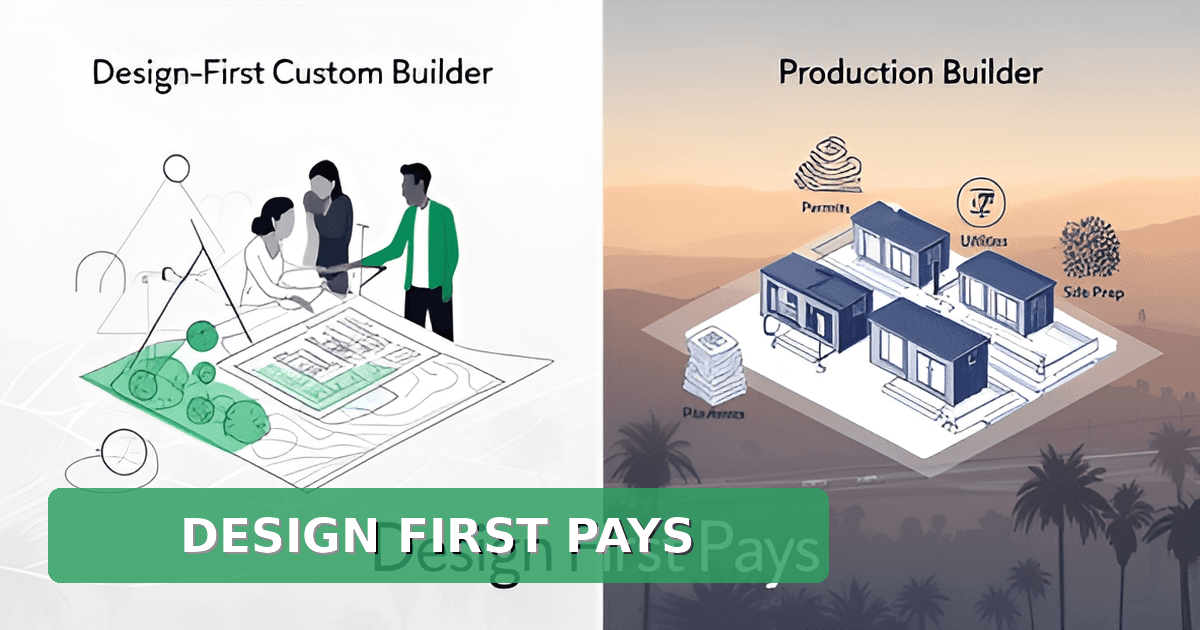
On a typical Los Angeles lot, no two properties pose the same challenges — a sloped rear yard, a garage foundation from 1952, a neighbor's second-story window staring directly into where a bedroom would go. This is exactly where design-first custom builders earn their keep: they plan the ADU around the property, the main house, and the homeowner's goals, rather than forcing a standardized unit onto land it was never designed for.
A custom ADU can respond to an existing foundation, an irregular footprint, privacy concerns, window placement, storage needs, or a particular kitchen and bathroom plan, according to guidance from renovation marketplace Sweeten. Production-style builders work in the opposite direction: the homeowner selects from a manufacturer's available floor plans and options first, then hopes the site cooperates.
The sequencing matters more than most homeowners realize. Before design is finalized, a custom contractor studies the proposed location, existing systems, and site access — shaping the layout around the property instead of discovering major conflicts after a unit has already been selected. Catching a utility conflict or access problem on paper costs far less than resolving it mid-construction.
Intended use also drives design in ways a catalog plan can't anticipate:
- Long-term rental or family living calls for a complete kitchen, private bathroom, laundry, and a separate entrance.
- Units for older family members benefit from layouts that anticipate future mobility changes.
- Home offices and studios prioritize natural light and sound separation from the main house.
- Designs on unusual lots, or those converting existing garages, need to relate closely to the main house's architecture.
This flexibility matters in a market that's moving toward bigger, better units. FHFA researchers note that higher appraised-value growth for ADU properties since 2018 could reflect the development of larger and higher-quality ADUs, aided by California's ADU grant program — a trend that favors design-first approaches over one-size-fits-all offerings. The stakes are real: California properties with ADUs showed a median appraised value of $1,064,000 in 2023 versus $715,000 without, and FHFA data shows those properties appreciated at 9.34% annually from 2013 to 2023, compared with 7.65% for non-ADU properties.
With more than 10,200 ADUs completed in LA County in 2025 — a record, representing 37% of all new housing units in the county — homeowners have more builder options than ever, per reporting on USC Lusk Center data. Before shortlisting design-first firms, verify credentials: the free CSLB license-lookup tool from Altadena Builder Directory lets you confirm any California contractor's license against California Contractors State License Board records, and every listing in the directory carries a verification seal once a license match is confirmed.
The ROI Case: How a Well-Designed ADU Performs as an Investment
An ADU isn't just extra square footage — in California, it's one of the most reliable value-adds in residential real estate, and the data shows the gap widening in favor of well-built units.
According to FHFA appraisal analysis, California properties with ADUs appreciated at 9.34% annually between 2013 and 2023, compared to 7.65% for properties without them. By 2023, the median appraised value of an ADU property reached $1,064,000 — roughly $349,000 above the $715,000 median for properties without one. Industry permit tracking goes further, suggesting a legal ADU can increase home equity by 20–30% (Shovels).
Here's where builder choice matters most: FHFA's statistical staff attribute the stronger appreciation of ADU properties since 2018 partly to the rise of larger, higher-quality ADUs, enabled by California's grant program that reimbursed development costs — a program whose funds were exhausted within days of allocation. In other words, the market is rewarding substance over minimal-compliance builds.
That finding maps directly onto the custom-versus-production question. A production approach delivers a standardized unit from a fixed catalog of plans. A design-first builder, by contrast, plans the ADU around the property, the main house, and the homeowner's goals — responding to existing foundations, irregular footprints, privacy concerns, and window placement, per renovation cost guidance. The result is a unit that looks intentional, functions well, and appraises accordingly.
The qualities that drive stronger appraised values tend to come from the design-first approach:
- Right-sized layouts that use the lot efficiently rather than forcing a standard footprint onto it
- Architectural relationship to the main house — finishes, proportions, and materials that read as one property
- Purpose-driven design: complete kitchens, private baths, and separate entrances for long-term rental or family use
- Site-aware placement that resolves utility, access, and privacy issues before construction, not after
For Altadena and greater Los Angeles homeowners weighing a six-figure investment, the ROI case is clear: the appreciation premium accrues to properties with genuinely livable, well-designed units, not just permitted boxes. The Altadena Builder Directory lists ADU and design-build firms whose licenses are verified against CSLB records — a practical first step toward finding a builder who treats your ADU as the investment it is.
How to Compare Builders and Verify Credentials Before You Sign
The cheapest bid is often the most expensive mistake. In a market where ADUs made up 37% of all new housing units in LA County in 2025, contractors know demand is high — and incomplete proposals are the easiest way to look affordable while covering less work.
The fix is to make bids truly comparable. As renovation marketplace Sweeten's ADU cost analysis explains, the deciding factor shouldn't be the lowest advertised number, because a lower estimate may simply include less work. Before you collect bids, write down four assumptions and require every builder to price against them:
- Identical square footage and layout scope, so no one is quoting a 500-square-foot unit against a 750-square-foot one.
- The same utility assumptions — electrical upgrades, sewer connection, water lines.
- An agreed finish level, from flooring to fixtures, so bids reflect the same quality tier.
- Identical site conditions, including grading, foundations, and any demolition.
This matters whether you're comparing a custom design-first builder against a production-style offering. Advertised package prices routinely exclude site preparation, foundations, permits, utilities, delivery, installation, and finishes — the "complete project cost" only emerges from a full proposal. In Los Angeles, guidance ranges put garage conversions starting around $60,000 and ground-up ADUs at $150,000 or more, so a $20,000 spread between bids can easily be a difference in scope, not price.
Once proposals are aligned, verify credentials. Every contractor working on your ADU must hold a valid California license, and you can confirm any of them for free through the CSLB license-lookup tool on the Altadena Builder Directory. The license data is attributed directly to the California Contractors State License Board, and listings display a verification seal once a license match is confirmed — so you can see, at a glance, that a builder's credentials check out rather than taking a website's word for it.
The Directory's listings also carry ratings only from real attributed public sources, with no paid rankings; featured placement is always labeled. For example, JMB Builders LLC (CSLB #1103479) appears as a labeled paid listing, with its license verified against CSLB records like every other entry.
With a project this large — and with California properties holding ADUs showing a median appraised value of $1,064,000 in 2023 versus $715,000 without, according to FHFA appraisal data — diligence before signing is the cheapest insurance you'll buy. Compare complete proposals, verify the license, then compare the builders themselves.
Frequently Asked Questions
Why do advertised $150,000 ADU prices end up costing so much more?
What's the actual difference between a design-first custom ADU builder and a production builder?
Is an ADU really a good investment for my Los Angeles property?
How do I compare ADU builder bids fairly when the numbers are so different?
Is the LA ADU market already saturated, or is it still growing?
How do I know an ADU builder is legitimately licensed before I sign?
Your Backyard, Your Builder, Your Move
Los Angeles homeowners are living through the biggest ADU boom in the country — 37% of all new housing units in LA County in 2025 — and the data shows the market rewarding substance: California properties with ADUs appreciated at 9.34% annually from 2013 to 2023, versus 7.65% for those without, according to FHFA appraisal data. But that premium only accrues to well-designed, well-built units. The path forward is straightforward: insist on complete, comparable proposals with identical square footage, utility assumptions, and finish levels; treat the lowest advertised number with skepticism; and confirm every contractor's license before the design conversation begins. The Altadena Builder Directory makes that last step easy — every listing is verified against California Contractors State License Board records, and a free CSLB license-lookup tool lets you check any California contractor in seconds. Your ADU will likely be the largest addition you ever make to your property. Start with a verified builder, and start today.