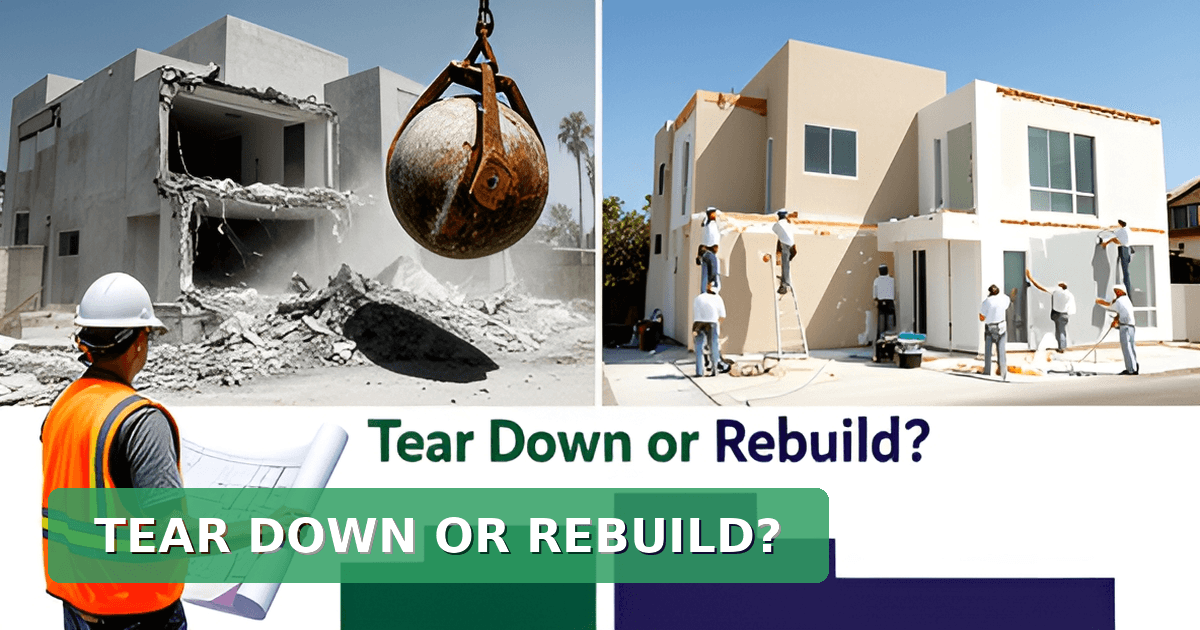
Demolish and Rebuild vs Remodel: Cost Comparison in LA
Key Facts
- LA residential construction costs surged 44% in five years, with another 6% jump in Q1 2025 alone, per 2025 market analysis.
- Full project budgets require adding 33–57% on top of base construction costs, according to LA cost data.
- A Studio City custom home penciled at $720K in construction actually totaled $912,000 after permits, design, and site work, per a case study.
- LA County's like-for-like rebuild permit runs $1,404 versus roughly $12,000 for a standard 1,500 sq ft project, per rebuild cost reporting.
- Fire-resilient construction adds less than 10% to cost while cutting destruction risk by up to 43%, per a Headwaters Economics/IBHS study.
- A year after the Eaton Fire, 74% of fire-impacted Altadena rental units show no record of rebuilding, UCLA research found.
- Post-fire rebuilds run $570–$800+ per square foot, with non-construction costs adding 40–60% to the base contract, per cost reporting.
The Sticker Price Is Only Half the Bill: Why LA Homeowners Can't Compare Rebuild vs Remodel on Base Costs Alone
Standing in your living room with a contractor's bid in one hand and a mortgage statement in the other, the question feels deceptively simple: do we tear it down or fix it up? In Los Angeles, that decision is happening inside one of the most expensive construction markets in the country — and the number on the bid is the least of your worries.
New construction in LA typically runs $400–$500 per square foot, according to California building cost data. Broader residential estimates range from $200–$300 per square foot for basic builds up to $650+ for luxury finishes, with LA-specific pricing varying by as much as 50% depending on neighborhood — Beverly Hills runs $450–$900+ per square foot while the San Fernando Valley sits 10–15% below the city average, per 2025 market analysis.
The pressure behind those numbers is real. Residential building costs in LA have surged 44% over the past five years, with another 6% jump in Q1 2025 alone. California construction costs now run 25–28% above pre-2020 trends, and forecasts project 3–5% further increases through 2025 amid persistent labor shortages.
Here's the number most homeowners miss: full project budgets require adding 33–57% on top of base construction costs. A 2,000-square-foot home penciled at $700,000 in construction actually totals roughly $1,029,000 once everything is counted. That gap includes:
- Permits and fees: +8–12% of base construction
- Design and architecture: +10–15%
- Site preparation: +5–10%
- Contingency reserve: +15–20%
Hidden line items compound the problem. Utility upgrades run $5K–$25K, seismic and soil work $15K–$50K, and hillside lots carry a 15–30% premium. Site conditions act as "hidden cost multipliers" — steep slopes add $50–$150 per square foot, contaminated soils $15–$45 per square foot, per LA construction cost research.
A real Studio City example makes this concrete: a 2,400-square-foot custom home finished at $912,000 — $380 per square foot — but the base construction was only $720,000. Permits added $68,000, design $84,000, and site improvements $40,000 on top.
The thesis of this comparison, then, is straightforward: the rebuild-versus-remodel decision in LA hinges on hidden costs, not sticker prices. Before you compare any bids, verify who you're comparing — the Altadena Builder Directory confirms every listed contractor's license against the California Contractors State License Board, so you can check any builder's CSLB standing for free before the numbers start flying.
The Hidden-Cost Math: When a Deep Remodel Stops Penciling Out
The sticker price of a remodel rarely survives contact with an LA jobsite. The categories that quietly kill renovation budgets — seismic work, aging utilities, contingency overruns — are the same ones that make a tear-down start looking reasonable.
Here's the honest caveat up front: no reliable source provides direct residential remodel cost data for Los Angeles. The best directional proxy available is commercial adaptive-reuse benchmarking, which runs $275–$425 per square foot and explicitly prices in the three cost drivers a deep remodel shares: structural seismic upgrades, MEP (mechanical, electrical, plumbing) replacement, and selective demolition. Treat those numbers as a compass heading, not a quote.
The hidden-cost categories stack up fast:
- Seismic and soil work: $15,000–$50,000
- Utility upgrades: $5,000–$25,000
- Site-condition multipliers: $12–$150 per square foot, ranging from high groundwater ($12–$30/SF) to steep slopes ($50–$150/SF)
- Contingency buffers: 13–23% layered across design, construction, and owner-side surprises
The break-even logic is straightforward. Full-cost budgeting for new construction in LA requires adding 33–57% on top of base construction for permits, design, site prep, and contingency. A tear-down pencils out when a renovation's hidden costs — seismic bracing, a full MEP swap, soil remediation, plus a 20% contingency on all of it — climb toward that same premium. At that point, you're paying near-new prices for an old structure.
A concrete anchor for the rebuild side: a Studio City case study tracked a 2,400-square-foot custom home to a final cost of $912,000, or $380 per square foot — $720K in construction, $68K in permits, $84K in design, and $40K in site improvements over an 18-month timeline. That's the realistic shape of a voluntary rebuild budget in today's market, where LA residential costs have surged 44% in five years.
Before committing to either path, get an itemized feasibility assessment — sources consistently warn that projects without adequate buffers run out of money mid-project. And whoever you hire, verify their license first; the Altadena Builder Directory offers a free CSLB lookup tool, with every listing checked against state license records, so the number on the contractor's card matches the state's.
The Regulatory Wildcards: Like-for-Like Permits and Tax Relief That Tilt the Scale Toward Rebuilding
The cheapest part of a rebuild isn't lumber or labor — it's the paperwork you never have to fight. In Los Angeles County, a handful of regulatory provisions quietly flip the remodel-versus-rebuild math in favor of tearing down and starting fresh.
The centerpiece is LA County's "like-for-like" rebuild pathway. As LA County DCBA explains, homeowners can rebuild with modifications as long as floor area, height, or footprint don't grow by more than 10% — and these projects get "quicker permitting review and approval times than more complex projects." Compare a $1,404 like-for-like permit benchmark against roughly $12,000 for a 1,500 sq ft standard project or $22,000 at 3,000 sq ft, per post-fire rebuild cost reporting, and the savings become hard to ignore.
Then there's the tax angle. Under AB 245, 2025 wildfire victims get three additional years — beyond the existing five-year window — to complete a like-for-like rebuild while retaining their property's original base-year value, avoiding reassessment at today's higher valuations. For a long-held Altadena property, that preserved tax basis can be worth more over a decade than the entire permit package.
Fire-rebuild conditions, however, look nothing like a voluntary tear-down budget:
- Rebuild costs run $570–$800+/sq ft in demand-surge conditions — well above the $400–$500/sq ft typical for LA new construction.
- Pre-construction phases (debris removal, hazmat remediation, soil testing, engineering, permits) commonly consume $75,000–$200,000 before framing begins.
- Full rebuild timelines commonly run 18–36 months, with non-construction costs adding 40–60% to the base contract.
One investment deserves special attention: fire-resilient construction adds less than 10% to cost while cutting destruction risk by up to 43%, per a Headwaters Economics/IBHS study. A 1,750 sq ft Altadena home saw WUI code upgrades add $13,070, with the full IBHS Wildfire Prepared Home Plus standard adding $15,242 — modest premiums for a home far more likely to survive the next event.
Before committing to either path, verify who you're hiring. The CSLB licenses roughly 285,000 contractors across 45 classifications, and LA County urges homeowners to work only with licensed professionals to avoid post-disaster fraud. The Altadena Builder Directory makes that step easy: every listing is license-verified against CSLB records, and a free lookup tool lets you check any California contractor yourself.
Your Decision Framework: Budgeting, Contingencies, and Feasibility Before You Commit
Before you commit to a remodel or a tear-down, put your decision on paper. In Los Angeles, budgeting only for construction is the fastest way to run out of money mid-project — one analysis of post-fire rebuilds found that pre-construction, permits, temporary housing, and finishes regularly add 40–60% on top of the base contract.
Start with an itemized feasibility assessment before choosing a path. Industry guidance suggests that $15,000–$30,000 invested in professional feasibility studies can prevent six- or seven-figure budget overruns — a small price compared with discovering, mid-demo, that your lot needs $15,000–$50,000 in seismic or soil work, or that hillside conditions add a 15–30% premium.
Budget in ranges, never a single number. LA residential construction costs span basic builds at $200–$300 per square foot, mid-range at $300–$450, and luxury at $450–$650+, while post-fire rebuilds have run $570–$800+ per square foot under demand-surge conditions. Add a 20–30% contingency to whichever range applies to you — the buffer that keeps a slow permit cycle or a material price spike from derailing the project.
A few levers can meaningfully cut your total:
- Pre-order materials to lock pricing before increases — one cited case avoided an 8% price hike this way.
- Hire experienced local contractors who know your jurisdiction's permit office; in one case study, local familiarity cut permit delays by two months.
- Explore LA County's like-for-like rebuild pathway, which offers quicker permitting review when modifications stay within 10% of floor area, height, or footprint.
- If your property was affected by the 2025 wildfires, look into AB 245's extended property tax base-year-value retention for like-for-like rebuilds.
Finally, protect yourself from fraud. The LA County Department of Consumer and Business Affairs urges homeowners to hire CSLB-licensed contractors, architects, and engineers — critical advice in a market where recovery is moving slowly. UCLA researchers found that 74% of fire-impacted rental units in Altadena sit on properties with no record of rebuilding activity a year after the Eaton Fire, which means demand for qualified builders remains intense and unlicensed operators have room to exploit it.
You can verify any California contractor's license for free through the Contractors State License Board, which licenses roughly 285,000 contractors across 45 classifications. Every listing in the Altadena Builder Directory is checked against CSLB records and carries a verification seal once a license match is confirmed, so you can compare licensed builders — from ADU specialists to fire-rebuild firms — with confidence before you sign anything.
Verify Before You Build: Matching Your Path to a License-Verified Altadena Contractor
Whichever path you choose — a like-for-like fire rebuild or a deep remodel of an existing structure — the single most important decision isn't the cost line item. It's who you hire. LA County's Department of Consumer and Business Affairs stresses that homeowners should hire CSLB-licensed contractors, architects, and engineers to protect against fraud, especially in a post-disaster market where demand surge can push contractor and material prices up 20–40% for a year or more.
The stakes are high in Altadena right now. A UCLA study found that a year after the Eaton Fire, 74% of fire-impacted rental units sat on properties with no public record of rebuilding permits, sales, or active listings — a slow recovery that leaves homeowners sorting through a crowded, high-pressure contractor market. Verification is your first line of defense.
Before signing anything, take these steps:
- Look up the contractor's license number on the CSLB website — the board licenses roughly 285,000 contractors across 45 classifications, and a quick search confirms the license is active and matches the name on your bid.
- Confirm the license classification fits your project: an ADU builder, a custom home builder, and a fire-rebuild specialist don't necessarily hold the same credentials.
- Get itemized bids that separate base construction from permits, design, and contingency — remember that full project costs typically run 33–57% above base construction figures.
- Ask for proof of insurance and check whether the bid accounts for site conditions like soil work, which can add $15,000–$50,000.
To make that process faster, the Altadena Builder Directory maintains a free CSLB license-lookup tool so you can verify any California contractor in seconds, with license data attributed directly to the California Contractors State License Board. Every listing — ADU builders, custom home builders, remodelers, fire-rebuild specialists, and design-build firms — is checked against CSLB records and carries a verification seal once a license match is confirmed. Ratings come only from real attributed public sources, featured placements are always labeled, and paid listings like JMB Builders LLC (CSLB #1103479) are clearly marked as such.
The math on demolish-and-rebuild versus remodel will vary with your lot, your budget, and your timeline. But the verification step doesn't change: check the license before you check the price. A contractor who can't pass a CSLB lookup shouldn't pass your driveway, no matter how competitive the bid.
Frequently Asked Questions
How much does it actually cost to rebuild a house in LA versus just remodeling it?
Why is my construction bid so much lower than what the project will actually cost?
What hidden costs should I worry about before tearing down or remodeling in LA?
Is it cheaper to do a like-for-like rebuild after a fire in Altadena?
How much contingency should I budget for a rebuild or major remodel in LA?
How do I avoid getting scammed by a contractor during my rebuild or remodel?
The Numbers Don't Decide — You Do, With the Right Builder Beside You
Rebuild or remodel? In Los Angeles, the honest answer is that the sticker price will never tell you. Base construction runs $400–$500 per square foot, but full project budgets typically climb 33–57% higher once permits, design, site prep, and contingency are counted — and hidden costs like seismic work ($15,000–$50,000) and site-condition multipliers can quietly erase a remodel's apparent savings. Add in LA County's like-for-like permitting pathway and AB 245's property tax relief, and the scale often tips toward rebuilding. Whatever your numbers say, the sequence stays the same: get an itemized feasibility assessment, budget with a 20–30% contingency, and verify your contractor's license before comparing bids. That last step matters more than ever in a market where a year after the Eaton Fire, 74% of fire-impacted rental units in Altadena still show no record of rebuilding activity — leaving room for unlicensed operators to circle. The Altadena Builder Directory makes verification simple: every listing is checked against CSLB records, and a free lookup tool lets you confirm any California contractor in seconds. Check the license first. Then check the price.