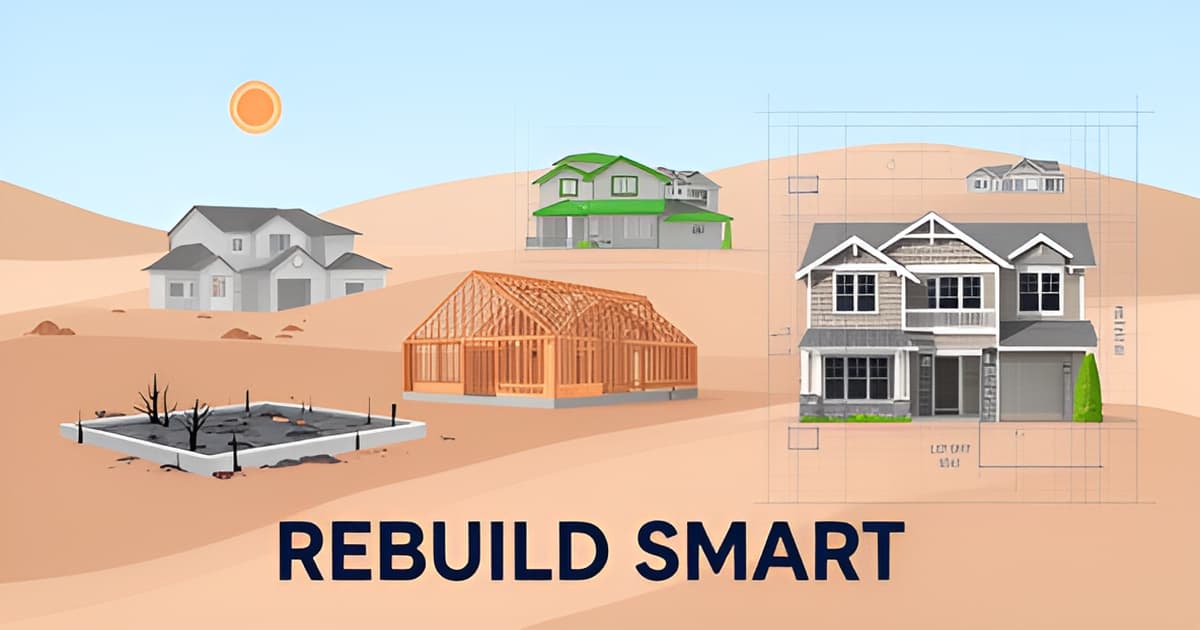
Eaton Fire Rebuild Plans: Design Options for Altadena Homeowners
Key Facts
- Only 23 of nearly 6,000 significantly damaged Altadena properties had fully rebuilt as of December 2025 per Catalyst California's tracking.
- Rebuilding a typical 1,500 sq ft Altadena home costs roughly $750,000 against average insurance coverage of just $607,000 according to Catalyst California.
- Like-for-like rebuild applications are due within two years of the emergency declaration — early 2027 — per county rebuild guidance.
- LA County targets a 10-business-day first plan check with 5-day rechecks and waives fees for pre-fire owner-occupants under county rebuild rules.
- By January 2026, 1,170 rebuilding permits had been issued and 1,425 Altadena properties' plans approved NBC Los Angeles reported.
- The LA County DA charged five unlicensed contractors with felonies in Altadena, where unlicensed disaster-zone contracting carries up to 3 years imprisonment per the DA's office.
- SB 1123 now allows up to 10 lots and 10 homes on a vacant single-family lot with 60-day ministerial approval under state housing law.
Where Altadena Rebuilding Stands — and Why Design Decisions Can't Wait
Nearly a year after the Eaton Fire, Altadena's recovery is moving at a pace that surprises no one who has lived through it — and faster design decisions are the one lever homeowners still control. The numbers are sobering: as of December 2025, tracking by Catalyst California shows only 23 of nearly 6,000 significantly damaged residential properties have fully rebuilt. Just 43% of owners have even applied for permits, and 57% of owner-occupied properties have no permit application on file at all.
The signs of momentum are real, though. By January 8, 2026, NBC Los Angeles reported that 1,170 rebuilding permits had been issued and 1,425 properties' plans approved. Ted Koerner, who received Altadena's first certificate of occupancy in December 2025, credits persistence: "Pick up the phone every day. Every day."
Two forces now squeeze every design decision you make.
- The like-for-like deadline. Streamlined rebuild applications are due within two years of the emergency declaration — early 2027 — with up to three one-year extensions available, per county rebuild guidance.
- The insurance shortfall. Rebuilding a typical 1,500 sq ft home at roughly $500/sq ft runs about $750,000, while average Altadena coverage was $607,000 — a gap exceeding $140,000 before temporary housing costs.
- Fraud risk. The LA County DA has charged five unlicensed contractors with felonies for working in Altadena; unlicensed contracting in a disaster zone carries up to 3 years imprisonment.
Here's why this matters for design specifically: your chosen path determines your permitting speed, your budget, and your timeline. A like-for-like rebuild is "built for speed," not for more homes — add an ADU, split the lot, or redesign substantially, and you exit the streamlined path entirely. That choice interacts directly with your insurance gap, since constrained budgets push many owners toward pre-approved plans or phased strategies like an ADU-first build.
Before signing with anyone, verify their credentials. The DA's office and CSLB urge homeowners to confirm every contractor's license — the Altadena Builder Directory's free CSLB license-lookup tool makes that check take seconds, and every listing in the registry is verified against state records.
Path 1: The Like-for-Like Rebuild — Fast Permitting, Fixed Footprint
For most Altadena homeowners, the fastest route back onto their lot isn't the most ambitious one — it's the one that looks most like the home they lost. The "like-for-like" rebuild is unincorporated LA County's streamlined path, and its whole design philosophy is captured in one line from YDS Architects: "Like-for-like is built for speed. It is not built for more homes."
Under the County rules that govern Altadena, you can rebuild roughly the same home — with up to 10% or 200 square feet added, whichever is greater. You can match your old height or the current zoning limit, but you cannot add stories. If the house is moved on the lot, at least 50% of the original footprint must be retained, and no covered parking is required.
The speed advantage is real. The County targets a 10-business-day first plan check, with 5-business-day rechecks, and it waives fees entirely for owners who owned and lived in their home before January 7, 2025. In-person help is available at the Altadena Community Center, and the county's recovery hub offers an express permitting lane and one-stop permit centers.
Like-for-like at a glance:
- Size: original home plus 10% or 200 sq ft, whichever is greater
- Height: match old height or current zoning — no added stories
- Moved house: retain at least 50% of the original footprint
- Parking: no covered parking required
- Timeline: applications due within two years of the emergency declaration (early 2027), with extensions available
Two caveats matter. First, "like-for-like" does not mean "like-for-old-codes": your rebuild must still meet current Building, Fire, and Health & Safety codes, including fire-hardening, sprinkler, and energy requirements. Second, the trade-off is structural — the moment you want to add units, split the lot, or substantially change the layout, you leave the streamlined path and design to current zoning or state housing law.
Given how slow the broader rebuild has been — only 23 of nearly 6,000 significantly damaged properties were fully rebuilt as of December 2025, per Catalyst California's tracking — the appeal of a fast, predictable path is obvious. Whichever builder you engage, verify credentials before signing: the LA County DA charged five unlicensed contractors with felonies in December 2025 for operating in Altadena. The Altadena Builder Directory's free CSLB license-lookup tool lets you confirm any California contractor's license before you commit.
Path 2: Beyond Like-for-Like — ADUs, Lot Splits, and Pre-Approved Plans
For homeowners facing the math that doesn't add up, like-for-like isn't the only option. Rebuilding a typical 1,500 sq ft home at ~$500 per square foot costs roughly $750,000, while average Altadena insurance coverage was only $607,000 — a shortfall of $140,000 or more before temporary housing costs. That gap is pushing many owners to consider designs that go beyond replacing what was lost.
Three upgraded paths are available, each with distinct trade-offs:
- ADU-first phasing. A standalone accessory dwelling unit can be built first and occupied until January 7, 2030 while the main home is rebuilt, giving you a place to live (or rent income) during construction.
- SB 1123 lot splits. State law now allows up to 10 lots and 10 homes on a vacant single-family lot, with 60-day ministerial approval — no discretionary hearings required.
- Pre-approved plans. The Foothill Catalog Foundation, a California nonprofit, is offering pre-approved home plans created specifically for this disaster recovery, partnering with San Gabriel Valley Habitat for Humanity.
The pre-approved route can meaningfully compress timelines. "Being able to have this pre-approval process, which was created specifically for this disaster recovery effort, really gets people that much further in the process," says Cynthia Sigler, a Pasadena-based licensed architect with the Foundation. Foundation president Alex Athenson puts it simply: the goal is to give homeowners "a head start" and get them as close to construction as possible.
For proof that multi-home designs work in Altadena, look no further than the Mariposa Complex at 385 Mariposa St. The project stacks three homes along a shared driveway, each with an attached ground-floor ADU and roof gardens — and it won the 2026 AIA Pasadena & Foothill Rebuild Design Award for "The Most Collaborative Process." As YDS Architects frames it: "Like-for-like is built for speed. It is not built for more homes." Adding units, splitting a lot, or changing the layout significantly means leaving the streamlined path and designing to current zoning or state housing law — a slower process, but one that can produce a smaller main home, rental income from an ADU, or saleable lots that close the insurance gap.
Whichever upgraded path you choose, the design decisions make contractor selection even more critical. ADU specialists, design-build firms, and fire-rebuild builders bring very different skill sets, and with the LA County DA's office having charged five unlicensed contractors with felonies operating in Altadena, verification matters. The Altadena Builder Directory's free registry lets you browse ADU builders, custom home builders, and design-build firms — every listing license-verified against the California Contractors State License Board — and its free CSLB lookup tool lets you check any contractor you're considering before you sign.
ctaText: Browse the Altadena Builder Directory — every listing license-verified against the California Contractors State License Board.
socialProofText: Ratings come only from real attributed public sources — no paid rankings. Featured listing: JMB Builders LLC (CSLB #1103479), labeled paid placement.
Verify Before You Sign: Avoiding the Contractor Fraud Wave
Rebuilding after losing a home is stressful enough — signing with an unlicensed contractor can turn recovery into a second disaster. That risk is not theoretical in Altadena. It has already produced criminal charges.
In December 2025, LA County District Attorney Nathan Hochman announced felony charges against five unlicensed contractors operating illegally in the Altadena rebuild zone. Because the Eaton Fire area is a Governor-proclaimed disaster zone, contracting without a license there is a felony punishable by up to 3 years in prison and/or a $10,000 fine. One defendant, Guillermo Ramirez, faces up to 6 years in state prison.
Hochman's message to homeowners was blunt: "My office is cracking down on criminal contractors who prey on residents who have already lost so much and cannot afford to lose more." He also reminded residents that "you are still the victim of a crime even if you knowingly hired an unlicensed contractor" (source: DA's press release).
Before you sign anything, take these verification steps:
- Look up the contractor's license on the CSLB Disaster Help Center at cslb.ca.gov — CSLB Registrar David Fogt calls it the official resource to verify a license or file a complaint.
- Confirm the license is active, in the correct classification, and held by the person actually signing your contract.
- Be skeptical of anyone soliciting work door-to-door or demanding large cash deposits up front.
- Get a written contract and never pay more than the legal down payment limit.
The stakes are high because so much money is in motion. With a typical 1,500 sq ft rebuild costing around $750,000 against average insurance coverage of $607,000, many Altadena owners face a shortfall of $140,000 or more before temporary housing costs, according to Catalyst California's rebuilding tracker. A fraudulent builder can wipe out that margin instantly.
To make verification easier, the Altadena Builder Directory offers a free CSLB license-lookup tool so you can check any California contractor yourself. Every listing in the directory is checked against official CSLB records and displays a verification seal only once a license match is confirmed — ratings come solely from real, attributed public sources, and any paid placement is always labeled as such.
One featured firm, JMB Builders LLC (CSLB #1103479, paid placement), illustrates the standard every builder should meet: an active, verifiable license you can confirm independently before signing.
Verify first. Sign second. Your rebuild depends on it.
Your Rebuild Action Plan: Deadlines, County Resources, and Next Steps
Rebuilding after the Eaton Fire is less a construction project than a logistics campaign — and the homeowners moving fastest are the ones treating it that way. Here is the practical sequence, grounded in where Altadena actually stands in early 2026.
If you want the streamlined path — same size and footprint, plus up to 10% or 200 sq ft in unincorporated LA County — confirm your eligibility now. Like-for-like applications are due within two years of the emergency declaration, meaning early 2027, though extensions of up to three one-year periods are available, per county rebuild guidance. Waiting costs you your fastest permitting option.
LA County has built real infrastructure for this recovery. The county recovery hub offers an Express lane for rebuilding, fee waivers, and One-stop Permit Centers. In-person help is available at the Altadena Community Center, 730 E. Altadena Dr., Monday through Friday, 9 AM–5 PM.
Your action checklist:
- Confirm like-for-like eligibility before the early-2027 deadline
- Verify your fee waiver — county fees are waived for owners who owned and lived in the home before January 7, 2025
- Submit through the Express lane and ask about the county's plan-review targets: 10 business days for a first check, 5 for rechecks
- Verify every contractor's CSLB license before signing anything
The honest picture: as of December 2025, only 23 of nearly 6,000 significantly damaged residential properties had fully rebuilt, and just 43% of owners had applied for permits, per Catalyst California's tracking. But momentum is building — 1,170 rebuilding permits had been issued and 1,425 properties' plans approved as of January 8, 2026.
Ted Koerner, who received Altadena's first certificate of occupancy in December 2025, fronted over $700,000 from his retirement fund before insurance paid out. His advice is blunt: "Pick up the phone every day. Every day. Get up early." Persistence, not luck, separates the finished homes from the stalled ones.
The risk is real: LA County DA Nathan Hochman announced felony charges in December 2025 against five unlicensed contractors operating in Altadena, where unlicensed contracting in a disaster zone carries up to three years imprisonment and/or a $10,000 fine, per the DA's warning to fire victims.
Before you sign, browse the Altadena Builder Directory — every listing is license-verified against the California Contractors State License Board, and the free license-lookup tool lets you independently confirm any contractor in the state. Featured listing (paid placement): JMB Builders LLC, CSLB #1103479.
Frequently Asked Questions
What does a "like-for-like" rebuild actually let me change in Altadena?
When is the deadline to apply for a streamlined like-for-like rebuild?
Will my insurance actually cover the cost of rebuilding my Altadena home?
Can I build an ADU first and live in it while I rebuild my main house?
How do I avoid hiring a fraudulent contractor during the Altadena rebuild?
Is rebuilding in Altadena actually moving, or is everyone stuck?
Your Design Decision Is the One Lever You Still Control
Rebuilding in Altadena comes down to one choice made early: the streamlined like-for-like path, with its 10-day plan checks, fee waivers, and early-2027 application deadline, or an upgraded design — an ADU-first build, an SB 1123 lot split, or pre-approved plans — that trades speed for a way to close the $140,000+ insurance gap. Either way, the data shows persistence wins: only 23 of nearly 6,000 significantly damaged properties had fully rebuilt by December 2025, yet over 1,170 permits were issued by January 2026. Your next steps are concrete: confirm your like-for-like eligibility before the deadline, check your fee waiver status, use the county's Express permitting lane, and — before signing anything — verify your builder's CSLB license, given the felony charges already filed against unlicensed contractors in the rebuild zone. The Altadena Builder Directory makes that last step easy: every listing is license-verified against the CSLB, and the free license-lookup tool lets you independently confirm any contractor in the state. Browse the directory, verify first, and sign second.