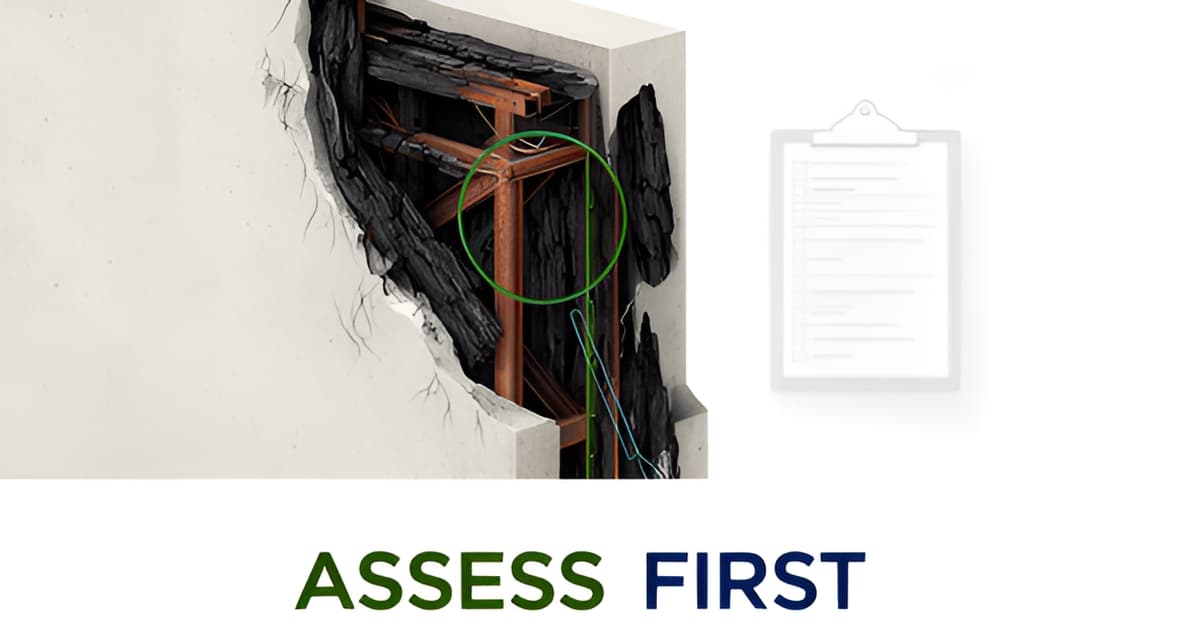
Fire-Damaged Home Rebuild: Structural Assessment Before You Sign
Key Facts
- Charred wood often retains its core strength, charring at roughly 1.5 inches per hour.
- Steel loses over 50% of its yield strength above 600°C, though most structure fires peak at 800–1,100°C per practicing structural engineers.
- A fully blackened warehouse needed just one column replaced, saving roughly $180,000 over a full teardown engineers report.
- If residual capacity falls below 70–80% of code-required capacity, full rebuild usually beats repair according to engineering guidance.
- Only 23 of nearly 6,000 damaged Altadena properties had completed rebuilding as of December 2025 per a recovery report.
- Average Altadena insurance coverage of $607,000 falls over $140,000 short of a $750,000 rebuild example research shows.
- Six of ten tested intact, remediated Altadena homes remained uninhabitable due to elevated lead or asbestos testing found.
Why Your Eyes Can't Judge Fire Damage
The most dangerous assumption an Altadena homeowner can make after the Eaton Fire is trusting what the burn looks like. Structural engineers report that visible damage misleads in both directions — some badly blackened structures need only targeted repairs, while fires that appear contained hide serious damage behind finished walls.
Two case studies from a practicing structural engineer illustrate the stakes. A warehouse with a fully blackened, partially collapsed roof deck needed only one column replaced, saving roughly $180,000 over a teardown. In the opposite direction, a duplex fire that looked contained to a single bedroom had char extending nearly a foot beyond the visible damage, traveling through stud bays — the kind of hidden compromise that ends up buried behind new drywall if nobody opens the cavities.
Fire doesn't respect sight lines. It moves through concealed spaces — attics, chases, stud bays — which is why engineers insist that wall and floor cavities must be opened before any burn pattern can be trusted. Surface cues mislead the other way, too: smoke staining and minor heat blistering are frequently cosmetic, and treating them as structural loss leads to unnecessary demolition and expense, according to forensic engineers at EES Group.
Material behavior compounds the problem, because different materials fail in invisible ways:
- Charred wood often retains core strength — solid-sawn lumber chars at roughly 1.5 inches per hour, leaving an insulating layer that protects the interior, per Miyamoto International.
- Steel can lose more than 50% of its yield strength after prolonged exposure above 600°C — yet most structure fires peak between 800–1,100°C, well below steel's melting point, so deformed-looking members may be fine and straight-looking ones may be compromised.
- Concrete can spall explosively as trapped moisture turns to steam, and color changes between 300–600°C can signal up to 40% compressive strength loss.
The financial consequences of guessing are severe. When residual capacity falls below roughly 70–80% of code-required capacity across a significant portion of the structure, full replacement usually becomes more cost-effective — and a partial repair can trigger code compliance review, including seismic and wind upgrades that push costs near rebuild levels anyway. With a typical Altadena rebuild example running $750,000 against average insurance coverage of $607,000, there is little margin for a wrong call.
The takeaway for Altadena homeowners: get an invasive, engineer-led structural assessment before signing any repair or rebuild contract. Assessment findings should drive your repair scope, cost estimates, and insurance claim — not the color of your walls. When you're ready to select a contractor for that work, the free Altadena Builder Directory lists fire-rebuild specialists whose licenses are verified against the California Contractors State License Board, and its CSLB lookup tool lets you check any California contractor yourself before you sign.
How Materials Behave in a Fire: What an Engineer Actually Checks
A charred beam and a warped steel column can tell completely different stories — and only one of them might be salvageable. Understanding how each material behaves under fire is what separates an engineer's assessment from a contractor's eyeball estimate.
Wood is often the survivor. Solid-sawn timber chars at a predictable rate of roughly 1.5 inches per hour, and that char layer actually insulates the unburned core beneath it. As Miyamoto International notes, charred wood may look severely damaged while its interior retains structural integrity. Engineers measure the char depth, calculate remaining section size, and determine whether the member still carries its required load.
Steel is the quiet failure risk. It doesn't need to melt — steel melts near 1,370°C, while most structure fires peak at 800–1,100°C. Prolonged exposure above 600°C causes softening and permanent deformation even when members appear visually straight. Engineers read the surface like a temperature record:
- Straw or blue tinting (200–300°C): under 10% strength loss — often reusable
- Bare, flaky, oxidized surface (600°C+): 50%+ yield strength loss — flagged for replacement
- Any visibly deformed member: considered compromised, per forensic engineering guidance
Concrete and masonry announce their damage in color. Pink-to-grey discoloration (300–600°C) indicates up to 40% compressive strength loss; buff or white coloring with spalling (above 950°C) often exceeds 60% loss and may require removal. Spalling happens explosively as trapped moisture converts to steam, exposing rebar to direct heat. Foundations, however, are rarely directly fire-damaged because soil insulates buried concrete.
All of this feeds into the central decision rule engineers apply: if residual capacity falls below roughly 70–80% of code-required capacity across a significant portion of the structural system, full replacement usually becomes more cost-effective than repair. That threshold is why a blackened warehouse can be saved with one replaced column, while a "contained" bedroom fire hides char extending nearly a foot beyond visible boundaries through stud bays.
This is also why Altadena Builder Directory emphasizes engineer-led assessments before any contract is signed — the residual capacity number, not the burn pattern, drives the repair-versus-rebuild call. Once you have that number in hand, you can compare it against real cost benchmarks and negotiate from evidence rather than appearances.
The Hidden Costs That Tip Repair Toward Rebuild
The repair estimate looked affordable on paper — until the code compliance review, the smoke corrosion follow-up, and the insurance shortfall turned it into the most expensive decision of the recovery. For many Altadena homeowners, the true cost of "repairing" only reveals itself after the contract is signed.
The biggest hidden trigger is code. Structural repairs beyond a defined threshold can require a full code compliance review, meaning a partial repair may force seismic and wind upgrades that push total costs near rebuild levels. As one practicing structural engineer puts it, "a partial repair can end up requiring seismic and wind upgrades that push the total cost close to what a rebuild would have cost anyway." In Altadena's high and very high fire hazard severity zones, rebuilding also triggers defensible space and wildland-urban interface requirements that add cost and complexity.
Benchmarks make the economics clearer. Localized wood framing damage typically runs $40–$90 per square foot to repair versus $180–$260 per square foot to rebuild — repair usually wins. But widespread damage with spalled concrete flips the math: $120–$200 per square foot to repair versus $250–$350 to rebuild, where full replacement is often favored. If residual capacity falls below roughly 70–80% of code-required capacity across a significant portion of the structure, rebuild usually becomes more cost-effective.
Then there's the insurance gap. A 1,500-square-foot rebuild at $500 per square foot totals roughly $750,000, while the average Altadena home carried about $607,000 in coverage as of 2023 — a shortfall of more than $140,000 before temporary housing costs. That gap makes an accurate, engineer-led scope essential before committing either way.
Post-fire risks compound the budget in ways homeowners rarely anticipate:
- Saturated framing must be dried within 48–72 hours or decay fungi take hold
- Acidic smoke residue accelerates corrosion in steel connectors and rebar, warranting a follow-up inspection 60–90 days after the fire
- Soot and ash penetrate porous materials, causing long-term contamination
- Lead contamination has kept 6 of 10 tested intact, remediated Altadena homes uninhabitable
That last point deserves emphasis: even homes that survived the Eaton Fire and completed debris removal have failed environmental testing, with lead levels remaining above acceptable residential standards on many properties.
Before signing any repair or rebuild contract, verify who you're hiring. Every listing in the Altadena Builder Directory is license-verified against the California Contractors State License Board, and a free CSLB lookup tool lets you confirm any California contractor — including fire-rebuild specialists like JMB Builders LLC (CSLB #1103479). With nearly 6,000 significantly damaged Altadena properties and only 23 fully rebuilt as of December 2025, choosing a verified builder early matters.
Your Altadena Assessment and Rebuild Roadmap
If you're rebuilding after the Eaton Fire, your first signature should be on an engineering assessment — not a construction contract. Nearly 6,000 Altadena properties were significantly damaged, yet only 23 had completed all rebuilding and repairs as of December 2025, and just 43% of owners had even applied for permits, according to a Catalyst California recovery report.
Start with the assessment. Commission an invasive, engineer-led evaluation that opens wall and floor cavities, because fire travels through concealed stud bays, attics, and chases — visible burn patterns are unreliable in both directions. For a typical 2,500–6,000 square foot home, expect 3–10 days of field work plus 1–2 weeks of lab analysis before a final report arrives, per practicing structural engineers. The findings should also guide environmental testing: 6 of 10 tested intact, remediated Altadena homes remained uninhabitable due to elevated lead or asbestos.
While the engineers work, clear your permitting path. LA County's Like-for-Like rebuild program expedites permits for homes rebuilt at the same size, location, and purpose — but only after Phase 1 hazardous materials removal and Phase 2 debris removal are complete. Modifications are capped at 10% or 200 square feet, whichever is greater, and even like-for-like rebuilds must meet current Building, Fire, and Health and Safety Codes.
Then, before signing anything, verify your builder:
- Confirm the contractor's license through the California Contractors State License Board — a free lookup takes minutes and can save you from unlicensed operators who flock to disaster areas.
- Use the Altadena Builder Directory, an independent, free registry where every listing is license-verified against CSLB records and shows a verification seal once a match is confirmed.
- Check that the builder's specialty matches your project — fire-rebuild specialists, custom home builders, and design-build firms face very different code requirements.
- Read ratings carefully; the directory only publishes ratings from real attributed public sources, and any featured placement — such as JMB Builders LLC (CSLB #1103479) — is always labeled as paid.
Finally, budget realistically. The average Altadena home carried $607,000 in insurance coverage against a rebuild example of $750,000 for a 1,500-square-foot home — a shortfall of more than $140,000 before temporary housing costs. An engineer's report, completed debris removal, a verified contractor, and a clear-eyed budget are the four documents that should exist before you sign a rebuild contract.
Choosing a Fire-Rebuild Contractor You Can Trust
Your structural assessment tells you what needs to happen to your home. But the contractor you hire determines whether it actually does — and in Altadena right now, that choice carries more risk than usual.
The math is sobering. Of nearly 6,000 significantly damaged residential properties in Altadena, only 23 had completed all rebuilding and repairs as of December 2025. That gap means thousands of households will be hunting for qualified builders simultaneously, and demand for fire-rebuild specialists with real credentials is extreme.
In a market this tight, unlicensed operators and storm-chasing contractors thrive. Before you sign anything, verify the license yourself. The California Contractors State License Board (CSLB) is the authoritative source, and any legitimate builder will happily give you a license number to check.
The Altadena Builder Directory makes this step easier: every listing in the registry is license-verified against CSLB records, and listings display a verification seal only once a license match is confirmed. A free CSLB license-lookup tool lets you independently confirm any California contractor — including ones you find elsewhere.
When screening fire-rebuild specialists, look for these signals:
- A verifiable CSLB license number you can cross-check yourself, not just a business card claim
- Familiarity with LA County's expedited "Like-for-Like" rebuild permitting, which still requires compliance with current Building, Fire, and Health and Safety Codes per LA County recovery guidance
- Willingness to work from an engineer-led structural assessment rather than a visual walkthrough — remember that hidden char and weakened steel often lurk behind intact walls
- Transparency about code-trigger economics, since partial repairs can require seismic and wind upgrades that approach rebuild costs
One example of a properly documented listing is JMB Builders LLC (CSLB #1103479), which appears in the directory as a labeled paid placement. The point isn't the specific company — it's that you can immediately verify the license number against CSLB records before you ever pick up the phone.
Editor's note: Featured placements in the directory are always labeled as paid, and ratings come only from real, attributed public sources — no one buys a ranking.
Given the stakes — a typical rebuild example of $750,000 against average insurance coverage of $607,000 — you cannot afford a contractor mistake on top of a coverage gap. Verify first, then sign.
Frequently Asked Questions
Can I trust what the fire damage looks like when deciding whether to repair or rebuild?
Does charred wood always need to be replaced after a fire?
How do engineers decide whether a fire-damaged home should be repaired or fully rebuilt?
Why can a 'cheap' partial repair end up costing as much as a rebuild?
How long does a structural fire assessment take, and what should I do before signing a rebuild contract?
My home survived the Eaton Fire intact — is it safe to move back in after debris removal?
Sign With Evidence, Not With Hope
Fire damage is a story told in stud bays, not on surfaces — and the only reliable translator is an invasive, engineer-led structural assessment. The stakes are real: a blackened warehouse was saved with one column replacement, while a "contained" bedroom fire hid char nearly a foot beyond its visible edges. With repair-versus-rebuild economics hinging on the 70–80% residual capacity threshold, and average Altadena insurance coverage of $607,000 falling more than $140,000 short of a typical rebuild example, a wrong call can cost you six figures. Your next steps are straightforward: commission an engineer-led assessment that opens wall and floor cavities, complete Phase 1 and Phase 2 debris removal, and budget for the coverage gap before committing either way. Then verify everyone you hire — with only 23 of nearly 6,000 significantly damaged Altadena properties fully rebuilt as of December 2025, per Catalyst California's recovery report, qualified builders are in extreme demand and unlicensed operators know it. The Altadena Builder Directory lists license-verified fire-rebuild specialists, and its free CSLB lookup tool lets you confirm any California contractor in minutes. Verify first — then sign.