Fire-Resistant Home Building in Altadena: Materials That Matter
Key Facts
- Embers, not flames, destroy most homes — researchers call wildfire a home-ignition problem, not a wildland fire problem, per Headwaters Economics and IBHS.
- Wildfire-resistant new construction cost 2% less than typical construction in a Headwaters Economics and IBHS model home study.
- An 'Enhanced' California wildfire-resistant home adds only about $2,800 over the Chapter 7A baseline, according to a Headwaters Economics cost study.
- Tempered glass is roughly four times more resistant to breaking during a wildfire, according to CAL FIRE home-hardening guidance.
- Openings larger than 1/8 inch are ember entry points; CAL FIRE recommends 1/16–1/8 inch metal mesh vents to block them.
- Retrofitting a 2,000 sq ft home for wildfire can cost $2,000 to over $100,000 — far more than building fire-resistant from the start, reports CalMatters.
- Three-coat stucco at 7/8-inch thickness delivers about one hour of fire resistance — the 'gold standard' among siding materials, per a siding comparison analysis.
- The January 2025 Palisades Fire destroyed 6,837 structures, but survivor homes shared hardened details like fiber-cement siding and no attic vents, per WFCA.
Why Homes Ignite: The Ember Problem Altadena Rebuilders Face
When the Palisades Fire tore through more than 23,000 acres in January 2025 and destroyed 6,837 structures, the homes that survived told a strikingly consistent story. It wasn't luck, and it wasn't distance from the flames — it was construction details. Fire researchers now describe the wildfire crisis as a home-ignition problem, not a wildland fire problem, meaning the choices made during a rebuild matter more than anything happening in the brush.
The mechanism is embers. Wind-driven embers can travel far ahead of a fire front and find any opening larger than 1/8 inch — a gap CAL FIRE flags as the critical threshold for ember entry across roofs, siding, doors, and vents. Once inside an attic or wall cavity, a single ember can ignite a home from within while the fire itself never touches it.
For Altadena homeowners planning a rebuild, the vulnerable points are predictable:
- Attic and foundation vents without ember-resistant mesh (CAL FIRE recommends 1/16- to 1/8-inch metal mesh or State Fire Marshal–listed WUI vents)
- Open eaves and overhangs where embers accumulate and heat gets trapped
- Wood decks and the gaps beneath them, which need 1/8-inch metal mesh screening and metal flashing at wall intersections
- Vinyl gutters and gaps at the roof edge where embers can lodge
- Combustible fences attached directly to the house
The January 2025 fire outcomes made this vivid. Two Palisades Fire survivor homes were built with fiber-cement siding, Class A metal roofs with fire-resistant underlayment, double-paned windows — and, notably, no attic vents, eaves, or overhangs at all. An IBHS forensic survey in Los Angeles found repeated cases where a single tempered-glass window, a stucco wall, or a plant-free walkway likely kept flames at bay.
This reframing changes how Altadena rebuilders should think about priorities. Because embers, not flames, destroy most homes, material and detailing decisions — vent mesh, enclosed soffited eaves, noncombustible gutters, a gravel zone zero within 5 feet of the structure — determine survivability more than lot location does. And installation quality matters as much as material choice: fire-resistant products only perform as specified when trained contractors install them correctly, something local permitting officials and builders don't always have deep fire-risk knowledge of.
That's why every listing in the Altadena Builder Directory is license-verified against the California Contractors State License Board, with a free lookup tool so you can confirm any contractor's credentials before signing a rebuild contract. Fire-rebuild specialists like JMB Builders LLC (CSLB #1103479) appear in the registry, and featured placements are always labeled. As you compare builders for your Altadena rebuild, ask each one specifically how they'll close ember entry points — the answer will tell you more about the home you'll get than any brochure.
ctaText: Browse license-verified Altadena fire-rebuild specialists in the free Altadena Builder Directory — every listing checked against CSLB records. socialProofText: Every builder listing is license-verified against the California Contractors State License Board, with ratings drawn only from real attributed public sources — no paid rankings.
The Cost Myth: Fire-Resistant Building Doesn't Break the Budget
If you've been putting off a fire-resistant rebuild because you assume the materials will blow your budget, the research says otherwise. According to a Headwaters Economics and IBHS study, wildfire-resistant new construction actually cost 2% less than typical construction in their model home analysis. The researchers' conclusion was blunt: "the cost of constructing a home to meet wildfire-resistant building codes need not be a barrier."
The California-specific numbers tell the same story. Building to the state's Chapter 7A wildfire code baseline is affordable on its own, and a California cost study found that an "Enhanced" home — Chapter 7A requirements plus an enclosed under-deck and a noncombustible zone zero — adds only about $2,800 to the total. Even the top-tier "Optimum" specification adds just $18,200 to $27,100 depending on region, and wildfire-resistant features overall add roughly 2–13% to a new home's cost. For most Altadena rebuild budgets, that's the difference between a standard upgrade and a genuinely ignition-resistant house.
Compare that to retrofitting an existing home. A 2024 Headwaters analysis found that hardening a 2,000-square-foot home after the fact can run anywhere from $2,000 to more than $100,000, depending on what needs replacing. California's own Wildfire Mitigation Program pilot illustrates the pain: a $117 million program has retrofitted only 21 homes so far, with costs ranging from roughly $36,000 to $110,000 per home. Building fire-resistant from day one is simply the economical path.
A few cost realities worth knowing as you plan:
- Fiber-cement siding can actually save money — in the model home study it cost $12,190 less than cedar plank siding while offering far better fire performance. The biggest cost deltas are modest: roof upgrades added $5,860 (27%), wall features $5,370 (29%), and deck hardening $1,850 in the Montana model.Landscape changes were the largest percentage increase — $2,570 for a noncombustible zone zero — but it's also one of the highest-impact survivability measures.Pending incentives could soften costs further, including proposed state tax credits of $2,500–$10,000 starting in 2026 and a federal SAFE HOME Act proposal for a 25% refundable credit up to $25,000 per year.Prioritize cheap, high-impact fixes first: as one cost analysis put it, if your vents are unprotected and your Zone 0 has bark mulch, don't spend $18,000 on siding — fix the vents and Zone 0 first.
One caveat: these figures are regional averages, not Altadena-exact pricing, so treat them as planning ranges. And because installation quality directly influences real-world fire performance, the builder you choose matters as much as the materials. Every listing in the Altadena Builder Directory is license-verified against the California Contractors State License Board, so you can confirm any contractor's credentials for free before committing to a fire-resistant rebuild.
The Five Components That Decide Survival: A Material-by-Material Spec Guide
When the Palisades Fire destroyed 6,837 structures in January 2025, the homes that survived shared a handful of material choices — and those same choices are what separate a rebuild that endures from one that doesn't. Fire researchers at Headwaters Economics and IBHS frame wildfire as a home-ignition problem, and their work identifies five components that decide whether a house survives an ember storm.
The roof comes first. Because of its large surface area, it's the most ember-vulnerable part of any home, and California requires Class A-rated coverings — asphalt fiberglass composition shingles, tile, or metal panels — per CAL FIRE's home-hardening guidance. The full spec goes further: fire-resistant underlayment beneath the covering, metal gutters with guards and drip edge, and noncombustible fascia.
Second, the eaves. Open-eave designs let embers accumulate and enter, so fire-conscious builders enclose soffited eaves in fiber cement or stucco and install vents with metal mesh between 1/16 and 1/8 inch — anything larger is an ember entry point. Two Palisades survivor homes took the most aggressive approach: no attic vents, eaves, or overhangs at all.
Siding is third, and the options differ more than most homeowners realize:
- Fiber cement and metal: roughly 30 minutes of fire resistance; fiber cement installed runs about $18,000 on a 2,000 sq ft home
- Three-coat stucco at 7/8-inch thickness: the "gold standard" at roughly one hour, around $14,000 installed
- Brick or masonry veneer: about two hours of resistance, but at roughly $28,000 installed
NIST's post-fire study of Paradise found homes with noncombustible siding were significantly more likely to survive than wood or vinyl homes. Vinyl melts at 300–500°F, exposing sheathing to embers.
Fourth, windows. Tempered glass is about four times more resistant to breaking during a wildfire; broken glass is how embers reach interior contents. Double-pane tempered units with noncombustible metal framing are the recommended spec.
Fifth, the deck. Composite or metal deck boards, 1/8-inch metal mesh screening beneath, and at least 6 inches of vertical metal flashing where the deck meets the wall keep the attachment point from becoming a wick.
The proof points are local. An IBHS forensic survey in Los Angeles found repeated cases where a single tempered-glass window, stucco wall, or plant-free walkway likely kept flames at bay. And the cost of getting this right is modest: an "Enhanced" wildfire-resistant home costs only about $2,800 more than the Chapter 7A baseline, and wildfire-resistant construction adds roughly 2–13% to total new-home cost — far less than retrofitting later, which can run from $2,000 to more than $100,000.
Because installation quality directly determines real-world fire performance, choosing a builder who knows these details matters as much as the materials themselves. Every listing in the Altadena Builder Directory is license-verified against the California Contractors State License Board, so you can confirm any fire-rebuild specialist's credentials for free before signing. Featured placements, such as JMB Builders LLC (CSLB #1103479), are always clearly labeled.
Zone Zero and the Details Builders Overlook
After the January 2025 Palisades Fire destroyed 6,837 structures, forensic surveys repeatedly found that small details — a gravel strip, a tempered window, a stucco wall — decided which homes survived. According to IBHS forensic research in Los Angeles, single hardened features often kept flames at bay while neighboring homes burned.
That's why the most important zone on any Altadena rebuild isn't the roof or the siding. It's the first five feet.
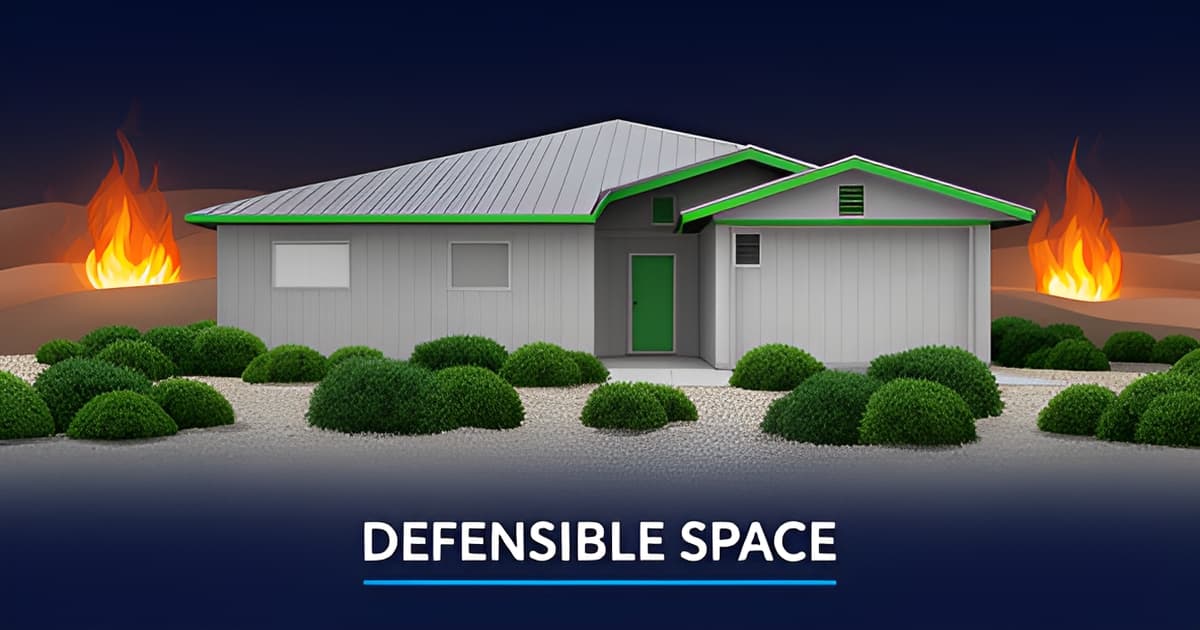
The 0–5 foot perimeter, done right. CAL FIRE calls this "zone zero," and the specification is simple: replace bark mulch and flammable plantings within five feet of the structure with pea gravel or rock over landscape fabric. Embers landing in bark mulch against a wall can ignite siding directly; gravel cannot. Statewide zone zero regulations are currently being drafted under a February 2025 executive order, so expect this to become codified rather than optional.
Fencing and garage doors — the overlooked entry points. A wood fence attached to the house acts as a fuse, carrying fire straight to the structure. CAL FIRE recommends replacing the first eight feet of any attached fence with noncombustible material. Garage doors matter too: weather-stripped doors close the ember-sized gaps that let fire reach everything stored inside.
Prioritize in the right order. There's a common mistake in post-fire rebuilds: spending the budget on premium materials while ignoring cheap, high-impact fixes. As one fire-cost analysis put it bluntly, if your vents are unprotected and your Zone 0 has bark mulch, do not spend $18,000 on fiber cement siding — fix the vents and Zone 0 first, because you'll get more risk reduction per dollar.
- Install ember-resistant vents with 1/16–1/8 inch metal mesh before upgrading siding
- Establish the gravel zone zero perimeter — often a landscaping-scale expense
- Replace attached wood fencing with noncombustible material for the first 8 feet
- Weather-strip garage doors and seal gaps larger than 1/8 inch
The economics favor this sequencing. A California cost study found that an "Enhanced" hardened home — Chapter 7A baseline plus zone zero and under-deck enclosure — adds only about $2,800 to new construction. And starting in 2026, state tax credits of $2,500 to $10,000 will offset fire-resistant upgrades further.
Because installation quality directly determines whether these details actually perform, choosing a builder who understands ember-resistant construction matters as much as the materials themselves. Every listing in the Altadena Builder Directory is license-verified against the California Contractors State License Board — verify any contractor for free before your rebuild, including fire-rebuild specialists like JMB Builders LLC (CSLB #1103479).
Choosing a Fire-Conscious Builder: Verify Before You Sign
A $27,000 fire-resistant roof can fail in minutes if the flashing is wrong. The same holds true across every component of a hardened home: materials only deliver their rated performance when they're installed correctly by contractors who understand wildfire mechanics — and research on fire-resistant building materials confirms that installation quality directly influences actual fire performance, requiring trained contractors to do the work.
That's a real problem in the current rebuild environment. CalMatters reporting on California's home-hardening effort found that local contractors and permitting officials often lack fire-risk knowledge, and fire-resistant materials are specialty products that can be difficult to source in the right sizes. In a post-fire market like Altadena, where dozens of builders are competing for rebuild contracts, homeowners need a way to separate genuine WUI experience from sales pitch.
The good news: the technical bar is well-defined. A fire-conscious builder should be fluent in CAL FIRE's home-hardening specifications — the 1/8-inch gap rule, State Fire Marshal–listed WUI vents with 1/16- to 1/8-inch metal mesh, tempered double-pane glazing, enclosed soffited eaves, and noncombustible zone-zero landscaping within 5 feet of the structure. Ask candidates to explain how they'd detail the deck-to-wall intersection or the gutter-to-fascia connection. Vague answers are a red flag.
Before you sign anything, run these verification steps:
- Confirm the contractor holds an active California license by checking their CSLB license status — the California Contractors State License Board offers a free lookup anyone can use in minutes.
- Ask specifically about Chapter 7A and WUI code experience, since these standards govern new construction in high fire-severity zones and are reviewed every three years.
- Request references from previous fire-zone or rebuild projects, not just general residential work.
- Get the material specs in writing — Class A roofing, fiber-cement or three-coat stucco siding, tempered windows — so substitutions can't quietly downgrade your protection.
The stakes justify the diligence. The Palisades Fire in January 2025 destroyed 6,837 structures, and the homes that survived were built with fiber-cement siding, metal or Class A roofs, double-paned windows, and no vulnerable attic vents or overhangs — detailed by WFCA as real-world proof that correct material and construction choices decide survivability. An IBHS forensic survey in Los Angeles found single features — one tempered-glass window, one stucco wall — likely kept flames at bay on otherwise vulnerable homes.
Because vetting every contractor individually is slow, the Altadena Builder Directory maintains a free registry of Altadena-serving builders — custom home builders, ADU specialists, remodelers, and fire-rebuild specialists — with every listing license-verified against the CSLB and marked with a verification seal once the license match is confirmed. Ratings come only from real attributed public sources, with no paid rankings; featured placements are always labeled. One featured listing is JMB Builders LLC (CSLB #1103479), shown as paid placement.
Every listing in the Altadena Builder Directory is license-verified against the California Contractors State License Board — verify any builder for free before your fire-resistant rebuild, and sign with confidence.
Frequently Asked Questions
Does building a fire-resistant home in Altadena cost a lot more than standard construction?
What siding material gives me the best fire protection for my rebuild?
Why do embers matter more than the flames themselves?
What's 'zone zero' and is it really necessary?
Should I spend my budget on premium siding first, or on smaller details?
Did any homes actually survive the January 2025 Palisades Fire because of their materials?
Build It Once, Build It Right: Your Rebuild's Real Bottom Line
The evidence from the Palisades Fire is unambiguous: homes survive ember storms because of construction details, not luck. A Class A roof, ember-resistant vents with 1/16- to 1/8-inch mesh, enclosed eaves, fiber-cement or three-coat stucco siding, tempered double-pane windows, and a gravel zone zero within five feet of the structure — these choices decide survivability. And the cost myth is busted: California research shows an Enhanced hardened home adds only about $2,800 to new construction, while retrofitting later can run $2,000 to over $100,000. Your next steps are concrete: prioritize vents and zone zero before premium upgrades, get material specs in writing, and ask every builder how they'll close ember entry points — vague answers are a red flag. Then verify credentials before signing. The Altadena Builder Directory makes that easy: every listing is license-verified against the California Contractors State License Board, with a free lookup tool. Browse the directory, confirm your builder's license, and rebuild with confidence.