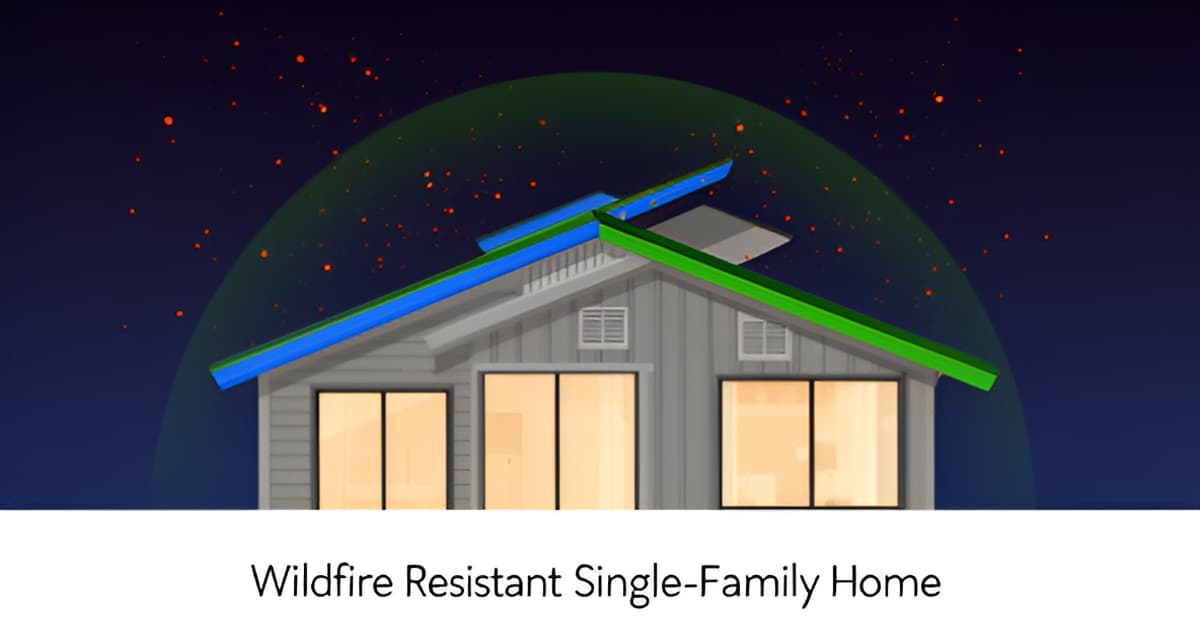
Fire-Resistant Home Design: Materials That Lower Rebuild Risk
Key Facts
- Wind-carried embers, not flames, ignite most homes — traveling more than a mile ahead of the fire front according to wildfire research.
- Homes built to California's wildfire codes are 40% more likely to survive, and FEMA estimates the codes could prevent $24 billion in damages over 75 years per NPR analysis.
- A wildfire-resistant model home cost 2% less than typical construction, with fiber cement siding saving $12,190 over cedar plank according to a Headwaters Economics study.
- Any vent opening larger than 1/8 inch is ember-susceptible, per CAL FIRE, which recommends 1/16–1/8 inch metal mesh screening in official home-hardening guidance.
- Homes combining hardening features with defensible space survived wildfires at roughly 50%, versus 20% for homes with no mitigation at all per a 2026 CDI study.
- Retrofitting fire resistance costs multiples of building it right: $22,010 for a roof and $40,750 for exterior walls according to Headwaters Economics cost data.
- Tempered glass windows are about four times more resistant to breaking during a wildfire than standard annealed glass per CAL FIRE guidance.
The Ember Problem: Why Most Homes Ignite Before the Fire Arrives
When the Eaton Fire swept through Altadena, many homes ignited long before the flames arrived. Wind-carried embers — not the fire front itself — cause most home ignitions, and they can travel more than a mile ahead of the flames, exploiting the smallest weaknesses in a home's envelope.
Embers don't need a dramatic entry point. They slip through attic and underfloor vents, lodge in gutters, and accumulate under eaves. The roof is arguably the most vulnerable area of the home, precisely because it collects embers on its surface and funnels them through vents and gaps. According to CAL FIRE guidance, any vent opening larger than 1/8 inch is susceptible to ember intrusion.
The survival stakes are well documented. Houses built to California's wildfire codes are 40% more likely to survive a wildfire, and FEMA analysis estimates those codes could prevent $24 billion in damages to single-family residences over 75 years. A 2026 California Department of Insurance study found that homes combining hardening features with defensible space survived at roughly 50%, versus 20% for homes with no mitigation at all.
The most common ember entry points include:
- Attic, crawlspace, and under-eave vents with openings larger than 1/8 inch
- Gutters and roof valleys where embers accumulate on debris
- Gaps at roof ridges, edges, and improperly installed tile
- Combustible siding that provides a flame path to windows and vents
Here is the critical catch for Altadena homeowners: more than 7,800 structures destroyed in the Eaton Fire fall outside California's newly designated wildfire hazard zones. Because the maps don't account for house-to-house fire spread, those rebuilds won't be legally required to follow wildfire building codes — even though LA County is strongly encouraging compliance for future resiliency.
That means fire resistance is now a homeowner's choice, not a code mandate. The good news is that partial upgrades aren't enough — homes with incomplete hardening often fare no better than unprotected neighbors, because the weakest link determines survival. Fire resistance must be designed as a complete system, with decisions made at the schematic design stage rather than improvised during construction.
That makes choosing the right builder consequential. The Altadena Builder Directory lists fire-rebuild specialists and design-build firms serving Altadena, with every listing license-verified against the California Contractors State License Board — so homeowners can confirm credentials before entrusting someone with a rebuild that must stand up to the next ember storm.
What Actually Works: The Four Materials That Move the Survival Needle
Embers, not flames, destroy most homes in a wildfire — wind-carried embers travel more than a mile ahead of the fire front, slipping through vents, eaves, and gaps to ignite the structure from the inside. Four material decisions, made together, determine whether that ember storm finds a way in.
- Ember-resistant vents. CAL FIRE reports that attic and underfloor vents with openings larger than 1/8 inch are ember-susceptible, and recommends State Fire Marshal-approved ember-resistant vents or noncombustible metal mesh between 1/16 and 1/8 inch. This is typically the lowest-cost hardening upgrade on the list.
- Class A roofs. California law requires Class A roof coverings — and common, affordable asphalt composition shingles already qualify, as do tile and metal panels. The roof is arguably the most vulnerable area of the home because embers accumulate on surfaces and in gutters, so the assembly around the covering (gutters, soffits, fascia) matters as much as the shingles.
- Noncombustible siding. NIST's post-fire study of the 2018 Camp Fire in Paradise found homes with stucco, masonry, or fiber cement siding were significantly more likely to survive than homes with wood or vinyl. Vinyl melts at 300–500°F, sloughing off to expose wall sheathing, while fiber cement is noncombustible and — per Headwaters Economics — was cheaper than cedar plank in their model home, helping the wildfire-resistant build cost 2% less overall.
- Tempered glass windows. Tempered glass is about four times more resistant to breaking during a wildfire than standard annealed glass, keeping the window intact — and the ember path closed — under radiant heat that would crack ordinary panes.
The catch is that these four work as a system, not a product swap. Homes with only partial upgrades often don't fare better than unprotected neighbors, because the weakest link — a single unscreened vent, an improperly seated tile ridge, a vinyl panel beside a stucco wall — sets the survival odds. That's why these decisions belong at the schematic design stage, when roof assembly, vent placement, glazing, and cladding can be coordinated as one package rather than patched together mid-construction.
For Altadena homeowners rebuilding after the Eaton Fire, the stakes are concrete: houses built to California's wildfire codes are 40% more likely to survive, and FEMA estimates those codes could save $24 billion in damages over 75 years. The research also shows retrofitting is far more expensive than building right the first time — a roof retrofit runs $22,010 and exterior wall work up to $40,750.
Because installation quality matters as much as material choice, verify any contractor before signing. The Altadena Builder Directory is a free, independent registry where every listing is license-verified against the California Contractors State License Board, and its free CSLB lookup tool lets you check any California contractor yourself. Featured listings, such as JMB Builders LLC (CSLB #1103479), are labeled paid placements; ratings come only from attributed public sources.
CTA: Browse license-verified Altadena rebuild contractors at the Altadena Builder Directory — free to use, every listing confirmed against CSLB.
Social proof: Ratings come only from real attributed public sources, and each listing displays a verification seal once its license match is confirmed.
The Cost Surprise: Fire-Resistant Rebuilds Don't Have to Cost More
If you're worried that rebuilding fire-resistant means rebuilding expensive, the research says otherwise. A model home built to wildfire-resistant standards actually cost 2% less than a typical home, according to a Headwaters Economics and IBHS study using RSMeans cost data.
The savings came from an unexpected place: siding. Fiber cement cost less than cedar plank, cutting exterior wall costs by $12,190 — a 25% reduction. As Headwaters researcher Kimiko Barrett told NPR, these are "very, very common, very affordable" materials like asphalt shingles and Hardie plank fiber cement. That's good news for Altadena rebuilds, where fiber cement is widely available.
But honesty requires the other side of the ledger. Individual components do carry premiums:
- Roof upgrades (gutters, vents, soffits, fascia) added $5,860 — 27% — even with Class A asphalt shingles on both homes
- Other wall features like tempered glass and fire-resistant doors added $5,370 (29%)
- Near-home landscaping with rock and fabric added $2,570 — a 210% jump
- Retrofitting an existing home is far pricier: $22,010 for a roof, $40,750 for exterior walls
Two caveats matter. These figures are modeled for a single representative 3-bedroom home and will vary by region and by contractor. And the gap between new construction and retrofit is the real story — hardening a home after it's built costs multiples of doing it right the first time.
That's why the ROI priority order matters more than any single price tag. If your budget is tight, spend it where survival odds improve most:
- Ember-resistant vents first — roughly $1,500, and the cheapest fix for the most common ignition path
- Zone 0 defensible space second — clearing the first five feet around the structure
- Class A roof third — required by California law anyway
- Siding fourth — valuable, but not before the cheaper fixes are done
For Altadena homeowners navigating Eaton Fire rebuilds, the practical takeaway is to get component-level bids early, before schematic design locks in your roof assembly, vent placement, and cladding. The cost anxiety is real — one local homeowner told NPR he was "already maxing out our policy" — but the data shows fire resistance and budget discipline aren't enemies. The Altadena Builder Directory lists license-verified fire-rebuild specialists you can screen for free, with every listing checked against CSLB records before it earns a verification seal.
Your Rebuild Plan: Priorities, Budget Order, and Choosing the Right Builder
Rebuilding after the Eaton Fire isn't a single decision — it's a sequence, and the order matters. A 2026 CDI study found that removing vegetation within 5 feet of a home was associated with a 17% reduction in structure loss, meaning some of the most effective work costs almost nothing. Start there, then move up the budget ladder.
A sensible priority order for Altadena rebuilds looks like this:
- Clear Zone 0 defensible space — remove bark mulch and combustible vegetation within 5 feet of the structure (estimated around $3,000 installed).
- Install ember-resistant vents with openings no larger than 1/8 inch, per CAL FIRE home-hardening guidance — roughly $1,500.
- Meet California's mandatory Class A roof requirement with asphalt shingles, tile, or metal, budgeting for upgraded gutters, soffits, and fascia.
- Choose noncombustible siding — fiber cement is both fire-resistant and, in one Headwaters Economics study, $12,190 cheaper than cedar plank on a model home.
Timing works in your favor here. The same Headwaters study found a wildfire-resistant new build cost 2% less than typical construction, and NPR reports that meeting California's codes adds only "a few thousand dollars" to a rebuild. Retrofitting is the expensive path — up to $40,750 for exterior walls alone — so build it right the first time. LA County is "strongly encouraging" code compliance even where the new hazard maps don't require it, and homes built to these codes are 40% more likely to survive.
The catch: fire resistance is a system, not a shopping list. Homes with partial upgrades often don't fare better than unprotected neighbors, and key decisions — vent placement, glazing, overhangs — must be locked in at schematic design. That means choosing your builder early, and choosing well, under real pressure to move fast.
Before signing anything, verify credentials. California requires contractor licensure through the CSLB, and with rebuild budgets stretched — one Altadena homeowner told NPR, "we're already maxing out our policy" — a licensed, qualified contractor is your cheapest insurance. The Altadena Builder Directory offers a free CSLB license-lookup tool so you can verify any California contractor in minutes, and every listing in the registry is license-verified, with a verification seal shown once a match is confirmed.
CTA_TEXT: Verify your contractor's license free before you sign — use the Altadena Builder Directory's CSLB license-lookup tool. SOCIAL_PROOF_TEXT: Every builder listed in the Altadena Builder Directory is license-verified against the California Contractors State License Board.
Frequently Asked Questions
How do most homes actually catch fire in a wildfire — is it the flames?
Does building a fire-resistant home cost more than a normal rebuild?
I'm rebuilding after the Eaton Fire — am I legally required to follow California's wildfire building codes?
What are the most cost-effective fire-hardening upgrades if my budget is tight?
Is vinyl siding okay if I just upgrade my roof and vents?
How do I make sure my rebuild contractor is actually qualified for fire-resistant construction?
Build It Once, Build It Right: Your Ember-Proof Rebuild Starts Today
The evidence is clear: embers, not flames, destroy most homes, and survival comes down to a coordinated system — ember-resistant vents, a Class A roof, noncombustible siding, and tempered glass, designed together from day one. The cost surprise works in your favor: wildfire-resistant new construction can actually cost less than typical building, while retrofitting later runs up to $40,750 for exterior walls alone. And with homes hardened to California's codes 40% more likely to survive a wildfire, the return on getting it right the first time is hard to ignore. Your next steps are simple: lock in vent placement, glazing, and cladding decisions at schematic design, budget in the priority order that maximizes survival odds, and vet your builder before signing anything. The Altadena Builder Directory makes that last step easy — browse fire-rebuild specialists with every listing license-verified against the CSLB, or use the free license-lookup tool to check any California contractor yourself. Verify before you sign; it's the cheapest insurance your rebuild will ever get.