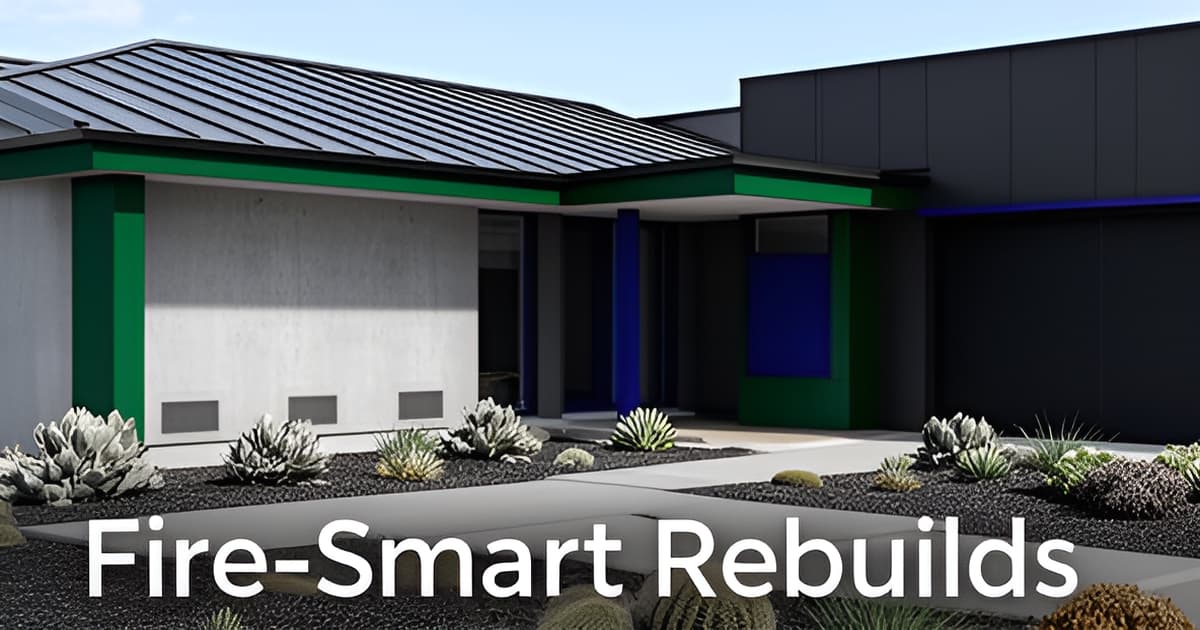
Fire-Resistant Home Rebuilds: Firms and Features That Matter
Key Facts
- Homes built after 2008 under Chapter 7A codes were over three times as likely to survive the Camp Fire than pre-1997 homes, per WUI compliance analysis.
- Home hardening plus defensible space can cut wildfire destruction by up to 50% and double structure survival, a UC Berkeley study found.
- Clearing the 5-foot Zone 0 perimeter around a home alone reduces structure losses by 17%, according to peer-reviewed research.
- Rebuilding to the IBHS Wildfire Prepared Home standard cuts modeled wildfire losses 31–35% at a marginal cost of only ~3%, a landmark CDI/NAIC study found.
- A peer-reviewed study of 679 Marshall Fire rebuilds found advanced wildfire codes were not associated with higher costs per square foot.
- The LA fires caused an estimated $76B–$131B in capital losses, wiping out two-thirds to three-quarters of the county's annual housing supply, per the UCLA Anderson Forecast.
- Simple wildfire retrofits like ember-resistant vents and metal flashing typically run just $2,000–$15,000, a Headwaters Economics/CAL FIRE report found.
The Rebuild Reality: Why Getting It Right the First Time Matters
For Altadena homeowners, the Eaton fire erased more than a neighborhood — it created a once-in-a-generation decision about how to rebuild. The fire destroyed 9,414 structures, part of a disaster that wiped out two-thirds to three-quarters of L.A. County's typical annual housing supply, according to the UCLA Anderson Forecast.
The financial stakes are enormous. Rebuilding costs reach up to $1,000 per square foot in some areas, and the fires caused an estimated $76B to $131B in total capital losses. With a weighted median home price of $2.15 million in the burned areas, few families can afford to rebuild twice.
The rules are also changing mid-stream. California's updated Wildland-Urban Interface Code (CWUIC) takes effect in January 2026, superseding the Chapter 7A standards that governed fire-hardened construction since 2008. The new code mandates home hardening for new construction and post-2008 renovations, plus defensible space for all structures — including a Zone 0 requirement covering the critical 5-foot perimeter around a home, per the WFCA's WUI compliance guide.
Why does getting it right the first time matter so much? Because the evidence shows hardening decisions made at the drafting table determine both survival and insurability:
- Homes built to post-2008 Chapter 7A codes were more than three times as likely to survive the Camp Fire than pre-1997 homes.
- A UC Berkeley study found home hardening plus defensible space can cut wildfire destruction by up to 50% and double structure survival.
- A landmark CDI/NAIC study found rebuilding to the IBHS Wildfire Prepared Home standard could reduce modeled wildfire losses by roughly one-third — at a marginal cost of only about 3% per home.
There's an insurance dimension, too. In Paradise, California — which lost more than 18,000 structures in the Camp Fire — adoption of the Wildfire Prepared Home standard brought insurers back, and some residents saw premiums fall dramatically compared to FAIR Plan pricing. California Insurance Commissioner Ricardo Lara has called resilient rebuilding "the single most powerful lever available to restore a sustainable insurance market in wildfire country."
And the wildfire threat isn't going away. The wildlands where the Eaton and Palisades fires started will regrow to critical fuel load within 10 years, meaning today's rebuild will face this risk again.
That's why the choices made now — and the builder you choose to execute them — carry decades of consequences. The Altadena Builder Directory exists to make that choice easier: every listing is license-verified against the California Contractors State License Board, so homeowners can confirm a firm's credentials before entrusting it with a fire rebuild. In a rebuild this consequential, verification isn't a formality — it's the first line of defense.
What Actually Works: The Three Evidence-Backed Pillars of a Fire-Hardened Home
When wildfire researchers examined why some homes survive and others burn, the answer wasn't luck — it was a specific, repeatable set of design choices. The evidence now points to three pillars that consistently separate hardened homes from vulnerable ones.
The first pillar is WUI-compliant materials. Homes built under California's Chapter 7A codes after 2008 were more than three times as likely to survive the 2018 Camp Fire than homes built before 1997, according to a WUI compliance analysis. That means Class A roofing, one-hour fire-rated eaves and walls, noncombustible siding like fiber cement or stucco, and multi-pane tempered glass windows.
The second pillar is ember-resistant venting. NIST research shows embers can travel several miles, and embers entering vents and chimneys are a major ignition pathway. Vents protected with at least 1/8-inch mesh — a modest upgrade — block this vulnerability at the source.
The third pillar is defensible space, especially Zone 0: the five-foot perimeter immediately surrounding the home. Clearing dead plants, burnable materials, and bark mulch from that zone alone reduces structure losses by 17%, per a peer-reviewed UC Berkeley study. Combined, home hardening plus defensible space can cut wildfire destructiveness by up to 50% and double structure survival.
What makes these pillars practical rather than aspirational is the cost picture. Rebuilding to the IBHS Wildfire Prepared Home standard — the benchmark that reduces modeled Average Annual Loss by 31% at the Base tier and 35% at the Plus tier — adds only about 3% per home beyond minimum code, according to a California Department of Insurance study. A separate peer-reviewed analysis of 679 Marshall Fire rebuilds found advanced wildfire codes were not associated with higher costs per square foot.
For Altadena homeowners planning a rebuild, the specification sheet matters as much as the builder. When evaluating firms, look for fluency in:
- Class A roof assemblies and one-hour fire-rated eaves, walls, and decks
- Noncombustible siding and multi-pane tempered glass windows
- 1/8-inch mesh ember-resistant vents on all openings
- A Zone 0 plan with a clear, noncombustible five-foot perimeter
Because these features work as an integrated system — not as standalone upgrades — it's worth confirming that any contractor you consider can deliver all three. Every listing in the Altadena Builder Directory is license-verified against the California Contractors State License Board, and our free CSLB lookup tool lets you check any California contractor before you sign. Featured listing: JMB Builders LLC (CSLB #1103479), labeled paid placement.
Choosing a Rebuild Firm: Standards Fluency Over Sales Pitches
No source ranks "best" fire-rebuild firms — but the research is clear about what separates qualified builders from smooth talkers. The right firm isn't the one with the loudest pitch; it's the one fluent in the standards that will define your rebuild.
Start with regulatory fluency. California's updated Wildland-Urban Interface Code (CWUIC) takes effect in January 2026, superseding Chapter 7A and mandating home hardening and defensible space, including Zone 0 compliance in Very High Fire Severity zones, per the WFCA's WUI compliance guide. Ask candidates directly about the IBHS Wildfire Prepared Home standard too — its Base and Plus tiers cut modeled wildfire losses by 31–35%, according to a landmark CDI/NAIC study. A builder who can't explain these unprompted is learning on your dime.
Builder type also shapes outcomes. A peer-reviewed study of 679 Marshall Fire rebuilds found production builders deliver faster, less expensive homes — but their fire resilience outcomes vary more than custom builders'. Neither type is inherently better; the difference is whether the firm treats hardening as a system rather than a checkbox.
When interviewing firms, listen for these markers:
- Specifics on ember-resistant vents with 1/8-inch mesh, since ember entry through vents is a major ignition pathway
- A plan for Zone 0 — the 5-foot vegetation-free perimeter that alone reduces structure losses by 17%
- Willingness to spec Class A roofs, noncombustible siding, and tempered multi-pane glass without prompting
- Clarity on whether the finished build qualifies for WPH designation and related insurance discounts
Before signing anything, verify the contractor's CSLB license — every time, no exceptions. The Altadena Builder Directory offers a free CSLB license-lookup tool that lets you confirm any California contractor's status in minutes, with license data attributed to the Contractors State License Board. Listings there display a verification seal only after a license match is confirmed, and ratings come exclusively from real, attributed public sources — never paid rankings.
That diligence matters more than speed. As CalMatters reported on Altadena's rebuild, homeowners can pull permits quickly but abandon plans when costs aren't sorted out. A license-verified builder fluent in CWUIC and WPH standards is the one who gets you from permit to a resilient, insurable home.
ctaText: Browse the Altadena builder registry — every listing license-verified against CSLB. socialProofText: Free CSLB license lookup • No paid rankings, only real public-source ratings • Featured placements always labeled
Controlling Costs Without Cutting Protection
If you're worried that fire-resistant rebuilding will price you out of your own lot, the research says the opposite. One of the biggest fears homeowners bring to a rebuild — that hardened construction carries a punishing premium — simply doesn't hold up in the data.
Consider the evidence. A peer-reviewed study of 679 Marshall Fire rebuilds found that advanced wildfire and energy codes were not associated with higher costs per square foot — hardened homes came in at comparable prices to conventional builds. Meanwhile, the California Department of Insurance and NAIC estimated that building to the Wildfire Prepared Home Plus standard adds a marginal cost of only about 3% per home beyond code, while cutting modeled average annual losses by 35%.
For homeowners upgrading existing houses rather than rebuilding, the numbers are even friendlier. According to a Headwaters Economics report produced with CAL FIRE, simple retrofits — ember-resistant vents, metal flashing, noncombustible mulch — typically run $2,000 to $15,000, and the report's co-authors concluded that "some of the most effective strategies" can be done affordably. Full retrofits to the highest protection level can approach $100,000, but the report notes that approach is often unnecessary.
Budget pressure also eases on the design side. Altadena's Foothill Catalog offers more than 25 county-approved plans, and pre-approved plan catalogs can trim roughly 10% off total development costs for custom single-family homes. Some firms, like Genesis Builders, now sell fixed-price rebuild packages specifically so costs are locked before permits are pulled.
That last point matters more than it may seem. As Devang Shah of Genesis Builders observed, homeowners can pull permits and then abandon their plans when costs aren't sorted out upfront — meaning permit counts can overstate actual rebuilding progress. Getting a firm, all-in price before committing is what separates a finished rebuild from a stalled one.
- Ask builders whether their designs qualify for WPH Base or Plus designation — the insurance and resale implications are significant.
- Request fixed-price or clearly itemized contracts so hardening features aren't value-engineered out mid-project.
- Compare pre-approved plans against fully custom designs; the 10% savings can fund Zone 0 landscaping and vent upgrades.
- Verify any contractor's license before signing — the Altadena Builder Directory offers a free CSLB license-lookup tool that confirms licenses against California Contractors State License Board records, with a verification seal shown once a match is confirmed.
With rebuild costs reaching up to $1,000 per square foot in some Los Angeles areas, per the UCLA Anderson Forecast, every dollar of protection has to be spent deliberately. The good news: the most valuable fire protections — a Class A roof, ember-resistant vents, a clear five-foot Zone 0 perimeter — are among the most affordable items on the entire budget.
Your Action Plan: From Permit to Insurable, Resilient Home
Rebuilding after a wildfire is a once-in-a-lifetime project — and the decisions you make before the first nail gets hammered determine whether your new home survives the next one. The good news: the playbook is now clear, evidence-backed, and more affordable than most homeowners expect.
Step 1: Verify the license before anything else. California makes this easy. The Contractors State License Board maintains public records for every licensed contractor in the state, and the Altadena Builder Directory offers a free CSLB license-lookup tool so you can confirm any firm's credentials in minutes. Every listing in the directory carries a verification seal once a license match is confirmed, and ratings come only from real, attributed public sources — no paid rankings.
Step 2: Write the three feature pillars into your rebuild specs. Don't leave hardening to chance or contractor discretion. Specify exactly what the research says matters most:
- WUI-compliant materials: Class A roofs, noncombustible siding (fiber cement or stucco), multi-pane tempered glass windows, and one-hour fire-rated assemblies for roofs, eaves, and walls.
- Ember-resistant vents with at least 1/8-inch mesh — NIST research shows embers can travel several miles and enter homes through vents, a major ignition pathway.
- Zone 0 defensible space: a clear, vegetation-free 5-foot perimeter, which alone reduces structure losses by 17%.
Step 3: Ask the insurance question early. When interviewing firms, ask directly whether their builds qualify for the IBHS Wildfire Prepared Home (WPH) designation and CDI "Safer from Wildfires" discounts. A landmark CDI/NAIC study found rebuilding to WPH standards cuts modeled wildfire losses by roughly one-third, at a marginal cost of only about 3% per home beyond code. In Paradise, California — the first U.S. municipality to adopt WPH as its rebuild benchmark — insurers returned, and some residents saw premiums fall dramatically compared to FAIR Plan rates.
Step 4: Leverage fast-track permitting. Altadena's rebuild environment is unusually favorable right now. Local governments are issuing permits three times faster than pre-fire norms, and Altadena architect Tim Vordtriede reported planning approvals in three days that would normally take three months. Pre-approved plan catalogs like the Foothill Catalog can trim roughly 10% off total development cost. One caution from practitioner Devang Shah of Genesis Builders: homeowners can pull permits but abandon plans when costs aren't sorted — so nail down your budget before committing.
The Altadena Builder Directory lists fire-rebuild specialists with CSLB-verified credentials, including JMB Builders LLC (CSLB #1103479), a labeled featured placement among license-verified firms. Whether you choose a featured firm or another listed builder, the same rule applies: verify the license, specify the features, and confirm insurability before signing. That's the difference between a rebuild and a resilient one.
Frequently Asked Questions
Does building a fire-resistant home actually cost a lot more than a regular rebuild?
What features really make the difference between a home that survives a wildfire and one that doesn't?
How much does clearing the 5 feet around my house actually matter?
Will a fire-hardened rebuild help me get insurance instead of staying on the FAIR Plan?
What should I look for when choosing a fire-rebuild contractor?
Is it worth retrofitting my existing house instead of rebuilding?
Build Once, Build Right: Your Rebuild's Legacy Starts Now
The evidence is on your side. Homes built to hardened standards were more than three times as likely to survive the Camp Fire, hardening plus defensible space can cut wildfire destruction by up to 50%, and rebuilding to the Wildfire Prepared Home standard costs only about 3% beyond code while cutting modeled losses by roughly a third. The playbook is clear: verify your contractor's license, write the three pillars — Class A roofs, ember-resistant vents, and a five-foot Zone 0 perimeter — into your specs, and confirm your build qualifies for insurance recognition before you sign. With rebuild costs reaching up to $1,000 per square foot in some areas, few families can afford to build twice — and with wildfire fuels regrowing within a decade, the home you build today will face the test again. The Altadena Builder Directory makes the first step easy: every listing is license-verified against the CSLB, and our free lookup tool confirms any California contractor in minutes. Start with the registry, verify the credentials, and build the home that's still standing twenty years from now.