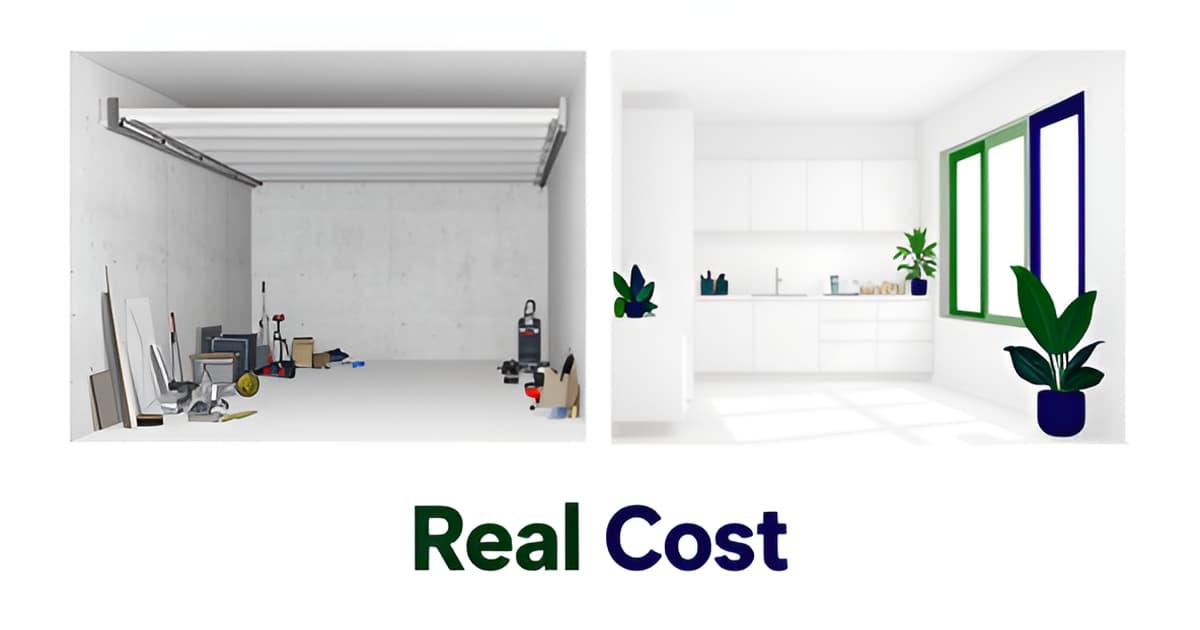
Garage to ADU Cost in California: Line-Item Breakdown
Key Facts
- Most homeowners expect to pay $50,000 for a garage conversion, but a 400 sq ft Southern California project starts around $150,000.
- A realistic budget for a two-car garage conversion in California runs $100,000–$175,000 all-in.
- Garage conversions cost 30–50% less than new detached ADUs, saving an estimated $15,000–$40,000 on foundation work alone.
- An Oakland comparison found a conversion cost about $144,000 versus $242,000 for ground-up construction — roughly 40% less.
- Kitchens are the largest line item at $15,000–$40,000, with bathrooms adding $12,000–$30,000 more.
- Change orders average 10–15% of contract value and are the number-one reason ADU projects exceed budget.
- Garages built before 1930 are usually better demolished and rebuilt within the same footprint, per Maxable's decision rule.
The $50K Expectation Gap: What a California Garage Conversion Really Costs
Most homeowners walk into a garage conversion with a $50,000 number in their head — and walk out with bids three times that size. This is the single most documented pain point in California ADU planning, and it shapes every budget conversation that follows.
The gap is real, not anecdotal. According to California-specific ADU research from Maxable, most homeowners expect to pay roughly $50,000, while a 400 sq ft Southern California conversion realistically starts at about $150,000. That's a threefold mismatch between expectation and market pricing, and it catches families mid-planning when financing is already half-arranged.
So what should you actually budget? Industry data converges on a $100,000 to $200,000 all-in planning band for a two-car garage. ADU Pilot's California analysis puts the typical range at $100,000–$175,000, while Los Angeles builder pricing runs $100,000–$200,000+ for a standard two-car footprint (https://www.adupilot.com/garage-conversion-adu, https://axeconstruction.com/is-a-garage-conversion-adu-worth-it-in-los-angeles-2025-roi-permit-guide/).
Why so high for a structure that already exists? Because conversions still run 30–50% cheaper than new detached construction — the foundation, walls, and roof are already standing, saving an estimated $15,000–$40,000 on foundation work alone (https://gauntletconstruction.com/garage-conversion-adu-cost-calculator/). An Oakland comparison showed roughly $144,000 for a conversion versus $242,000 for ground-up construction — about 40% less (https://www.adupilot.com/garage-conversion-adu).
The paradox is that per-square-foot costs often exceed a normal home build. A conversion carries all the infrastructure of a full house on a tiny footprint:
- A complete kitchen — $15,000 to $40,000, the single largest line item
- A full bathroom — $12,000 to $30,000
- Design, permits, and fees — $8,000 to $15,000, largely fixed regardless of size
- HVAC, electrical, and plumbing systems built for a standalone dwelling
As one ADU economics analysis puts it, "It's the fixed costs of development of an ADU that are expensive. Additional square footage is cheap" (https://www.buildinganadu.com/cost-of-building-an-adu). In a 2,500 sq ft home, that kitchen spreads across the budget. In a 400 sq ft garage, it lands all at once.
Before comparing bids against that planning band, make sure the contractors you're pricing are legitimate — the Altadena Builder Directory lets you verify any California contractor's license for free against CSLB records, so a lowball quote from an unverified source never tempts you back toward that $50K fantasy.
Where the Money Actually Goes: The Line-Item Breakdown
Most homeowners picture a $50,000 garage makeover — then discover a 400 sq ft Southern California conversion actually starts around $150,000, according to ADU industry data. Understanding where every dollar goes is the first step toward a budget that survives contact with reality.
For a typical two-car conversion (400–500 sq ft), 2026 builder pricing shows kitchens and bathrooms dominating the ledger. Kitchens run $15,000–$40,000 and bathrooms $12,000–$30,000 — together often a third or more of the total project. The remaining line items stack up quickly:
- Plumbing: $8,000–$20,000
- Design, permits & fees: $8,000–$15,000
- HVAC (ductless mini-split): $5,000–$15,000
- Structure & foundation work: $5,000–$15,000
- Electrical, insulation, windows/egress, and finishes: $19,000–$46,000 combined
Finish level moves the total more than any other variable. Builder estimates place basic conversions at $80–$130 per square foot, mid-range at $130–$200, and full remodels at $200–$280. By garage size, Los Angeles contractor figures put one-car conversions at $85,000–$170,000 and two-car projects at $100,000–$200,000 or more.
One contradiction deserves attention: permit costs. One California source cites $5,000–$15,000 for permits and fees, while another guide reports $1,500–$3,000 or more. The gap likely reflects jurisdiction and scope differences — budget conservatively and confirm locally.
Treat these figures as industry estimates, not guarantees. Most come from vendor content without disclosed methodology, and change orders average 10–15% on custom builds. Before comparing bids, verify every contractor through the Altadena Builder Directory's free CSLB license-lookup tool — because an itemized quote is only as trustworthy as the builder behind it.
The Four Budget-Killers: Change Orders, Hidden Structure, Finishes, and Opaque Bids
Most garage conversion budgets don't blow up at the contract-signing stage — they blow up in the four places homeowners never see coming. Industry data points to change orders, hidden structural defects, finish creep, and incomplete bids as the reasons a $120,000 project becomes a $160,000 one.
Change orders are the single biggest budget-killer. The industry average for change orders on custom builds runs 10–15% of the contract value, and they're the number-one reason ADU projects go over budget. That's why most experienced planners recommend a 10% contingency on top of your baseline number.
Hidden structural surprises are the second trap, and they're invisible until demolition starts. Slab leveling is the most common surprise in a garage conversion, since existing slabs are often cracked, sloped, or too thin for plumbing cuts. One documented case study found that adding missing footings alone cost roughly $12,000. Moisture issues and low ceiling heights add unplanned costs in older garages as well.
The third trap is the finish package. In one featured Los Angeles project that reached $250,000, custom white oak cabinets and high-end appliances absorbed a meaningful share of the budget — and they're also the line items easiest to scale down. Kitchens ($15,000–$40,000) and bathrooms ($12,000–$30,000) are the largest line items in any conversion, so finish decisions here move the total more than anywhere else.
The fourth trap is the quote itself. Many contractors quote construction cost only — excluding design, engineering, permits, appliances, and site work — so two bids that look $20,000 apart may actually describe identical scopes. Always ask exactly what's included before comparing numbers.
There's also a contrarian question worth asking: is converting even the right move? One architecture firm argues that renovating an existing garage often costs about the same as demolishing it and building new, once structural repairs, slab cuts, and re-framing are counted. Maxable's decision rule is blunt: if your garage was built before 1930, demolition and rebuild is usually the better path — and building within the original footprint still qualifies for conversion's regulatory benefits.
- Budget a 10% contingency for change orders before you sign anything.
- Get a structural assessment of the slab, footings, and moisture history before committing to conversion.
- Demand itemized, all-in quotes that show design, permits, and site work — not construction only.
- Keep the finish package in check; cabinets and appliances are the easiest place to cut.
Every one of these traps gets less dangerous with a vetted contractor. The Altadena Builder Directory verifies every listed ADU builder's license against official CSLB records, so before you accept any bid, run a free license lookup on the contractor you're considering — and if you're comparing firms like JMB Builders LLC (CSLB #1103479), you can confirm the license number yourself in seconds.
California's Regulatory Edge: Rules That Save Garage Conversions Money
California law quietly stacks the deck in favor of garage conversions, and those statutory advantages translate directly into thousands of dollars saved. Under Government Code §66314, cities cannot require you to replace the parking spaces your garage occupied — a rule that alone can eliminate a driveway redesign or a new carport from your budget.
Several other legal advantages compound the savings:
- Setback exceptions for existing garages, which new construction wouldn't qualify for, let you build right up to the footprint you already have.
- Prop 13 treatment: only the added conversion value is reappraised, so property taxes stay lower than they would with a new-build ADU.
- As of 2025, owner-occupancy is no longer required, and fire sprinklers are usually not required for detached conversions.
That said, the law gives with one hand and takes with the other. Compliance requirements carry real cost, and they're non-negotiable. Title 24 energy standards demand roughly R-15+R-5 or R-21 wall insulation, R-30 to R-38 ceilings, and U-0.30 windows, with a heat-pump water heater required for units over 500 square feet. Bedrooms need egress windows of at least 5.7 square feet clear opening, and attached conversions must include 1-hour fire separation using 5/8-inch Type X gypsum — typically a $4,000–$10,000 windows-and-egress line item plus insulation and drywall costs of $6,000–$12,000 on a typical two-car project.
Skipping permits to dodge those costs is a false economy. An unpermitted conversion can block a home sale, void insurance coverage, and force expensive retroactive corrections — so it is never worth skipping. Budget $8,000–$15,000 for design, permits, and fees as a normal, unavoidable cost of doing it right.
Because these code requirements are easy to miss in a bid, it pays to work with a contractor who knows them cold. Before you sign a garage conversion bid, verify your contractor's license for free — the Altadena Builder Directory checks every ADU builder's license against official CSLB records, and its free lookup tool lets you verify any California contractor yourself.
Your Action Plan: Budget, Assess, and Verify Before You Sign
You've seen where the money goes — now here's how to protect it. The homeowners who get burned on garage conversions almost always skip one of five steps, and each one is cheap or free to do.
Start by budgeting realistically: plan for $100,000–$200,000 for a two-car conversion, plus a 10% contingency for change orders, which run 10–15% on custom builds according to industry cost data. Most homeowners expect around $50,000 — but a 400 sq ft Southern California conversion starts at roughly $150,000, a gap that causes real sticker shock per California ADU guidance.
Next, get a structural assessment before you commit to anything. Slab leveling is the single most common surprise in garage conversions, and cracked slabs, poor footings, and moisture issues are the budget-killers hiding under your existing floor. One Portland case study found missing footings alone added roughly $12,000 to a project. If your garage predates 1930, seriously consider demolishing and rebuilding within the same footprint instead.
Then demand itemized, all-in bids. Many contractors quote construction cost only, excluding design, engineering, permits, appliances, and site work — so a bid that looks $30,000 cheaper may just be hiding half the project. Require every quote to break out the kitchen, bathroom, plumbing, permits, and site work as separate lines.
Your checklist before signing anything:
- Set a $100K–$200K budget with a 10% contingency for change orders
- Order a structural assessment — especially slab condition and footings — before design work begins
- Require itemized, all-in bids covering design, permits, appliances, and site work
- Scale down the kitchen and bath finish package first — kitchens run $15,000–$40,000 and bathrooms $12,000–$30,000, and custom cabinets and high-end appliances are the easiest line items to trim
- Verify your contractor's CSLB license before signing — it's free and takes minutes
On that last point: don't rely on a contractor's word or a business card. The Altadena Builder Directory offers a free CSLB license-lookup tool that lets you confirm any California contractor's license against official state records, and every ADU builder listed in the directory — including featured ADU builders like JMB Builders LLC (CSLB #1103479, paid placement) — has already been checked against CSLB data before appearing. An unpermitted or unlicensed conversion can block a home sale and void insurance, so the verification step is never worth skipping.
Budget honestly, assess the structure first, demand transparent bids, trim finishes not function — and verify before you sign.
Frequently Asked Questions
How much does a garage conversion to an ADU actually cost in California?
Why does converting a garage cost so much per square foot compared to building a house?
Is converting my garage cheaper than building a detached ADU from scratch?
What are the most common reasons garage conversion budgets go over?
Should I convert an old garage or demolish it and rebuild?
What California rules make garage conversions more affordable?
Do I need permits for a garage conversion, and how much do they cost?
Key Takeaways
{ "title": "The Bottom Line: Your Garage Is Worth Six Figures — Plan Like It", "content": "The math is clear: a California garage conversion isn't the $50,000 project most homeowners imagine — it's a $100,000–$200,000 investment that still saves 30–50% over building new, thanks to the foundation