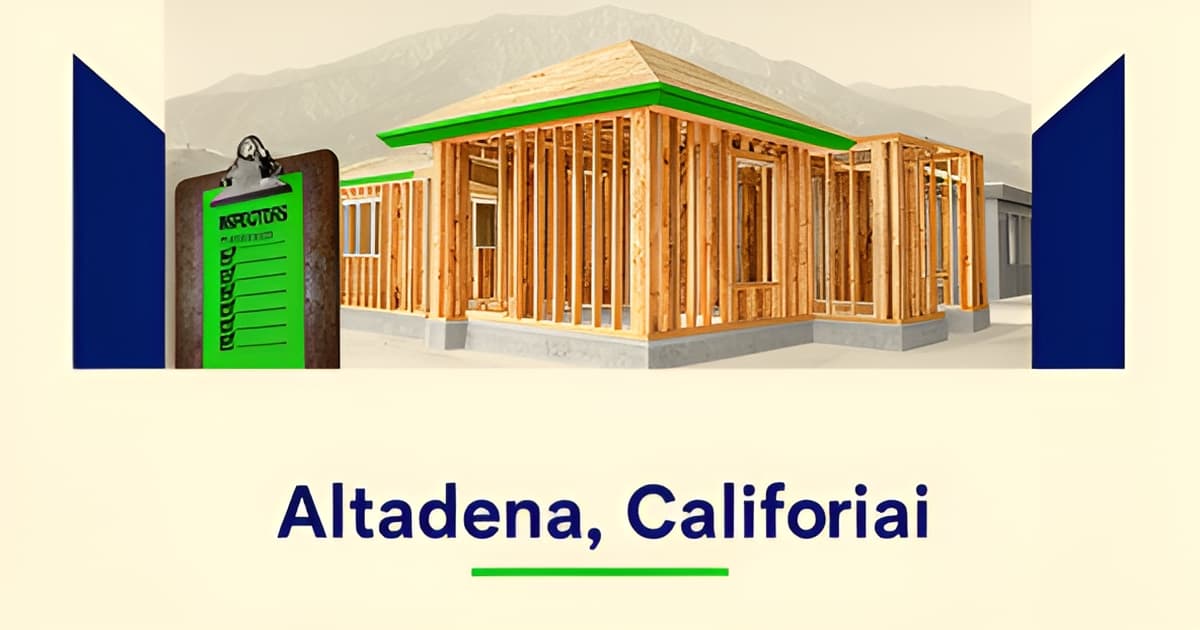
Home Inspections in Altadena, CA: What Inspectors Check and When
Key Facts
- Altadena is unincorporated, so home inspections fall under LA County Building & Safety — not LADBS.
- Every inspection in Altadena must be requested at least 24 hours in advance and happens only during regular working hours, per County rules.
- If work gets covered before passing inspection, the permit holder pays the full cost of uncovering it — the County accepts no liability.
- The most common final-inspection failure is finished construction not matching approved plans — wrong outlets, handrail clearances, egress windows — per Altadena builder guidance.
- Eaton Fire like-for-like rebuilds allow modifications up to 10% or 200 square feet, whichever is greater, under County recovery rules.
- LA County permits expire if work hasn't started within 12 months or lapses more than 180 days, according to Building & Safety.
- The 2025 Title 24 code becomes mandatory January 1, 2026, and your submittal date — not permit issuance — determines which code applies.
Who Inspects Your Altadena Home: Why Jurisdiction Matters First
Before you study a single checklist, you need to answer one question: who actually inspects your home? In Altadena, getting this wrong means preparing for the wrong test.
Altadena is an unincorporated Los Angeles County community, so construction inspections fall under the LA County Department of Public Works Building & Safety division — not LADBS or any city department. This distinction trips up homeowners constantly, especially those rebuilding after the Eaton Fire who find City of LA inspection guides online. Those guides describe a different jurisdiction with different procedures, and following them can leave you unprepared for what the County actually requires.
The County lays out a formal six-step inspection sequence that governs every permitted project in Altadena. According to LA County Building & Safety, the process runs as follows:
- Permit and inspection record card issued and posted at the jobsite
- Permit holder requests each inspection at least 24 hours in advance
- Inspector approves the work or issues a corrections list
- Phased work is inspected before anything gets covered
- Final sign-off on all permitted work
- Certificate of Occupancy issued
Scheduling works differently here too. For unincorporated County areas like Altadena, inspection requests go through the EPIC-LA online portal, with a confirmation email arriving once an inspector confirms. Contract Cities handle it differently — they call their local district office — which is exactly why jurisdiction matters before you pick up the phone.
The 24-hour advance rule deserves emphasis. Every inspection must be requested at least a full day ahead, and inspections happen only during regular working hours. If work gets covered before an inspector approves it, the permit holder bears the full cost of removing and replacing that material — the County accepts no liability for it. That expense adds up fast when drywall has to come back down.
What inspectors actually evaluate is consistent across the County: compliance with the Building Code, conformance with your approved plans, and whether the work matches the permitted scope. Per builder accounts of the Altadena process, the most common final-inspection failure is finished construction not matching approved plans — wrong outlet counts, handrail clearance issues, windows that miss egress requirements.
This is why working with contractors who know the County system matters. The Altadena Builder Directory lists ADU builders, remodelers, and fire-rebuild specialists serving the area, each verified against CSLB license records — a practical first filter when you need someone fluent in County procedures rather than City ones.
For Eaton Fire rebuilds specifically, the County has expedited like-for-like permitting, with inspections scheduled at specific milestones to keep construction moving. In-person support is available at the Altadena Community Center, Monday through Friday, 9 AM to 5 PM.
What Inspectors Actually Check: Code, Plans, and Permitted Scope
When an LA County inspector steps onto your Altadena jobsite, they're not re-designing your project — they're checking three specific things. Understanding those three checks, and the staged sequence they fit into, is what separates a smooth final sign-off from a frustrating corrections list.
According to the County's Building & Safety division, the Building Official reviews permitted work for compliance with the Building Code, conformance with the approved plans and specifications, and whether the work matches the scope of work on the permit. A project counts as complete only once all permitted work passes final inspection. In practice, that means your inspector is comparing three documents against reality: the code, the stamped plans, and the permit itself.
Staged inspections happen before anything gets covered. The County is direct about this: foundation, framing, electrical, plumbing, and mechanical work must all be inspected before being concealed, and "generally, all work will need to be inspected before being covered over." The number of required inspections depends on job complexity, and the inspection record card — issued with your permit and posted at the jobsite — lists exactly which inspections your project requires. Each one must be requested at least 24 hours in advance, and if work gets covered before approval, the permit holder pays to uncover it; the County accepts no liability for removal and replacement costs.
The staged sequence typically looks like:
- Foundation and slab inspections before concrete is poured
- Framing inspection before insulation or drywall
- Rough electrical, plumbing, and mechanical inspections before walls close
- Final inspection, followed by the Certificate of Occupancy
Certain construction types add another layer: Special Inspection under Chapter 17 of the County Building Code (Title 26), which requires continuous or periodic inspection by qualified specialists for specific structural or seismic work. The Building Official may also require additional inspections at their discretion.
Here's the part that trips up most projects. The most common final-inspection failure isn't a hidden code violation — it's finished construction not matching the approved plans, according to builder guidance on the Altadena inspection process. Wrong outlet counts, handrail clearance issues, or windows that don't meet egress requirements all surface at final, when they're expensive to fix. That's why experienced contractors follow a "nothing gets covered until it passes" discipline, documenting each phase as the build progresses.
Because that discipline depends heavily on your contractor, the Altadena Builder Directory verifies every listed contractor's license against CSLB records — so the team holding your inspection record card is one you can trust to keep your build on sequence.
Passing Every Phase: A 'Nothing Gets Covered Until It Passes' Game Plan
The cheapest inspection is the one that passes the first time. LA County Building & Safety — the authority that governs Altadena because it's unincorporated — requires that "generally, all work will need to be inspected before being covered over," and the permit holder is responsible for keeping that work exposed until the inspector approves it (LA County DPW). If covered work must be opened, the permit holder bears the removal and replacement cost, and the County is not liable.
The playbook is simple discipline, applied at every phase:
- Nothing gets covered until it passes. Foundation, framing, electrical, plumbing, and mechanical work stay exposed until each phase is approved.
- Post the permit and inspection record card on site, and keep approved plans there throughout the build — the record card lists the inspections your job's complexity requires.
- Document each pass with photos and signed prerequisite approvals, assembled as you go rather than reconstructed at final.
- Request every inspection at least 24 hours in advance through the EPIC-LA portal, and have the person who scheduled it attend in person.
- Keep address numbers visible from the road — a 4-inch minimum for residential buildings.
The in-person attendance matters more than it sounds. The most common final-inspection failure is finished construction not matching approved plans — wrong outlet counts, handrail clearance issues, windows that don't meet egress requirements (JMB Builders). Someone on site who can answer questions and walk the inspector through the work prevents small discrepancies from becoming corrections lists.
Timing also matters at the code-cycle level. The 2025 Title 24 code becomes mandatory January 1, 2026, and the submittal date — not permit issuance — determines which code applies, so projects aiming for the current cycle should submit well before the deadline. Meanwhile, CALGreen is the sleeper issue: inspectors verify CALGreen notes in the plans before granting final approval, so missing sustainability documentation can hold up an otherwise finished project.
For Eaton Fire rebuilds, the County expedites like-for-like permitting with inspections scheduled at specific milestones, though site clearance must be complete before permits issue (LA County Recovery).
Every listing in the Altadena Builder Directory is license-verified against the CSLB, including fire-rebuild and design-build firms who run this pass-first workflow daily. Featured paid placement: JMB Builders LLC (CSLB #1103479).
socialProofText: Every contractor listing on Altadena Builder Directory is license-verified against the California Contractors State License Board — no paid rankings, only attributed public-source ratings.
ctaText: Browse the free Altadena builder registry and verify any contractor's CSLB license in seconds.
Eaton Fire Rebuilds: Milestone Inspections and County Support
Rebuilding after the Eaton Fire means navigating a permitting and inspection process that differs from standard construction — but Los Angeles County has built a faster path for homeowners rebuilding what they lost.
Under the County's like-for-like rebuild program, homes rebuilt to the same size, location, and purpose as the destroyed structure qualify for expedited permitting. Instead of waiting for traditional phased scheduling, inspections are set at specific milestones that let construction keep moving.
There's an important code distinction. Like-for-like rebuilds must comply with current Building, Fire, and Health and Safety Codes — but they are not held to the current Zoning Code. That means you rebuild to modern safety standards without zoning changes forcing a redesign.
Before any permit issues, your lot must be fully cleared. The County requires both EPA hazardous materials removal and fire debris removal to be complete before building permits are issued. Homeowners pursuing the debris removal program faced a Right of Entry deadline of April 15, 2025.
The County's rebuild process breaks down into four steps:
- Site clearance and plan submission
- Permits
- Construction and milestone inspections
- Move-in
You get flexibility within limits. Eaton Fire area rebuilds allow modifications up to 10% of the structure or 200 square feet — whichever is greater — while still qualifying for the expedited like-for-like path. Push beyond that, and different rules apply, including a 20-foot minimum front yard setback for non-like-for-like rebuilds.
You don't have to figure this out alone. The County operates One-stop Permit Centers and offers in-person support at the Altadena Community Center, located at 730 E. Altadena Drive, Monday through Friday from 9 AM to 5 PM. Staff there can answer questions about site clearance, plan submission, and milestone scheduling specific to your property.
Once construction begins, the standard rules still apply. Each inspection requires at least 24 hours' advance notice, and covered work must stay exposed until it passes — the permit holder covers the cost of reopening anything that was closed in early. The County's inspection process remains the governing framework, so keeping your posted record card and approved plans on site matters just as much during a rebuild.
Choosing a contractor who understands the like-for-like process can prevent costly missteps. Altadena Builder Directory lists fire-rebuild specialists serving the area, each with license data verified against the California Contractors State License Board, so you can confirm credentials before hiring.
Don't Skip Inspections: Protecting Your Home, Budget, and Resale Value
Skipping an inspection might feel like a shortcut today, but in Altadena it's a decision that can cost you thousands in repairs, fines, or a stalled sale. LA County is explicit that periodic inspections are a core component of ensuring your project actually meets code — and the consequences of bypassing them compound quickly.
The stakes are concrete. According to real estate guidance for Altadena homeowners, skipping required inspections can result in costly repairs or fines. Worse, if work doesn't pass inspection and gets covered anyway, the County places the cost of uncovering it squarely on the permit holder — you pay to tear out drywall or concrete just so an inspector can see what should have been checked the first time.
Permits themselves have hard deadlines. Under LA County Building & Safety rules, permit applications expire if no permit is issued within 12 months, and an issued permit expires if work hasn't started within 12 months or lapses more than 180 days. Let a project sit idle and you may be re-applying, re-paying plan check fees, and re-preparing under a newer, stricter code cycle.
The flip side is equally real: properly permitted, inspected work enhances property value at sale. Buyers and their lenders increasingly ask for permit records, and a clean paper trail — approved plans, passed inspections, final sign-off — signals a home built to code. Unpermitted work, by contrast, surfaces during escrow and often becomes the seller's problem to fix.
Before any of this matters, though, you need the right contractor. Here's what to verify:
- A valid CSLB license, checked directly against the state board's records
- Experience with LA County Building & Safety — not LADBS, since Altadena is unincorporated
- A track record of projects that pass final inspection on the first or second attempt
- Willingness to follow the "nothing gets covered until it passes" discipline
The Altadena Builder Directory offers a free CSLB license-lookup tool so you can confirm any California contractor's license before work begins, with license data attributed to the Contractors State License Board. Every listing in the registry — including featured builders like JMB Builders LLC (CSLB #1103479) — carries a verification seal once a license match is confirmed.
An inspection is not an obstacle to your project; it's the proof that your investment is real. Verify your contractor first, schedule every inspection on time, and protect the value you're building — one stamped record card at a time.
Frequently Asked Questions
Who inspects my home in Altadena — LA City or LA County?
How do I schedule an inspection in Altadena?
What do inspectors actually check during an Altadena home inspection?
Can I cover up work before the inspector approves it?
How do inspections work for Eaton Fire rebuilds?
What happens if I skip a required inspection?
Pass Inspection the First Time — Your Altadena Build Depends On It
Navigating home inspections in Altadena comes down to a few essentials: know that LA County Building & Safety — not LADBS — governs your project, request every inspection at least 24 hours ahead through EPIC-LA, and never let work get covered before it passes. Inspectors check three things — code compliance, conformance with your approved plans, and permitted scope — and the most common final-inspection failure is finished construction that doesn't match those plans, per builder guidance on the Altadena process. If you're rebuilding after the Eaton Fire, the County's like-for-like path offers expedited, milestone-based inspections once site clearance is complete. Your next steps are practical: post your permit and record card on site, keep approved plans available, document each phase as you go, and work with a contractor fluent in County procedures. The Altadena Builder Directory makes that last part easier — every listing is license-verified against CSLB records, and the free lookup tool lets you confirm any California contractor's credentials in seconds before work begins. Verify first, schedule on time, and protect the value you're building.