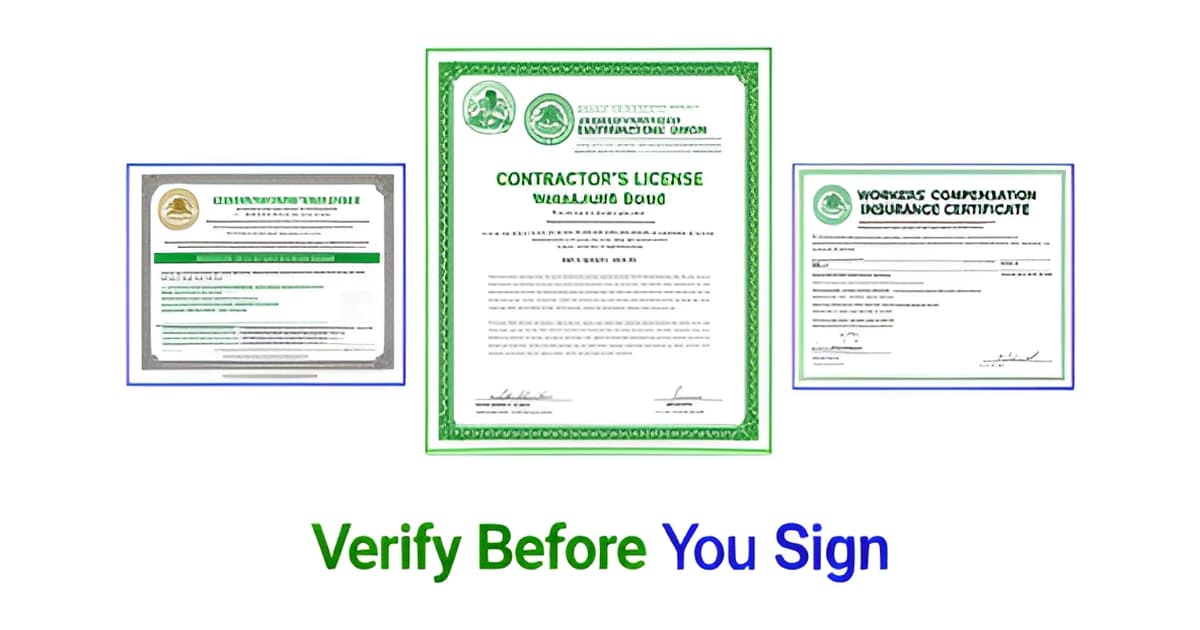
How to Verify a Contractor Is Licensed and Insured in California
Key Facts
- A license number on a truck or business card proves nothing — CSLB warns a displayed number doesn't guarantee validity, so verify status via its official consumer guidance.
- California caps contractor down payments at $1,000 or 10% of the contract price — demanding more is a misdemeanor with fines up to $5,000, per the Riverside County DA.
- Unlicensed contracting penalties in California reach $15,000 in fines and 6 months in jail, with mandatory 90-day sentences for repeat offenders, prosecutors report.
- A September 2024 Menifee sting cited 12 individuals with illegal bids ranging from $2,300 to $31,590, according to the DA's office.
- California's unlicensed-work threshold doubled from $500 to $1,000 on January 1, 2025 under AB 2622, compliance guidance notes.
- Workers' comp becomes mandatory for all licensed California contractors by January 1, 2028, with verification phases starting in 2026, industry analysts explain.
- Every licensed California contractor carries a $25,000 bond — but CSLB cautions it's a recovery mechanism for misconduct, not a competence guarantee, per state guidance.
Why a License Number Alone Isn't Enough
A license number on a business card, truck door, or website can look reassuring — but it proves very little on its own. The California Contractors State License Board itself warns that seeing a license number doesn't necessarily mean the license is valid, and it urges homeowners to check status online or by calling (800) 321-CSLB before signing anything.
The gap between "has a number" and "is properly credentialed" carries real financial consequences. If a worker is injured on your property and the contractor lacks insurance, you could be financially liable for injuries and rehabilitation costs. And because general liability insurance isn't legally required in California, hiring someone without coverage can leave you with no way to pay for property damage the crew causes.
Unlicensed work also strips away your recourse entirely. California's $25,000 contractor license bond is a recovery mechanism for homeowners harmed by licensed-contractor misconduct — abandonment, defective work, contract violations — but it's not insurance, and it won't protect you if the person you hired was never licensed in the first place. Even with a valid license, CSLB cautions that bonds don't assure a contractor's financial or professional integrity, and $25,000 can fall short on larger projects like ADUs or fire rebuilds.
The stakes are rising. Contractor fraud, unfinished work, and insurance disputes increased in late 2024 and throughout 2025, with labor shortages pushing more unlicensed individuals to advertise through social media and neighborhood apps. CSLB describes unlicensed contractors as lacking accountability with a high rate of involvement in construction scams, and enforcement is active: a September 2024 sting in Menifee led to 12 individuals being served notices to appear in criminal court, with illegal bids ranging from $2,300 to $31,590.
Before you sign, verify four things — not just the number:
- The license status is ACTIVE in the CSLB lookup, with no unresolved complaints
- A $25,000 contractor bond is on file
- Workers' compensation coverage is current if the contractor has employees
- The license classification actually matches your project scope
If a number doesn't come up at all — expired, cancelled, inactive, or never issued — treat that as a stop sign. A Certificate of Insurance sent directly from the insurer, not a photocopy handed over on the spot, is the only documentation worth accepting.
This is why every listing in the Altadena Builder Directory is verified against CSLB records and displays a verification seal once a license match is confirmed. You can also use the directory's free CSLB license-lookup tool to check any California contractor yourself — including JMB Builders LLC (CSLB #1103479), one of our featured fire-rebuild specialists — before a single dollar changes hands.
The Four-Pillar License Check: Status, Bond, Workers' Comp, and Classification
A license number printed on a business card or truck decal proves nothing. The CSLB itself warns that seeing a license number doesn't necessarily mean the license is valid — which is why a complete verification covers four distinct pillars.
Pillar one: confirm ACTIVE status. Run the contractor through the CSLB's Check a License tool or call (800) 321-CSLB (2752). The lookup shows license information including complaint disclosure, and CSLB data refreshes weekly. If a number doesn't come up at all, compliance guidance is blunt: the license is expired, cancelled, inactive, or was never issued — treat that as a stop sign.
Pillar two: the $25,000 bond. Every licensed California contractor must carry a $25,000 contractor license bond on file. Understand what it actually is: a recovery mechanism that pays homeowners harmed by contractor misconduct — abandonment, defective work, contract violations — not insurance, and not proof of competence. CSLB cautions that bonds "do not assure the financial or professional integrity or competency of a contractor," and $25,000 can fall short on larger projects like ADUs or fire rebuilds if multiple complaints share the pool.
Pillar three: workers' compensation. Contractors with employees must carry workers' comp, and certain classifications — including C-39 Roofing, C-20 HVAC, C-8 Concrete, and C-22 Asbestos Abatement — must carry it regardless of employee count. If an uninsured worker is injured on your property, CSLB warns you could be financially liable for injuries and rehabilitation.
Two developments matter here. Under SB 216 (delayed by SB 1455), workers' comp becomes universally mandatory for all licensed contractors by January 1, 2028, with verification phases starting in 2026. And beware "ghost policies" — minimum-premium, zero-payroll policies that produce a certificate of insurance for bids but pay no actual claims.
Pillar four: classification must match the job. The license classification tells you what the contractor is legally allowed to do:
- B — General Building: ADUs, additions, remodels, custom homes
- C-10 — Electrical
- C-36 — Plumbing
- C-39 — Roofing
A C-39 roofer legally cannot frame your ADU; a B general contractor can pull the whole project but must subcontract specialty trades. Also ask to see the pocket license and picture I.D. to confirm the person matches the license.
The Altadena Builder Directory runs every listed contractor through this same four-pillar framework against CSLB records, displaying a verification seal only once a license match is confirmed. You can run any California contractor through the free CSLB license-lookup tool yourself before you sign — every listing in the Altadena Builder Directory is license-verified against CSLB data, so the groundwork is already done when you start comparing bids.
Verifying Insurance the Right Way: Certificates Direct from the Insurer
A photocopy of an insurance certificate can be edited, expired, or entirely fabricated — and the contractor handing it to you has every incentive to make it look legitimate. That's why insurance professionals consistently advise homeowners to request a Certificate of Insurance sent directly from the insurer, never a copy from the contractor's truck.
Here's the catch many California homeowners don't know: general liability insurance is not legally required in California. The CSLB's consumer guidance is explicit — because the state doesn't mandate it, you must ask the contractor directly how property damage will be covered if they don't carry it. CSLB also requires that any insurance information appear in your written contract.
Requesting the certificate the right way is simple. Ask the contractor for their broker or insurer's contact information, then call or email and request the COI be sent to you directly. Verify that the policy is active, the coverage limits fit your project's scale, and the policyholder name matches the name on the contractor's license and contract. As Good Housekeeping's Dan DiClerico told KCRA, "Don't take their word for it. You have to get a copy before you sign that contract."
Workers' compensation deserves the same skepticism, because a certificate alone doesn't guarantee real coverage. Industry experts warn about "ghost policies" — minimum-premium, zero-payroll policies that produce a valid-looking COI for bids and contracts but, as workers' comp specialists explain, "provide no actual benefits or claim payouts."
To confirm workers' comp is real, not just paper:
- Check the CSLB license record, which shows whether active workers' comp coverage is on file.
- Ask the insurer directly whether the policy covers payroll employees or is a zero-payroll ghost policy.
- Confirm mandatory coverage for high-risk classifications — C-39 Roofing, C-20 HVAC, C-8 Concrete, C-22 Asbestos Abatement, and C-61/D-49 Tree Service require workers' comp regardless of employee count.
The stakes are real: CSLB warns that if a worker is injured on your property and the contractor lacks insurance, you could be financially liable for injuries and rehabilitation. California's rules are also tightening — a universal workers' comp mandate takes effect January 1, 2028, with verification phases beginning in 2026. Until then, the burden of verification falls on you.
The Altadena Builder Directory makes the license side of this easier — every listing in our free registry is verified against CSLB records before it earns a verification seal, and our CSLB license-lookup tool lets you confirm any California contractor yourself. Pair that with an insurer-issued COI, and you've closed the two biggest gaps in contractor verification.
Red Flags and Fraud Screens Before You Sign
Some red flags don't announce themselves — they arrive as a friendly handshake, a lowball bid, and a request for cash up front. Knowing which warning signs matter legally can save Altadena homeowners thousands of dollars and months of disputes.
The clearest screen is the down payment. California caps down payments at the lesser of $1,000 or 10% of the contract price, and a contractor who demands more is committing a misdemeanor punishable by fines up to $5,000. If a bid starts with an oversized deposit, walk away.
Unlicensed operators carry their own risks. Under California law, contracting work over $1,000 in combined labor and materials requires a license — a threshold raised from $500 on January 1, 2025 under AB 2622. Penalties are real: administrative fines up to $15,000, up to six months in jail, and mandatory 90-day jail terms for repeat offenders. In a September 2024 sting in Menifee, the Riverside County District Attorney's office reported 12 individuals cited with illegal bids ranging from $2,300 to $31,590.
The license number itself deserves scrutiny. CSLB warns that seeing a number doesn't mean the license is valid, and compliance guidance is blunt: if a number doesn't come up at all — expired, cancelled, inactive, or never issued — treat that as a stop sign. Run any candidate through a CSLB license lookup before signing anything; the free lookup tool in the Altadena Builder Directory lets you confirm any California contractor's license in minutes.
Before signing, also check:
- Permits pulled under the same business name as your contract — a mismatch suggests a front or a borrowed license.
- At least three written bids, so you can spot outliers that are suspiciously high or impossibly low.
- A $25,000 contractor license bond on file — a recovery mechanism, not a guarantee of competence.
- A Certificate of Insurance sent directly from the insurer, not a photocopy handed over on the job site.
Fraud pressure is rising. Contractor scams, unfinished work, and insurance disputes increased in late 2024 and through 2025, and labor shortages have pushed more unlicensed individuals to advertise on social media and neighborhood apps. As one insurance industry analysis put it, the biggest mistake homeowners make is rushing — a few extra steps before hiring can prevent thousands in losses.
Every listing in the Altadena Builder Directory is license-verified against CSLB records, with a verification seal shown once a license match is confirmed. Ratings come only from real, attributed public sources — never paid rankings.
Verify Any California Contractor in Minutes
You have the license number in hand — but as CSLB warns, seeing a number doesn't mean the license is valid. The good news: a complete verification takes minutes if you know what to check. Here is the pre-signing checklist that covers every base.
Start with the free CSLB Check a License tool, which confirms license information including complaint disclosure. Enter the contractor's name or number (license numbers run 4 to 8 digits, and CSLB data refreshes weekly, per this compliance guide). If no record comes up, treat that as a stop sign — the license may be expired, inactive, or never issued.
Once the record loads, confirm four things before signing anything:
- Active status — not expired, suspended, or inactive
- A $25,000 bond on file — a recovery mechanism for misconduct, not a competence guarantee
- Current workers' compensation coverage (mandatory for roofing, HVAC, concrete, asbestos, and tree service work regardless of employee count)
- A classification matching your job — B (General Building) covers ADUs, additions, and remodels
Then handle insurance separately. Request a Certificate of Insurance sent directly from the insurer — never a photocopy from the contractor. And screen the contract itself: California caps down payments at $1,000 or 10% of the price, whichever is less, and asking for more is a misdemeanor red flag.
For Altadena homeowners, the Altadena Builder Directory streamlines the first step. Every listing — ADU builders, remodelers, custom home builders, and fire-rebuild specialists — is license-verified against CSLB records and displays a verification seal once the license match is confirmed. The free directory lookup tool lets you double-check any California contractor yourself, with license data attributed directly to the CSLB.
The directory's featured placement, currently JMB Builders LLC (CSLB #1103479), is always labeled as paid — rankings come only from real, attributed public sources. That transparency matters: as one home improvement expert puts it, never take a contractor's word for it — get proof before you sign.
A few minutes of verification now protects you from the outcomes that cost homeowners thousands: uninsured worker injuries on your property, voided claims, and no recourse for defective work. Run the check, request the insurer-sent COI, and sign only when every box is confirmed.
Frequently Asked Questions
Is a contractor's license number enough proof they're legit in California?
How do I check if a California contractor's license is still active?
What should I do if a contractor asks for a big down payment?
Do California contractors have to have general liability insurance?
Am I liable if a worker gets hurt on my property?
What does the $25,000 contractor bond actually protect me from?
Your Signature Is the Last Line of Defense
Verifying a contractor in California comes down to four pillars: an ACTIVE license in the CSLB lookup, a $25,000 bond on file, current workers' compensation coverage, and a classification that matches your project scope. Add one more habit — a Certificate of Insurance sent directly from the insurer, never a photocopy from the job site — and you've closed the biggest gaps that leave homeowners liable for injured workers, property damage, and defective work with no recourse. The stakes are real: CSLB warns that if an uninsured worker is hurt on your property, you could be financially liable for injuries and rehabilitation. With contractor fraud rising and unlicensed operators increasingly advertising on social media and neighborhood apps, a few minutes of verification before signing can prevent thousands in losses. Start with the Altadena Builder Directory — every listing is license-verified against CSLB records, and the free CSLB license-lookup tool lets you confirm any California contractor yourself. Run the check, request the insurer-sent COI, and sign only when every box is confirmed.