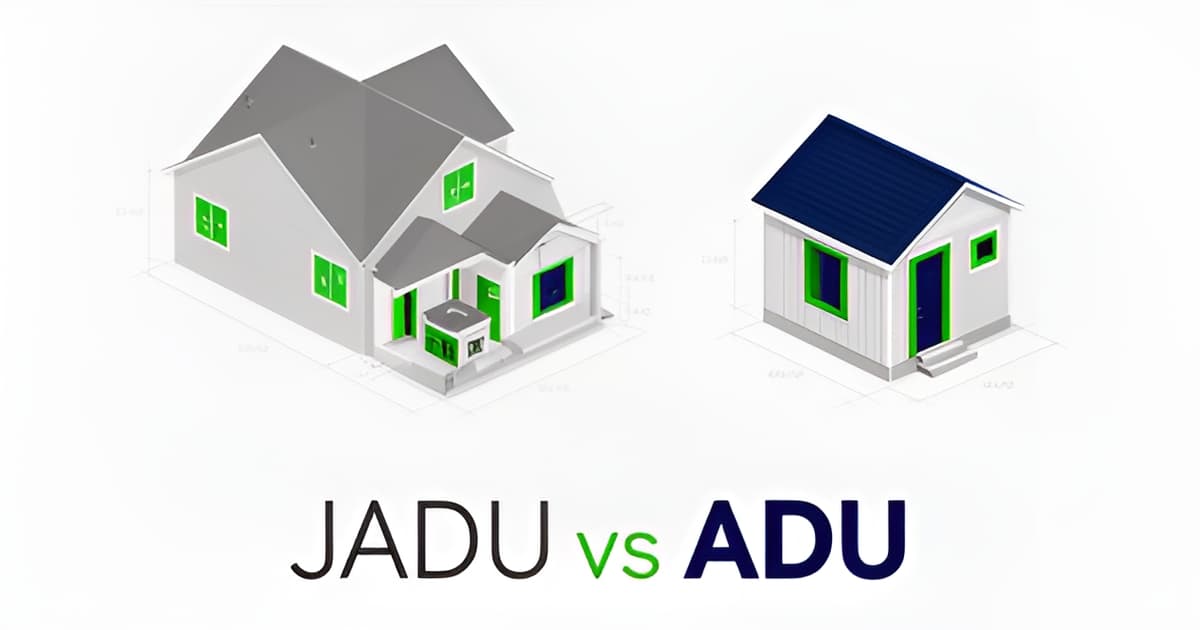
JADU vs ADU in California: Requirements and Cost Differences
Key Facts
- JADUs are capped at 500 square feet of interior livable space and must sit inside a single-family home or accessory structure per the City of LA.
- Jurisdictions cannot apply standards that would prohibit a standard ADU of at least 800 square feet under state law.
- New legislation eliminates development impact fees for ADUs of 750 square feet or less — and every JADU qualifies automatically per legal analysis.
- JADUs may share a bathroom with the main house and need only an efficiency kitchen, which the City of LA calls a significant cost-reduction factor.
- Starting January 1, 2026, AB 1154 requires owner-occupancy only when a JADU shares a bathroom with the main house under new legislation.
- ADU permits must now be approved or denied within 60 days, down from the previous 120-day timeline per the City of LA.
- California allows one ADU and one JADU on the same lot — but both must be rented for terms longer than 30 days per recent legislation.
Which Unit Fits Your Property: The JADU vs ADU Decision Altadena Homeowners Face
Two acronyms, one letter apart — and in Altadena, that single letter changes what you can build, what it costs, and how you can rent it. Junior ADUs and standard ADUs sound interchangeable, but California law treats them as entirely different categories with separate rules, size limits, and financial implications.
The legal distinction comes down to size and location. A JADU is capped at 500 square feet of interior livable space and must sit within an existing or proposed single-family home or an accessory structure like a garage, according to the City of Los Angeles. A standard ADU, by contrast, is a standalone unit protected up to at least 800 square feet — jurisdictions cannot apply standards that would prohibit an ADU of that size.
That difference cascades into everything else. Because a JADU lives inside your existing walls, it may share a bathroom with the main house and needs only an "efficiency kitchen" — which the City of LA calls "a significant cost-reduction factor." A standalone ADU requires full independent systems, but delivers more living space and greater rental flexibility.
The fee picture also diverges sharply. Under recently signed legislation, development impact fees are eliminated for ADUs of 750 square feet or less — but since every JADU is by definition 500 square feet or smaller, every JADU qualifies for the exemption automatically. An ADU between 751 and 800 square feet can still trigger fees.
So which unit fits your property? The decision usually hinges on three questions:
- Space needs: A garage conversion or spare bedroom suits a JADU; a backyard footprint suits an ADU.
- Budget: JADUs cost less because they reuse existing structure, share utilities, and skip impact fees entirely.
- Rental goals: Both unit types must be rented for terms longer than 30 days — short-term rentals are prohibited.
Owner-occupancy rules add another layer. Historically, JADU owners had to live on the property, but AB 1154 — effective January 1, 2026 — narrows that requirement to JADUs that share a bathroom with the main house. A JADU with its own bathroom frees the owner to live elsewhere.
One more option worth knowing: California law allows one ADU and one JADU on the same lot, so you may not have to choose at all. For Altadena homeowners weighing either path, the Altadena Builder Directory offers a free CSLB license-lookup tool to verify any California contractor before committing to a conversion — every listing in the registry is license-verified against the California Contractors State License Board.
The Rules That Drive Cost: Why JADUs Are Almost Always Cheaper
Why can two backyard housing projects on identical lots carry dramatically different price tags? The answer lies almost entirely in the rules — not the lumber.
The single biggest cost lever is what a JADU doesn't have to include. Under the City of Los Angeles' framework, a JADU may share a bathroom with the main house and needs only an "efficiency kitchen" rather than a full one — allowances the city itself calls "a significant cost-reduction factor" (adu.lacity.gov). A standard ADU, by contrast, is a self-contained unit with its own full bathroom and kitchen.
The second lever is fees. Recent legislation eliminates development impact fees for ADUs of 750 square feet or fewer and for JADUs of 500 square feet or fewer, and exempts units of 500 square feet or less from school impact fees as well (legal analysis of the 2025 ADU bills). Because every JADU is capped at 500 square feet of interior livable space, every JADU qualifies for both exemptions automatically. An ADU between 751 and 800+ square feet can still trigger fees.
Here's how the regulatory levers stack up:
- Shared bathroom allowed for JADUs — full plumbing rough-in for a second bathroom avoided
- Efficiency kitchen requirement instead of a complete kitchen buildout
- 100% fee exemption for JADUs; ADUs exempt only up to 750 sq ft
- No new land purchase for either unit type, per the City of LA
One nuance worth knowing: as of AB 1154 (effective January 1, 2026), owner-occupancy applies only when the JADU shares a bathroom with the main dwelling. Build the JADU with its own bathroom and the owner no longer needs to live on the property — but you give up the shared-bathroom savings that make a JADU cheap in the first place (the BBK legal alert).
The trade-offs are real. JADUs cannot exceed 500 square feet, and they — like most ADUs — must be rented for terms longer than 30 days; short-term rental use is prohibited. If your plans involve Airbnb-style income, neither unit type works.
Whichever path fits your lot and budget, the contractor you hire matters as much as the rules. The Altadena Builder Directory lists ADU and JADU builders serving Altadena, with every listing checked against CSLB records — and homeowners can run any California contractor through the free license-lookup tool themselves before signing anything.
New for 2026: Owner-Occupancy and Permitting Rules Have Changed
If you've been putting off a JADU project because of the owner-occupancy requirement, 2026 is the year to take a fresh look. Under AB 1154, effective January 1, 2026, owner-occupancy is now required only when the JADU shares a bathroom with the main house.
That's a meaningful shift. Historically, state law required the JADU owner to reside in either the JADU or the remaining portion of the single-family structure — a constraint that made JADUs unworkable for many investors and absentee owners. Now, if your JADU has its own bathroom, the owner need not live on the property at all. Combined with the fact that JADUs are fully exempt from development impact fees (every JADU qualifies, since all are capped at 500 square feet of interior livable space), self-contained JADUs have become a far more attractive option for rental-focused homeowners.
One caution: a lot of the guidance still circulating online is stale. Some older summaries, including City of Los Angeles materials, state that SB 13 prohibits owner-occupancy requirements "until 2025" — language that no longer reflects current law. If you're reading a JADU guide that doesn't mention AB 1154, treat it as outdated and verify against the California Department of Housing and Community Development's ADU resources before making decisions.
Permitting has also gotten faster, which matters whether you're building a JADU or a full ADU:
- Permits must be approved or denied within 60 days, down from the previous 120-day timeline.
- Agencies must issue a completeness determination within 15 business days under SB 543.
- Appeals must be resolved within 60 business days.
Another rule worth knowing: California allows up to one ADU and one JADU on the same residential lot, and SB 543 confirms a single-family property can combine a converted ADU and JADU with a detached ADU. For homeowners thinking about long-term rental income, that's a path to two units on one lot — though keep in mind JADUs must be rented for terms longer than 30 days, so short-term rental use is off the table.
If you're weighing these new rules against a specific property in Altadena, it pays to work with a contractor who's current on the 2026 changes. The Altadena Builder Directory lists license-verified ADU and JADU builders — every listing is checked against the California Contractors State License Board, and you can run a free license lookup on any contractor you're considering before signing anything.
The bottom line: between relaxed owner-occupancy, faster permit timelines, and the ADU-plus-JADU combo allowance, the regulatory math for small secondary units changed significantly heading into 2026.
Your Next Steps: Choosing, Planning, and Hiring a Verified Builder
Deciding between a JADU and an ADU comes down to your space, your budget tolerance for shared amenities, and your long-term goals — and the good news is you don't always have to choose just one.
Start by assessing your property. A JADU works best if you have under 500 square feet of interior livable space inside your existing home or an accessory structure like a garage, and you're comfortable with the cost-saving trade-offs: a shared bathroom with the main house and an efficiency kitchen, which the City of LA calls a significant cost-reduction factor. A full ADU makes more sense if you want a standalone unit — remember, jurisdictions cannot apply standards that would prohibit at least an 800 sq ft ADU, and every JADU is exempt from development impact fees while ADUs are exempt only up to 750 sq ft.
Next, ground yourself in the current rules before you talk to a contractor. The California HCD ADU Handbook and portal is the authoritative starting point, and note that several laws changed recently: under AB 1154, effective January 1, 2026, owner-occupancy is only required when your JADU shares a bathroom with the main house. Permits must now be approved or denied within 60 days, and JADUs cannot be rented for stays of 30 days or less — important if rental income is part of your plan.
Your quick decision checklist:
- Under 500 sq ft inside the existing structure, budget-focused? Lean JADU.
- Want a standalone rental with full amenities? Lean ADU.
- Maximizing density? California allows one ADU and one JADU on the same lot.
- Planning long-term rentals only? Both unit types require terms longer than 30 days.
That last point deserves emphasis: you can build both a JADU and an ADU on the same residential lot, and SB 543 confirms a single-family lot may even combine a converted ADU and JADU with a detached ADU. For Altadena homeowners rebuilding after the fires, that's a rare opportunity to add two units in one project.
Before you sign anything, verify your contractor's CSLB license — especially critical for fire-rebuild work, where unlicensed operators follow demand. The Altadena Builder Directory offers a free CSLB license-lookup tool, and every listing in the registry is license-verified against the California Contractors State License Board, with ratings drawn only from real, attributed public sources. Featured placements — such as JMB Builders LLC (CSLB #1103479) — are always clearly labeled as paid.
Take the assessment first, confirm the rules second, and verify your builder third. In that order, your project starts on solid ground.
Frequently Asked Questions
What's the actual difference between a JADU and an ADU in California?
Why is a JADU cheaper to build than an ADU?
Do I still have to live on my property if I build a JADU?
Can I rent my JADU or ADU on Airbnb for short stays?
Can I build both a JADU and an ADU on the same lot?
How long does it take to get an ADU or JADU permit approved in California?
One Letter, Two Very Different Projects: Your Next Move
The gap between a JADU and an ADU comes down to rules, not preferences. JADUs stay under 500 square feet of interior livable space, can share a bathroom and use an efficiency kitchen — allowances the City of Los Angeles calls a significant cost-reduction factor — and every JADU automatically skips development impact fees. ADUs deliver more space and independence but face fee exposure above 750 square feet. With AB 1154 effective January 1, 2026, owner-occupancy now applies only to JADUs sharing a bathroom, permits must be decided within 60 days, and one ADU plus one JADU can share a single lot. Your next steps: assess your space, confirm current rules through the California HCD ADU Handbook, and verify your builder's license before signing anything. The Altadena Builder Directory makes that last step easy — every listing is license-verified against the CSLB, and the free license-lookup tool lets you check any California contractor yourself. Browse the directory and start your project on solid, verified ground.