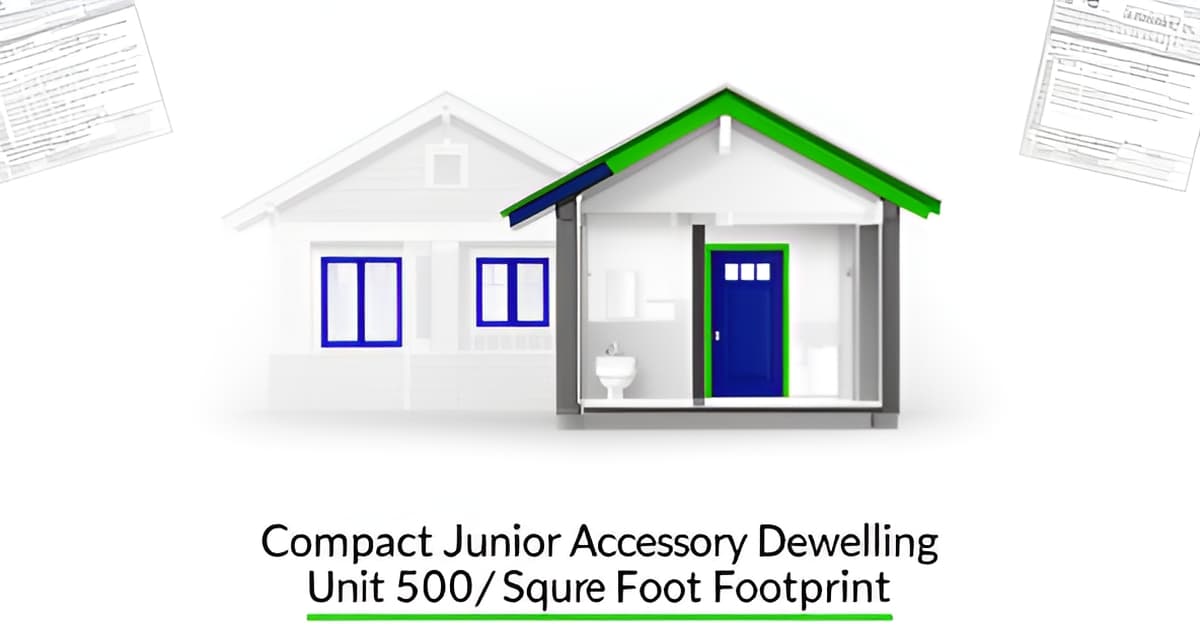
Junior ADUs in California: Owner-Occupancy and Permit Basics
Key Facts
- As of January 1, 2026, California JADU owner-occupancy applies only when the unit shares a bathroom with the main house, per legal analysis of AB 1154.
- JADUs are capped at 500 square feet of interior livable space, a definition clarified by SB 543 according to Nixon Peabody's legislative review.
- SB 543 exempts JADUs of 500 square feet or less from both development impact fees and school fees per statutory analysis.
- Every JADU must be rented for terms longer than 30 days — short-term rentals are banned unconditionally under AB 1154 per California YIMBY.
- Cities must complete a JADU application completeness review within 15 business days and approve or deny within 60 days per legislative review.
- Under AB 1332, JADU applications using city preapproved plans face a compressed 30-day decision deadline per Nixon Peabody.
- SB 543 confirms one single-family lot can combine a JADU with both a converted ADU and a detached ADU per legal analysis.
Why JADU Rules Confuse Homeowners: The Owner-Occupancy Question
Ask three homeowners in Altadena whether you have to live on your property to build a Junior ADU, and you will likely get three different answers. The confusion is real — and it traces back to how quickly California's ADU laws keep changing.
For years, JADUs carried an unconditional owner-occupancy requirement: the property owner had to live on-site, in either the main house or the JADU itself. Many older articles and builder blogs still state this as current law, telling readers flatly that you cannot move out and rent both the main house and the JADU. That advice was accurate once — but it no longer reflects the statute.
The turning point is AB 1154, signed October 10, 2025 and effective January 1, 2026. Under the amended law, the owner-occupancy requirement now applies only when the JADU shares a bathroom with the main house. If your JADU has its own bathroom, you do not need to live on the property at all — a change that aligns JADUs with standard ADUs, which shed owner-occupancy rules statewide back in 2020.
The result is a landscape where outdated and current information sit side by side on page one of any search. Homeowners planning a bedroom or garage conversion can easily base a major financial decision on rules that expired months ago. The stakes are real:
- A shared-bathroom JADU still requires owner occupancy; an independent-bathroom JADU does not.
- JADUs are capped at 500 square feet of interior livable space, clarified by SB 543.
- JADUs cannot be rented for terms under 30 days — the short-term rental ban is unconditional.
Note that even legal sources diverged on timing during the transition, with some describing the old requirement as still in force before the January 1, 2026 effective date. California YIMBY, which sponsored the reform, frames it as a straightforward alignment of JADU rules with ADU rules in place since 2020. The practical takeaway: verify the rules against current statute, not a blog post's publish date.
For Altadena homeowners, the smart move is pairing that legal homework with vetted help. The Altadena Builder Directory lists ADU and remodel contractors whose licenses are verified against the California Contractors State License Board, and its free lookup tool lets you confirm any contractor's credentials before a conversion begins. Because the bathroom configuration now determines the occupancy rule, that design decision deserves a builder who understands the current statute — not the outdated version still circulating online.
What Changed in 2026: Owner-Occupancy Now Depends on Your Bathroom
For years, one rule kept California homeowners from treating a junior ADU like a true rental asset: the owner had to live on the property. That changed on January 1, 2026 — and the deciding factor is now something as small as a bathroom.
Under AB 1154, signed October 10, 2025, the JADU owner-occupancy requirement applies only when the unit shares a bathroom with the main house. If your JADU has its own bathroom, you can live elsewhere and rent out both the main home and the unit. California YIMBY, the bill's sponsor, notes this aligns JADUs with ADU rules that have been in place since 2020.
This is a meaningful shift from prior law. Historically, JADU owners had to reside in either the JADU itself or the remaining portion of the single-family home — an unconditional requirement that made JADUs less flexible than they appeared. Some older guides still describe that rule as current, so check any advice you read against the January 1, 2026 effective date.
The contrast with standard ADUs is stark. Under AB 976, which permanently removed the sunset on the state's prohibition of local owner-occupancy requirements, cities cannot demand that a property owner live on-site with an ADU at all. Now, a JADU with its own bathroom enjoys essentially the same freedom.
What this means in practice:
- Planning a JADU conversion with a shared bathroom? Owner-occupancy still applies to you.
- Adding an independent bathroom during the conversion removes the owner-residency requirement entirely.
- Standard ADUs on the same lot carry no owner-occupancy obligation, regardless of bathroom configuration.
One restriction did not budge: JADUs cannot be rented short-term. AB 1154's companion provisions require every JADU be rented for terms longer than 30 days, and local jurisdictions may impose their own short-term rental bans.
The practical takeaway for Altadena homeowners is that a bathroom is now a strategic design decision, not just a plumbing line item. If you're weighing a bedroom or garage conversion, the choice between a shared bath and an independent one determines whether you can ever move out while keeping both units rented.
Before hiring a contractor for that conversion, verify credentials first. The Altadena Builder Directory offers a free CSLB license-lookup tool so you can confirm any California contractor's standing, with every listing license-verified against the California Contractors State License Board.
JADU Permit Basics: Size Caps, Fees, and What You Can Build
A JADU might be the most affordable rental unit you can create in California — no new foundation, no new structure, just smart use of the space you already own. But the rules that govern what you can build, what you'll pay in fees, and how you can rent it out are specific, and getting them right before you pull a permit saves real money.
The 500 square foot cap — measured the right way. A JADU can reach a maximum of 500 square feet, created within the walls of an existing single-family home, typically by converting a bedroom or other interior room. Under SB 543, which took effect January 1, 2026, the law now clarifies that this figure refers to interior livable space — a definition that resolves ambiguity about what counts toward the cap, per legal analysis of the new legislation. The unit can include an efficiency-style kitchen, its own entrance, and either a shared or independent bathroom.
Fee exemptions that change the math. SB 543 exempts JADUs of 500 square feet or less from both development impact fees and school impact fees — a meaningful savings compared to the fee burden a larger detached ADU can carry. Standard ADUs, by comparison, are only exempt from development impact fees at 750 square feet or less, and from school fees at 500 square feet or less, according to the same statutory review.
What you can build on one lot. SB 543 also settled a question that had caused confusion among homeowners and planners: a single-family lot can combine a JADU with both a converted ADU and a detached ADU. That means a property could theoretically host three units — the main house plus two accessory units — under state law, though practitioners advise confirming details with your local jurisdiction.
The key permit basics to remember:
- Size cap: 500 sq ft of interior livable space, built within the existing home's footprint.
- Fee relief: JADUs are exempt from development impact fees and school fees under SB 543.
- Permitting: applications receive a 15-business-day completeness review and 60-day ministerial approval, reinforced by SB 543.
- Combinations: one lot may include a JADU plus a converted ADU and a detached ADU.
The short-term rental ban. JADUs cannot be rented on short-term platforms. Under AB 1154, every JADU must be rented for terms longer than 30 days — no 30-day vacation rentals, no weekend listings. Local jurisdictions may impose additional short-term rental prohibitions, mirroring existing ADU regulations, as California YIMBY notes. Homeowners banking on Airbnb-style income should plan for long-term tenants instead.
If a JADU conversion is on your Altadena project list, the Altadena Builder Directory offers a free CSLB license-lookup tool so you can verify any California contractor before signing a contract — every listing is license-verified against the California Contractors State License Board.
The Permitting Timeline: What to Expect From Application to Approval
California's ADU laws now come with real deadlines — and knowing them can save you months of waiting. Recent legislation has turned what was once an open-ended bureaucratic process into a predictable, clock-driven timeline for JADU and ADU applications.
Under SB 543, effective January 1, 2026, local agencies must complete an initial completeness review of your application within 15 business days, and they must review any resubmittal within the same window, according to a legal analysis of the new ADU bills. If your application is incomplete, the agency must provide a written list of what's missing — no vague, rolling requests for more information.
Once your application is complete, the 60-day ministerial approval requirement applies. As Nixon Peabody's analysis explains, cities must approve or deny a complete ADU or JADU application within 60 days, without discretionary review or public hearings. If you're denied and appeal, the agency must issue a final written appeal determination within 60 business days.
Here's the full timeline at a glance:
- 15 business days — initial completeness review of your application (SB 543)
- 15 business days — review of corrected or resubmitted plans (SB 543)
- 60 days — ministerial approval or denial of a complete application
- 60 business days — final written determination on an appeal
- 30 days — approval or denial if you use preapproved plans (AB 1332)
That last item deserves attention. Since January 1, 2025, every California municipality must maintain a preapproved-plan program under AB 1332, and applications using those plans face a compressed 30-day decision deadline. If your city offers a JADU or ADU plan set that fits your project, it can meaningfully shorten your wait.
If your JADU already exists but was never permitted, AB 2533 offers a path forward. Local agencies generally cannot deny legalization applications for units built before January 1, 2020 based solely on building-standard violations — unless there's a genuine health or safety risk. That makes now a practical time to bring an unpermitted bedroom conversion into compliance.
Before you file anything, line up a contractor you can verify. The Altadena Builder Directory offers a free CSLB license-lookup tool so you can confirm any California contractor's license, and every listing in the registry is license-verified against the California Contractors State License Board before it appears. A builder familiar with these statutory timelines helps keep your application complete the first time — which keeps the clock, not the paperwork, on your side.
Your Next Step: Plan the Conversion and Verify Your Builder
If you've been waiting for the right moment to build a junior ADU, the planning work ahead of you is refreshingly modest. Because a JADU is carved out of space you already own — typically a bedroom or other interior room within the existing home's footprint — it's widely described as a low-cost, faster alternative to a detached ADU, since no new foundation is required (builder analyses note the conversion uses square footage you already have).
The rules on your side are equally favorable. A JADU can be up to 500 square feet of interior livable space, a clarification codified by SB 543, which also exempts JADUs at or under that size from development impact fees and school fees (legal analyses of the 2025 ADU legislation note). And permitting is now on a firm clock: cities must complete an initial completeness review within 15 business days and issue ministerial approval within 60 days (Nixon Peabody's legislative review explains the timeline framework).
As you plan the conversion, keep these practical points front of mind:
- Confirm whether your JADU will share a bathroom with the main house — under AB 1154, that's now the only scenario where owner-occupancy applies.
- Plan for a separate entrance and an efficiency-style kitchen, which is permitted in place of a full kitchen.
- Remember the rental restriction: JADUs must be rented for terms longer than 30 days.
- Check your city's preapproved-plan program, which AB 1332 requires every California municipality to maintain.
The final step is choosing who does the work — and verifying them before you sign anything. Even a modest interior conversion deserves a properly licensed contractor. The Altadena Builder Directory offers a free CSLB license-lookup tool that lets you check any California contractor in seconds, with license data attributed to the California Contractors State License Board. Every listing in the registry carries a verification seal once a license match is confirmed, and ratings come only from real, attributed public sources — no paid rankings, and any featured placement is always clearly labeled.
Run the lookup before your first estimate meeting. It takes less time than a phone call, and it's the simplest way to start a JADU project with confidence.
Frequently Asked Questions
Do I have to live in my home if I build a Junior ADU in California?
Why do some articles say JADU owners must live on the property?
How big can a JADU be, and what counts toward the 500 square feet?
Can I rent my JADU on Airbnb or for short weekend stays?
What permit fees do I have to pay for a JADU?
How long does it take to get a JADU permit approved in California?
A Bathroom Decision, a Permit Clock, and One Last Check
California's 2026 JADU rules finally put homeowners in control: decide whether your unit shares a bathroom with the main house, and you've decided whether owner-occupancy applies. Add in the 500-square-foot interior livable space cap, SB 543's exemption from development impact and school fees, a 15-business-day completeness review, 60-day ministerial approval, and the 30-day preapproved-plan track, and a bedroom conversion has never been more predictable. Just remember the one rule that didn't change: JADUs must be rented for terms longer than 30 days. The smart sequence is simple — confirm your bathroom configuration, check your city's preapproved plans, then verify your builder before the first estimate meeting. The Altadena Builder Directory's free CSLB license-lookup tool lets you confirm any California contractor in seconds, and every listing is license-verified against the state's ADU framework in spirit — checked, sourced, and clearly labeled. California's ADU push has already produced over 65,000 new homes statewide. Run the lookup, pick a verified builder, and turn that spare bedroom into income.