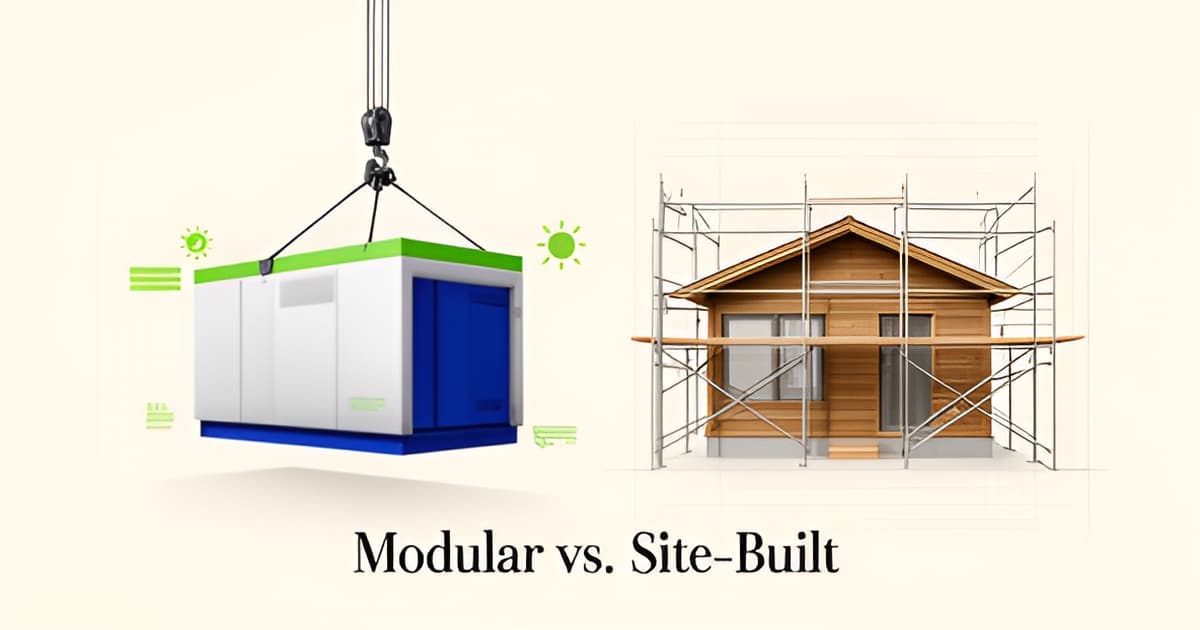
Modular ADU vs. Site-Built: Durability and Efficiency Compared
Key Facts
- California ADU permits surged 1,421% between 2016 and 2021, per industry data.
- Modular ADUs hold roughly 56% of the market, but site-built dominates units over 800 sq ft at nearly 57%, market research shows.
- Modular units pass 15–20 factory inspection stations versus 3–5 site inspections for stick-built, prefab data indicates.
- 30–50% of California ADU projects experience budget overruns, ADU industry analysis finds.
- Modular builds average 8 months versus 10 for site-built — a 50% time cut, per prefab industry data.
- Adding a legal ADU may boost home equity 20–30%, permit-data analysis suggests.
- Both modular and site-built ADUs must meet identical California Title 24 energy standards, per the state Energy Commission.
The ADU Decision Altadena Homeowners Can't Avoid
If you own a lot in Altadena with room for a second unit, you've probably already had the conversation: buy a factory-built modular ADU, or hire a contractor to build one on-site. It's not a hypothetical question anymore — it's a decision thousands of California homeowners are making right now.
The numbers behind that pressure are striking. California ADU permits surged 1,421% between 2016 and 2021, according to industry data, and the state issued more than 26,000 permits in 2023 alone — over a third of the U.S. total, per market research. Yet the boom hasn't made the process painless: ADU industry analysis finds that 30–50% of California ADU projects experience budget overruns, and quality defects often surface 6–18 months after completion — long after warranty coverage ends.
So the choice between modular and site-built carries real financial weight. Here's how the two options currently stack up:
- Modular holds roughly 56% of the ADU market, driven by faster construction, standardized quality, and lower material waste.
- Site-built dominates the custom niche — for units 800 sq ft or larger, it accounts for nearly 57% of projects, and about 63% of luxury backyard homes use conventional on-site construction.
- Modular promises fixed costs and 4–8 week installations, while site-built offers maximum architectural flexibility for irregular lots.
There's a catch, though, and it matters for everything that follows: most of the comparative data favoring one method comes from vendors with a commercial stake in the answer. The widely cited claims — that modular buildings are 15% more energy-efficient, or that factory quality control cuts first-year warranty claims by 40–60% — originate from prefab manufacturers and industry associations, not independent studies. No neutral research comparing the longevity or resale value of modular versus site-built ADUs currently exists, and even the prefab industry acknowledges "perception gaps regarding long-term resale value."
That's why this comparison deserves scrutiny rather than marketing copy. Whichever route you take, the contractor or manufacturer you hire matters as much as the construction method — which is why Altadena Builder Directory verifies every listing against the California Contractors State License Board, and offers a free CSLB license-lookup tool so you can confirm any builder's credentials before signing anything. Durability and efficiency claims are only as good as the team delivering them.
Durability Compared: Factory QC vs. Field Conditions
When it comes to build quality, the numbers favor the factory — but every one of those numbers comes from someone selling the factory. That's the honest starting point for comparing modular ADU durability against traditional site-built construction.
The core quality-control argument is straightforward. Modular units pass through 15 to 20 factory inspection stations during production, compared with the 3 to 5 site inspections typical of stick-built projects, according to prefab industry data. That tighter inspection cadence correlates with 40–60% fewer first-year warranty claims and rework costs of just 1–2% of project value, versus 5–10% for traditional construction.
Factory conditions also remove weather and site variability from the equation. Materials aren't rained on mid-framing, tolerances are machine-controlled, and market research reports fabrication precision improving roughly 26% with factory production. Vendor sources describe modular as "more consistent in quality (factory QC vs. field conditions)" — a claim that's plausible, but remember it comes from prefab sellers.
The site-built counterpoint deserves equal attention. Defects in conventionally built projects — roof leaks, plumbing failures, structural issues — often surface 6 to 18 months after completion, which can fall outside a contractor's warranty window entirely, per ADUscale. In other words, site-built quality problems may be undercounted precisely because they appear too late to show up in warranty statistics.
Here's what no one can yet tell you: whether a modular ADU actually lasts longer. No independent, neutral study comparing lifespan or long-term durability between the two methods exists in our research. The warranty-claim and rework figures above should be weighed as vendor-sourced data from parties with commercial interest in prefab — useful directional evidence, not settled fact.
What homeowners can control is the builder. Whether you choose modular or site-built, defects that surface a year later are largely a function of contractor quality. That's why Altadena Builder Directory verifies every listed builder's license against the California Contractors State License Board through its free CSLB lookup tool — so you can confirm credentials before signing, not after the leaks start. (Featured listings, such as JMB Builders LLC, CSLB #1103479, are labeled paid placements.)
- 15–20 factory inspection stations vs. 3–5 site inspections for stick-built
- 40–60% fewer first-year warranty claims reported for modular (vendor-sourced)
- Rework costs of 1–2% for modular vs. 5–10% for traditional construction
- Site-built defects often emerge 6–18 months post-completion — past typical warranty periods
The verdict on durability: the factory QC advantage is real but quantified only by interested parties, and long-term longevity remains an open question. Verify your builder regardless of construction method.
Energy Efficiency: The Title 24 Reality Check
If you've toured a prefab ADU showroom, you've probably heard some version of the claim that modular units are 15% more energy-efficient than conventional construction. The Modular Building Institute attributes this edge to superior insulation and airtightness from controlled factory assembly, and it's a real claim — but it's frequently presented in a way that misleads California homeowners about where the advantage actually comes from.
Here's the reality check: any ADU built in California, modular or site-built, must meet the same Title 24 energy standards at the time of construction. The California Energy Commission's Building Energy Efficiency Standards apply identically to both methods, and the 2025 Standards take effect January 1, 2026. Code-driven energy performance is method-neutral — there is no regulatory shortcut for factory-built units.
So where does modular's claimed efficiency edge come from? Build quality, not code compliance. The 15% figure reflects factory-controlled conditions: insulation installed in a controlled environment, tighter air sealing, and precision fabrication that improves material utilization by roughly 22% compared to field construction. A site-built ADU constructed by a meticulous crew with rigorous inspections can match that airtightness; a careless factory build can fall short of its potential. The construction method is a quality variable, not a compliance classification.
This distinction matters when evaluating vendor statistics. NREL research showing that factory construction cuts building-phase energy consumption by 67% is another commonly cited figure — but that applies to the construction process itself, not to how the finished ADU performs once you're living in it. Both numbers are legitimate; both are routinely conflated in marketing materials.
Before committing to either path, it's worth understanding how code cycles interact with your plans:
- The 2025 Energy Standards take effect January 1, 2026, so projects permitted on either side of that date may fall under different requirements.
- Preapproved plans of any construction type can be invalidated by code updates — Santa Barbara's BESHDA plans became ineligible for permitting due to updates in the 2025 construction codes.
- A factory-built ADU in Santa Barbara's Preapproved ADU Program was held to the same code standards as site-built designs in the same program.
- Confirm which code version your project will be permitted under before signing any contract.
The honest takeaway: modular's efficiency advantage is a build-quality story, not a regulatory one, and the same standards govern both paths. When evaluating builders making efficiency claims, verification beats vendor brochures. Every listing in the Altadena Builder Directory is license-verified against the California Contractors State License Board, and our free CSLB lookup tool lets you check any California contractor's credentials before you rely on their performance promises. Featured placements, like JMB Builders LLC (CSLB #1103479), are always labeled, and ratings come only from real attributed public sources — so the directory itself is a useful reality check for the claims you'll hear in showrooms.
Speed, Cost, and Resale: What the Numbers Actually Say
Speed is where the modular pitch gets concrete — and where the numbers get slippery. Strip away the marketing, and you'll find timelines that hold up better than the price tags do.
Modular construction cuts build times by roughly 50%, averaging 8 months versus about 10 for stick-built, according to prefab industry data. The fastest prefab installs wrap in just 4–8 weeks once the unit reaches your property, per contractor-matching data. Compare that to traditional projects, where 85–91% experience delays with median overruns exceeding 200 days.
Here the data splits sharply, and every source has skin in the game. The claims range from a modest gap to site-built costing nearly double:
- Prefab runs $180–$300/sqft versus $200–$400/sqft for general contractors — a narrow $20–$100 gap (ADUscale)
- One vendor claims factory-built ADUs start at $79,000 all-in versus $150,000–$450,000+ for comparable site-built California units (Epic Modulars)
- Industry figures claim prefab costs 10–20% less, up to 30% (Mesocore)
All three are commercially interested parties. Meanwhile, 30–50% of California ADU projects experience budget overruns regardless of method. Treat any single price quote — modular or site-built — as a starting bid, not a promise. That's why Altadena Builder Directory verifies every listed contractor's license against CSLB records before they appear in the registry.
No independent study compares resale outcomes between modular and site-built ADUs — none exists in the research we reviewed. The prefab industry itself flags "perception gaps regarding long-term resale value" as a persistent headwind, per industry statistics.
What we do know: adding any legal ADU may boost home equity by 20–30%, according to permit-data analysis. And the demand backdrop is strong — the global ADU market is projected to grow from $24.12B in 2026 to $99.92B by 2035, a 17.11% CAGR, per market research.
The practical takeaway: legality and code compliance drive value more than construction method. A permitted, inspected ADU of either type adds equity; an unpermitted one subtracts it. Before signing anything, run any California contractor through a free CSLB license lookup — it takes minutes and costs nothing.
How to Choose and Verify Your Builder in Altadena
The construction method you choose matters less than the builder you hire — and the data backs that up. Quality defects like roof leaks and plumbing failures often surface 6–18 months after completion, long after warranty periods expire, making upfront verification your best protection regardless of whether you go modular or site-built.
Start by matching the method to your project. Modular works best when you want a standard plan, a tight timeline, and predictable costs — factory-built units install in as little as 4–8 weeks with fixed pricing that reduces overrun risk. Site-built makes more sense for custom layouts and larger units: for ADUs of 800 sq ft or more, market research shows site-built accounts for nearly 57% of projects, and roughly 63% of luxury backyard homes use conventional construction.
Use this quick decision framework:
- Choose modular if you want a proven floor plan, speed, and budget predictability
- Choose site-built if your lot is irregular, your design is custom, or your unit exceeds 800 sq ft
- Verify the contractor's CSLB license either way — defects don't discriminate by method
Before signing anything, confirm which code cycle governs your project. California's 2025 Building Energy Efficiency Standards take effect January 1, 2026, and preapproved plans can be invalidated by code updates — Santa Barbara's preapproved ADU program saw plans become ineligible for permitting after 2025 code changes. Ask your builder directly which Title 24 cycle your permit will fall under, and get that answer in writing.
Then verify the license. With 30–50% of California ADU projects experiencing budget overruns, you can't afford to skip due diligence. The Altadena Builder Directory offers a free CSLB license-lookup tool that lets you check any California contractor in seconds, and every listing in the registry carries a verification seal once a license match is confirmed against the California Contractors State License Board. A verified license is the minimum bar, not the finish line — pair it with references from completed ADU projects similar in size and method to yours.
Finally, remember that both construction types must meet identical Title 24 energy standards, so code compliance is method-neutral. The builder's execution — factory QC or field craftsmanship — determines whether your ADU performs as designed. Choose the method that fits your project, then hold whoever you hire to the same verification standard.
Frequently Asked Questions
Are modular ADUs really more durable than site-built ones?
Is it true that modular ADUs are 15% more energy-efficient?
How much faster is a modular ADU to build than hiring a contractor?
Which is cheaper: a prefab ADU or building one on-site?
Do modular ADUs hurt your home's resale value?
When does site-built make more sense than going modular?
The Method Matters Less Than the Hands Building It
The modular-versus-site-built debate comes down to honest trade-offs: modular delivers speed, factory QC, and budget predictability, while site-built wins on custom layouts and larger units. But the most important finding here is what we don't know — no independent data confirms whether either method lasts longer or resells better, and most comparative claims come from parties selling the answer. What we do know: both must meet identical Title 24 standards, and a legal, permitted ADU of either type may boost home equity by 20–30%. In other words, the builder you hire matters more than the method you choose. Your next steps: match the construction type to your lot and timeline, confirm in writing which code cycle your permit falls under, and verify credentials before signing anything. The Altadena Builder Directory makes that last step easy — every listing is license-verified against the CSLB, and the free lookup tool lets you check any California contractor in seconds. Start there, and build with confidence.