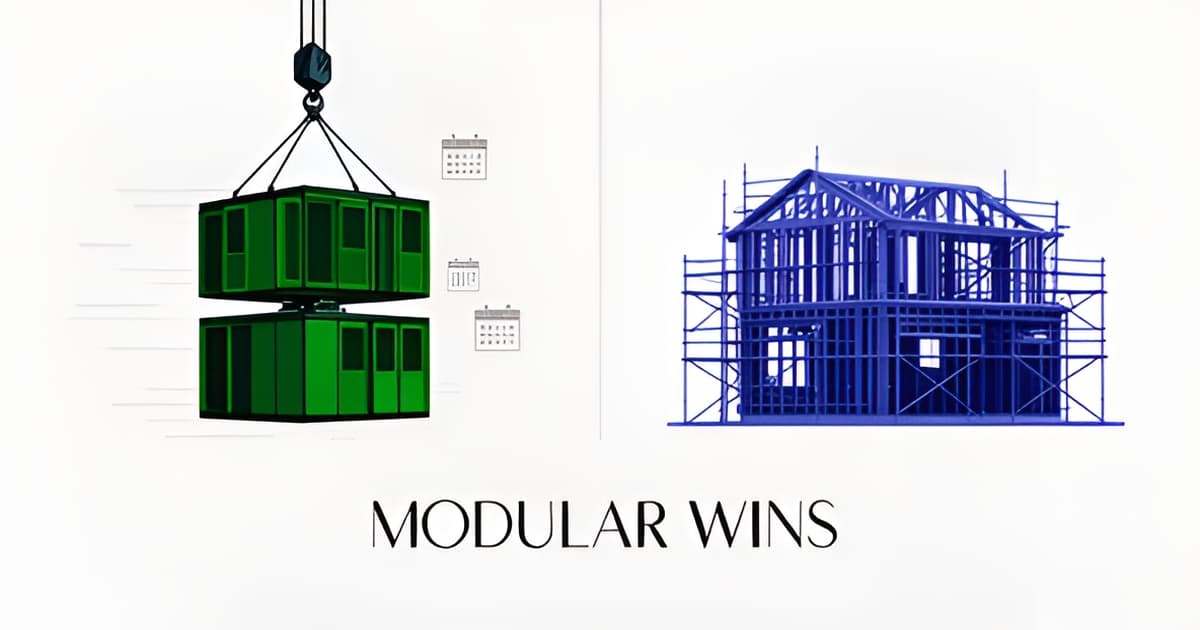
Modular ADU vs Site-Built: Durability, Cost, and Speed Compared
Key Facts
- Modular ADUs finish in 3–4 months versus 7–15 months for traditional builds, according to ADU market data.
- Factory construction running parallel to site prep cuts build timelines by 30–50%, the Modular Building Institute reports.
- Modular ADUs save 10–25% on cost — roughly $20,000–$50,000 on a $200,000+ project, market data shows.
- Modular units hold 57% of the ADU market share, per industry statistics.
- California accounts for 32% of 2.8 million ADU permits nationwide — 429,503 units since 2018, permit data reveals.
- Modular homes on permanent foundations are 'indistinguishable from traditional site-built homes,' the Center for American Progress notes.
- No independent, ADU-specific durability testing exists — durability claims rest on factory quality-control logic, not verified testing data.
- An NREL analysis found modular required $18.2M developer equity versus $13.6M traditional, with 40% due months before construction.
The Altadena ADU Decision: Why Method Choice Is Complicated
Choosing how to build your ADU in Altadena has never been straightforward, and the conflicting claims flooding the market make it harder. Modular advocates promise savings of 10–25% and timelines of 3–4 months, while traditional builders point to design freedom and proven durability. Sorting fact from vendor marketing is the real challenge.
Part of the confusion is definitional. Many homeowners still conflate modular homes with manufactured or mobile homes — a misconception the Center for American Progress directly addresses, noting that modular units are attached to permanent foundations, classified as real property, and "indistinguishable from traditional site-built homes." That perception gap, rooted in decades-old stereotypes about mobile homes, remains a documented barrier to wider adoption even as modular units now hold 57% of the ADU market share.
The speed advantage is the most reliable claim in the entire comparison. Multiple independent-ish sources, including the Modular Building Institute, corroborate that factory fabrication running in parallel with site preparation cuts timelines by 30–50%, largely by eliminating weather delays. But speed isn't the whole story, and honest trade-offs deserve equal weight:
- Higher upfront equity: an NREL analysis found a modular project required $18.2M in developer equity versus $13.6M for traditional, with 40% needed months before construction.
- Design restrictions: factory production limits customization, and inconsistent state codes make each project bespoke, driving up costs.
- Permitting bottlenecks affect both methods: approvals are a fixed timeline component regardless of construction approach, though California's ministerial reforms drove a 30x surge in LA ADU permits.
- A durability data gap: no independent, ADU-specific durability testing exists in available research — claims rest on factory quality-control logic, not verified testing.
There's also a sourcing problem worth naming: much of the ADU-specific cost data comes from modular manufacturers with a commercial stake in the answer, and no site-builder perspective appears in the available research. That's why we recommend treating bold vendor claims — like 37–50% savings or 10-day installations — as unverified until corroborated.
Whatever method you choose, the contractor matters more than the construction technique. Modular still requires foundation work, utility connections, and crane installation, all demanding properly licensed professionals. Every builder listed in the Altadena Builder Directory is verified against California Contractors State License Board records, and our free CSLB license-lookup tool lets you check any California contractor yourself — including featured firms like JMB Builders LLC (CSLB #1103479). Verify before you sign, whichever path you take.
Speed and Cost Compared: What the Numbers Actually Say
Time is money in ADU construction, and the numbers show the gap between modular and site-built is wider than most homeowners expect. Prefab ADUs typically finish in 3–4 months, while traditional builds stretch to 7–15 months, according to ADU market data.
The speed advantage comes from parallel workflows. While crews pour your foundation on-site, the factory builds your modules indoors simultaneously — a process the Modular Building Institute credits with cutting timelines 30–50%, since factory environments "virtually eliminate weather-related delays" that routinely stall stick-built projects.
Cost tells a similar story, with honest caveats. Modular ADUs run 10–25% less than traditional construction — roughly $20,000–$50,000+ in savings on a $200,000+ project — driven by bulk material purchasing, up to 90% waste reduction, and improved labor productivity. Traditional builds, meanwhile, run up to 80% over budget in worst-case scenarios, with 85–91% of construction projects experiencing delays that add more than 20% to costs for nearly half of affected projects.
Key numbers at a glance:
- Prefab ADU timeline: 3–4 months vs. 7–15 months traditional
- Modular savings: 10–25% ($20,000–$50,000+ on $200,000+ projects)
- Modular needs 50% fewer subcontractors — 8–10 trades vs. 15–20
- Faster timelines save $3,000–$8,000 in construction loan interest
Two caveats deserve attention. First, many favorable figures come from vendor-published analyses, so treat the upper savings ranges with healthy skepticism. Second, an NREL analysis found modular can require significantly more upfront equity — one $45M project needed $18.2M in developer equity versus $13.6M traditional, with 40% due months before construction begins.
Permitting, notably, is the shared bottleneck. Local permitting complexities delay modular projects too, and this fixed time component hits regardless of build method. For Altadena homeowners, California's ministerial approval reforms have made this less painful — streamlined approvals drove a 1,421% increase in state ADU permits, with California accounting for 32% of the 2.8 million permits issued nationwide through 2024.
Whichever method you choose, verify your builder before signing. The Altadena Builder Directory's free CSLB license-lookup tool lets you confirm any California contractor's credentials in minutes, and every listing in the registry is license-verified against state records.
Durability: Legal Parity vs. Public Perception
When a modular ADU rolls onto your property on a flatbed, neighbors may wonder how long it will last. The answer surprises most of them: legally and structurally, it's held to the same standard as any house on the block.
Modular ADUs are real property, not mobile homes. Once assembled, a modular unit is attached to a permanent foundation and classified as real estate — legally distinct from manufactured homes on wheels. The Center for American Progress goes so far as to describe modular buildings as "indistinguishable from traditional site-built homes" once installed.
The quality-control argument favors the factory, in some respects. Modular units undergo systematic inspections at every production stage, whereas site-built projects face a familiar problem: critical work often gets covered up before a municipal inspector arrives. The Modular Building Institute notes that factory settings enable quality control measures "difficult to achieve on an open construction site."
Material choices strengthen the case. Steel, the dominant modular framing material, offers structural strength, fire resistance, and pest resistance — a meaningful advantage in wildfire-prone Southern California and termite country alike.
So where's the catch? Two honest caveats:
- No independent, ADU-specific durability or lifespan testing data exists in current research — the strongest claims come from manufacturers and industry groups with clear commercial interests.
- Buyer skepticism persists. Market researchers note that limited awareness of modular's long-term value continues to restrict adoption, especially in conservative housing markets.
- The skepticism has a traceable root: confusion with mobile homes, which CAP notes carry a negative reputation from historical stereotypes, low-quality materials, and design flaws.
In other words, the durability gap is perceptual more than structural. A modular ADU on a permanent foundation meets the same building codes, undergoes more systematic inspection during construction, and — with steel framing — may outperform wood on fire and pest resistance.
The practical takeaway for homeowners: durability depends heavily on execution, not method. Even a factory-built ADU requires on-site foundation work, utility connections, and crane installation, so the contractor you hire still matters. That's why the Altadena Builder Directory verifies every listed builder's license against CSLB records — and offers a free license-lookup tool so you can confirm any California contractor yourself before signing anything, regardless of whether they build modular or stick-built.
Permitting: The Shared Bottleneck California Homeowners Can't Skip
No matter how fast your builder promises to move, the permit counter sets the pace. Before a single module rolls off a factory line or a stick of lumber hits your Altadena lot, the city has to sign off — and that clock runs the same for everyone.
This is the part of the timeline that ADU market research makes clear: even prefab projects, which finish in 3–4 months versus 7–15 months for traditional builds, still sit in the same permitting queue. One analysis of modular housing found that "some projects faced delays due to local permitting complexities" — a reminder that factory speed can't compress a fixed regulatory step.
California homeowners, however, hold a genuine advantage. A succession of state laws — SB 1069, AB 68, AB 881, and SB 13 — converted ADU approval into a ministerial, by-right process, stripping away discretionary review that once stalled projects for months. The results were dramatic: permit data show a 30x surge in Los Angeles ADU permits after the reforms took hold, and California permits increased 1,421% following streamlined approvals.
The scale is hard to overstate. Of the 2.8 million ADU permits issued nationwide through 2024, California accounts for 32% — 429,503 units since 2018, with 26,924 ADUs permitted in 2023 alone. As one data analyst put it, the post-2016 surge demonstrates how removing regulatory barriers can override economic headwinds. In other words, permitting reform — not construction method — is the biggest timeline lever available to an Altadena homeowner.
Site-built projects face one more pressure the reforms can't fix: labor. The construction industry needs 501,000 additional workers, and that shortage extends traditional timelines by roughly two months. Modular builds sidestep some of this by requiring 50% fewer subcontractors, but every ADU — modular or not — still needs foundation work, utility connections, and licensed trades on site.
What that means practically for your planning:
- Budget permitting time separately from build time — it applies equally to both methods
- Confirm your project qualifies for ministerial approval before committing to a builder or manufacturer
- Verify every contractor's license status, whether they're pouring a foundation or setting a crane-ready module
That last step is where Altadena Builder Directory comes in: every listing in the registry is license-verified against the California Contractors State License Board, and the free CSLB lookup tool lets you confirm any California contractor's credentials yourself before signing anything. Permitting may be the shared bottleneck — but choosing a verified builder is the variable you fully control.
Your Next Step: Vet Any Builder Before You Sign
Whichever construction method wins on paper, the builder you sign with determines how the project actually goes. Even a modular ADU — with its factory-built modules arriving largely finished — still requires licensed contractors for the foundation, utility connections, and crane work on site. The trade count is smaller, but the stakes are identical.
Here's the nuance many homeowners miss: industry analysis shows modular projects typically involve 8–10 types of subcontractors versus 15–20 trades for a site-built home — roughly 50% fewer, not zero. That means licensing verification matters in both scenarios. And given that research shows 85–91% of construction projects experience delays, with nearly half seeing those delays add more than 20% to costs, a weak contractor amplifies every risk in your timeline and budget.
Your vetting process should cover four steps before any contract is signed:
- Verify the license directly through the free CSLB license-lookup tool, which checks any California contractor against California Contractors State License Board records.
- Confirm the license-verified seal on Altadena Builder Directory listings — it appears only after a license match is confirmed against CSLB data.
- Compare bids across both construction methods, since modular's 10–25% cost advantage holds only when site work is scoped and priced accurately.
- Ask each bidder who performs the foundation, utility connection, and crane work, and verify those subcontractors' licenses too.
When comparing bids, remember that permitting is a fixed time component regardless of construction method — California's ministerial approval reforms drove a 1,421% increase in ADU permits, but local permitting complexities still delay some projects. A builder who handles permitting smoothly often matters more than the modular-versus-site-built decision itself.
The Altadena Builder Directory exists to make this vetting step faster: every listing is license-verified against CSLB, ratings come only from real attributed public sources, and any featured placement — such as JMB Builders LLC (CSLB #1103479) — is always clearly labeled as paid. No paid rankings, no anonymous reviews — just verifiable credentials you can confirm yourself in minutes.
Start your shortlist with builders whose licenses you've independently confirmed, then let the bids — not the marketing — decide between modular and site-built.
Frequently Asked Questions
Is a modular ADU the same thing as a mobile home?
How much faster is a modular ADU compared to a site-built one?
How much money does modular construction actually save on an ADU?
Are modular ADUs as durable as site-built homes?
What are the downsides of going modular for my ADU?
Does permitting take longer for one method than the other?
Let the Bids Decide — After You've Checked the License
The modular-versus-site-built debate comes down to honest trade-offs: modular's well-corroborated 30–50% speed advantage and 10–25% cost savings, weighed against higher upfront equity, design restrictions, and a durability data gap filled mostly by vendor claims. Permitting remains the shared bottleneck no build method can skip, and California's ministerial approval reforms — which drove a 30x surge in Los Angeles ADU permits — have done more for your timeline than any factory ever will. In the end, the contractor you hire matters more than the construction technique, because even a factory-built ADU needs licensed professionals for the foundation, utility connections, and crane work. That's where the Altadena Builder Directory helps: every listing is license-verified against California Contractors State License Board records, and our free CSLB license-lookup tool lets you confirm any California contractor yourself in minutes — no paid rankings, just verifiable credentials. Before you sign anything, check the license, compare bids across both methods, and let verified facts — not vendor marketing — make the call for your Altadena ADU.