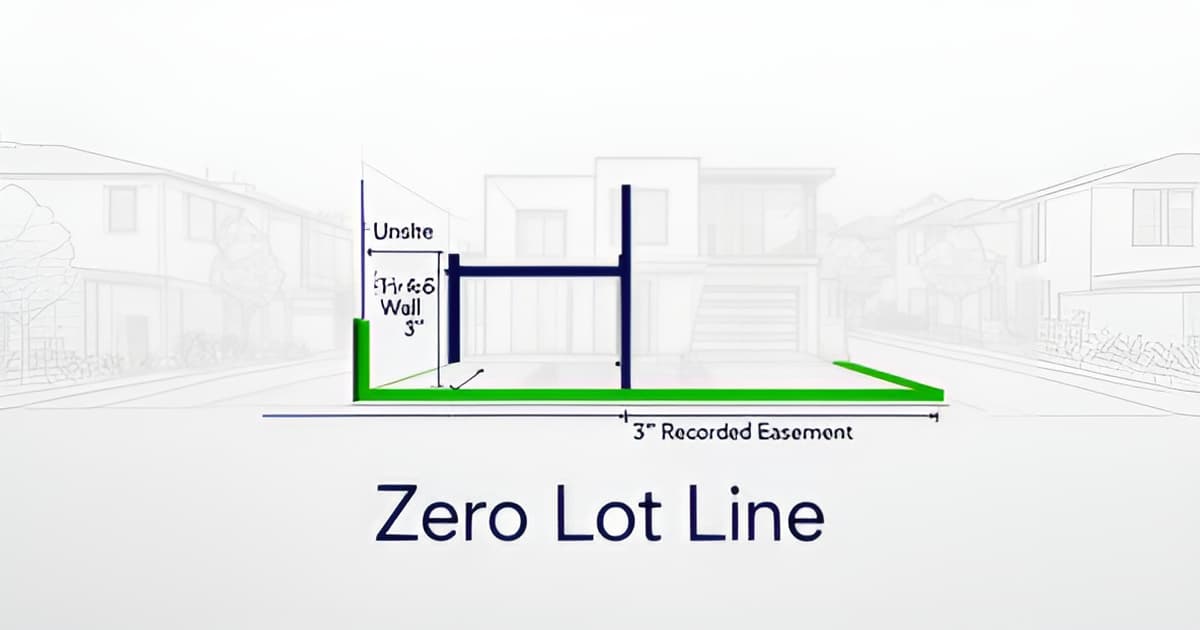
Zero Lot Line Building in LA County: What's Allowed
Key Facts
- Only two LA zones allow zero-foot side yards — RU and RZ — with strict conditions under the Los Angeles Municipal Code.
- A zero side yard requires a recorded 3-foot maintenance easement filed before any building permit is issued, per the LAMC.
- RZ Zone dwellings can attach across up to 5 contiguous lots with fire-rated common walls slab-to-roof, per municipal code.
- Eaton Fire like-for-like rebuilds can exceed 10% or 200 square feet in changes before losing setback exemptions, per LA County.
- LA County lets fire-rebuild homes return to their original footprint at the property line, per its recovery program.
- Non-like-for-like Altadena CSD rebuilds face a 20-foot minimum front yard setback, per county guidance.
- LA County Fire Code bans combustible storage within 10 feet of buildings and dry vegetation within 20 feet, per the 2022 code.
What Zero Lot Line Building Means — and Why LA's Rules Confuse Homeowners
Building right up to your property line sounds simple — until you discover that whether it's legal depends on which set of rules governs your specific parcel. In Los Angeles, that answer changes block by block.
Zero lot line construction means placing a home directly on or very near the property boundary, a technique used to maximize space on tight urban lots. As architecture practitioners explain, it's a way to increase density and use limited land efficiently — but regulations vary by location, so local rules control everything.
Here's where LA homeowners get confused. The Los Angeles Municipal Code permits zero-foot side yards only in two specific zoning categories: the RU (Residential Urban) Zone and the RZ (Residential Zero Side Yard) Zone. If your lot isn't zoned RU or RZ, a zero side yard generally isn't on the table.
Both zones come with strict conditions attached:
- The opposite side yard must be enlarged — to at least 6 feet in RU zones, or doubled in RZ zones.
- A 3-foot-wide maintenance easement must be recorded with the LA County Recorder before any permit is issued.
- No exterior wall openings are allowed on the lot-line side, and construction must meet Building Code fire-rating provisions.
The RZ zone even allows attached dwellings to be built across up to five contiguous lots, with fire-rated common walls running from slab foundation to roof sheathing.
For Altadena homeowners, there's a critical wrinkle: jurisdiction comes first. The RU and RZ provisions live in LA City's municipal code — but most of Altadena sits in unincorporated LA County, which operates under separate rules. The County's official recovery program covers unincorporated areas only, and explicitly directs residents of LA City, Pasadena, Malibu, and Sierra Madre to their own jurisdictions.
This distinction matters enormously for fire-rebuild projects. LA County allows like-for-like rebuilds in the original footprint regardless of current zoning setbacks — so a home that once stood at the property line can often return there — though current Building, Fire, and Health & Safety Codes still apply. Modifications in the Eaton Fire area are capped at 10% or 200 square feet of added floor area, whichever is greater.
Before planning anything, confirm which jurisdiction actually governs your lot. And when hiring help, the Altadena Builder Directory's free CSLB license-lookup tool lets you verify any California contractor before signing — zero-lot-line work demands recorded easements and fire-rated construction, so a properly licensed builder isn't optional.
The Two Zones That Allow Zero Side Yards: RU and RZ Requirements Explained
Los Angeles doesn't permit zero side yards everywhere — but it does authorize them in two specific zones, and the conditions are strict. Under the Los Angeles Municipal Code, the RU (Residential Urban) Zone and the RZ (Residential Zero Side Yard) Zone are the only single-family categories that explicitly allow a building to sit directly on the property line.
The RU Zone, created under Ordinance 161,716, was designed to encourage small single-family lots for manufactured, factory-built, or site-built homes. The RZ Zone, established by Ordinance 159,532, is even more direct — the code describes it as providing "for a 0-foot side yard, single-family residential zone."
Both zones impose the same core conditions before a side yard can be eliminated. Per the Los Angeles Municipal Code, you must:
- Enlarge the opposite side yard — to at least 6 feet in the RU Zone, and to double the required width in the RZ Zone
- Obtain a recorded 3-foot-wide maintenance easement for ingress and egress from the abutting owner, filed with the County Recorder before a building permit is issued
- Build the lot-line wall with no exterior openings — no windows or doors on that side
- Comply with the fire-rating provisions of the Building Code (Chapter IX, Article 1)
- Keep accessory buildings out of the enlarged side yard
The code also prohibits reduced side yards next to streets, alleys, or walkways, or beside lots that don't themselves allow zero-foot side yards. In the RZ Zone, attached dwellings may even span up to five contiguous lots, with common walls extending from slab foundation to roof sheathing.
Here's how the two zones compare:
| Requirement | RU Zone | RZ Zone |
|---|---|---|
| Front yard | 10 ft | 10 ft |
| Default side yard | 3 ft each side | 3 ft (≤2 stories); +1 ft/story above |
| Zero-side condition | Opposite side ≥6 ft | Opposite side doubled |
| Rear yard | 10 ft | 15 ft |
| Min. lot width | 35 ft | 25–30 ft |
| Min. lot area | 3,500 sq ft | 2,500–4,000 sq ft |
| Maintenance easement | 3 ft, recorded | 3 ft, recorded |
Because zero-lot-line work involves recorded easements and fire-rated wall construction, it demands a properly licensed builder. Altadena homeowners can verify any California contractor's credentials through the Altadena Builder Directory's free CSLB license-lookup tool — every listing in the registry is license-verified against the California Contractors State License Board, with a verification seal shown once a license match is confirmed.
The Price of Building to the Line: Fire Ratings and Attached Cross-Lot Construction
Building right up to the property line is only legal because the code trades setbacks for safety. In Los Angeles, a zero side yard comes with strict fire-protection strings attached: no exterior wall openings on the lot-line side and full compliance with the Building Code's fire-rating provisions.
Under the zoning code, any zero-lot-line construction must comply with the fire-rating provisions of Chapter IX, Article 1 of the Building Code. For attached dwellings built across lot lines, the requirements get even more specific. Common walls must meet the exception in Section 91.0502(h)2.A and extend continuously from the slab foundation to the roof sheathing, creating a fire-rated separation between units. Note that the specific hourly ratings referenced by these sections were not captured in the sources reviewed here — verify the exact rating with Building & Safety before finalizing plans.
The RZ (Residential Zero Side Yard) zone allows attached dwellings to be built across up to 5 contiguous lots, with one unit per lot. Footings, slab foundations, roof sheathing, roofing, and exterior wall coverings may cross lot lines, but each unit must have fully independent electrical, plumbing, HVAC, and sewer systems. Before any permit is issued, a recorded declaration of covenants (CC&Rs) approved by the City Attorney must be filed with Building & Safety.
For Altadena homeowners rebuilding after the Eaton Fire, the stakes are similar. LA County's recovery program confirms that like-for-like structures do not need to comply with current Zoning Code requirements, but they must meet current Building, Fire, and Health & Safety Codes. That means a home originally built at the property line can be rebuilt in the same footprint — but the fire-rated wall details still apply.
Even after construction, fire-code housekeeping rules remain in force. Under the County Fire Code:
- Combustible materials cannot be stored within 10 feet of any building.
- Dry vegetation must be kept at least 20 feet from structures.
- Dumpsters are restricted to 5 feet from combustible walls, openings, or roof eave lines.
These clearances matter more, not less, when a wall sits directly on the lot line with no openings to act as a fire escape or ventilation path.
Because zero-lot-line work demands precise fire-rated construction and recorded easements, it is not a project for an unlicensed handyman. Before hiring anyone, homeowners can verify any California contractor's license through the free CSLB lookup tool on the Altadena Builder Directory, where every listing is license-verified against the California Contractors State License Board and carries a verification seal once a match is confirmed. Featured listings, such as JMB Builders LLC (CSLB #1103479), are always clearly labeled as paid placement.
Altadena Fire Rebuilds: Rebuilding at the Property Line After the Eaton Fire
For Altadena homeowners rebuilding after the Eaton Fire, the question of where a new home can sit on the lot has an unusually generous answer. LA County's recovery program allows a destroyed structure to be rebuilt in its original footprint — even at or near the property line — without meeting current zoning setbacks.
Under the county's like-for-like rebuild guidance, replacement structures do not need to comply with current Zoning Code requirements, but they must still meet current Building, Fire, and Health & Safety Codes. That means a home that legally stood close to the lot line before the fire can generally return to that same position, provided the new construction satisfies modern fire-rated wall requirements and other safety standards.
The county sets clear limits on how much a like-for-like rebuild can change. Eaton Fire area rebuilds may not increase floor area, size, height, or footprint by more than 10% or 200 square feet, whichever is greater. Exceed that threshold and the project is no longer "like-for-like," which changes the setback rules that apply.
Homeowners who want a larger or repositioned home fall under different rules. For non-like-for-like rebuilds in the Altadena CSD, the minimum required front yard setback is 20 feet. A bigger house may therefore need to sit farther from the street than the original structure did — a trade-off worth weighing before finalizing plans.
Key points for Eaton Fire rebuilds:
- Like-for-like rebuilds may occupy the original footprint, including positions at or near the property line, without current zoning setbacks applying.
- Modifications are capped at 10% or 200 square feet (whichever is greater) in floor area, size, height, or footprint.
- Non-like-for-like rebuilds in the Altadena CSD face a 20-foot minimum front yard setback.
- Current Building, Fire, and Health & Safety Codes apply regardless of rebuild type.
Jurisdiction matters here. The recovery program covers unincorporated LA County — which includes Altadena — but excludes residents of LA City, Pasadena, Malibu, and Sierra Madre, who must work through their own jurisdictions. Homeowners should confirm which rules govern their parcel before assuming the like-for-like pathway is available.
Because rebuilding at the lot line involves fire-rated construction and county plan checks, choosing a properly licensed contractor is essential. The Altadena Builder Directory offers a free CSLB license-lookup tool so homeowners can verify any California contractor's license before hiring — every listing in the registry is license-verified against CSLB records, and ratings come only from real, attributed public sources with no paid rankings.
Your Next Steps: Permits, Easements, and Hiring a Licensed Builder
Knowing your lot qualifies for a zero-foot side yard is only half the battle — the other half is executing the paperwork and construction in the right order. The Los Angeles Municipal Code is explicit that a recorded 3-foot maintenance easement must be in place with the LA County Recorder before a building permit is even issued, so sequence matters from day one.
Start by confirming which jurisdiction actually governs your parcel. The zero-side-yard provisions live in the LA City code (RU and RZ zones), while the like-for-like fire-rebuild program covers unincorporated LA County — and the county's recovery portal directs residents of LA City, Pasadena, Malibu, and Sierra Madre to their own jurisdictions. Altadena homeowners rebuilding after the Eaton Fire should note that like-for-like structures skip current zoning setbacks but must still meet current Building, Fire, and Health & Safety Codes, with modifications capped at 10% or 200 square feet, whichever is greater.
Next, negotiate the easement with your abutting neighbor early. The code requires a 3-foot-wide recorded ingress/egress easement from the neighboring owner, and the zero-foot side must adjoin your neighbor's enlarged side yard — in the RU Zone, that means their remaining side yard measures at least 6 feet. This is a legal negotiation, not a formality, so budget time for it.
Before permit drawings go final, verify fire-rated wall specifications with Building & Safety. The code prohibits any exterior wall openings on the lot-line side and requires compliance with fire-rating provisions of Chapter IX, Article 1; attached cross-lot dwellings need common walls per Section 91.0502(h)2.A extending from slab foundation to roof sheathing. Specific hour ratings aren't spelled out in the zoning text, so confirm them directly with the plan-check office.
Your implementation sequence, in order:
- Confirm your zone (RU or RZ) and governing jurisdiction before anything else.
- Negotiate and record the 3-foot maintenance easement with the County Recorder prior to permit application.
- Verify fire-rated wall specs and opening prohibitions with Building & Safety during plan check.
- Confirm your contractor's license status before signing any contract.
Because zero-lot-line work involves recorded easements and fire-rated construction that many builders rarely touch, licensing verification is worth two minutes of your time. The Altadena Builder Directory offers a free CSLB license-lookup tool that checks any California contractor against California Contractors State License Board records, and every listing in the registry carries a verification seal once a license match is confirmed. Fire-rebuild specialists like JMB Builders LLC (CSLB #1103479) appear in the directory as a featured, clearly labeled paid placement — the directory takes no paid rankings, and ratings come only from real attributed public sources.
A building that sits on the property line maximizes your lot, but only a properly sequenced permit process and a licensed builder will get you there without a stop-work order.
Frequently Asked Questions
Can I build my house right up to the property line in Los Angeles?
What conditions do I have to meet to build a zero-lot-line home in LA?
Can I rebuild my Altadena home at the property line after the Eaton Fire?
Does the zero-lot-line rule apply the same in Altadena as in LA City?
Can attached homes share walls across property lines in the RZ Zone?
Do I need a special contractor for zero-lot-line construction?
Build to the Line — But Only With the Right Rules in Hand
Zero lot line building in LA County is legal, but only under precise conditions: your lot must sit in the RU or RZ zone (for LA City parcels) or qualify for a like-for-like fire rebuild (for unincorporated County areas like Altadena), and every path requires a recorded 3-foot maintenance easement, an enlarged opposite side yard, no wall openings on the lot-line side, and fire-rated construction per the Los Angeles Municipal Code. For Eaton Fire rebuilds, the like-for-like pathway lets a home return to its original footprint — capped at 10% or 200 square feet of modification — while current Fire and Building Codes still apply. Your next steps are clear: confirm your jurisdiction and zone first, negotiate the easement early, verify fire-rating specs with Building & Safety during plan check, and hire a properly licensed contractor. Before signing anything, run any California builder through the Altadena Builder Directory's free CSLB license-lookup tool — every listing is license-verified against the California Contractors State License Board, so you can build to the line with confidence, not a stop-work order.